Given that there is such a thing as "comfort food," why shouldn't there also be "comfort books"? Comfort books, as I imagine them, are personal, much-read favorites, to be resorted to when other reading (or life in general) seems flat, stale, and unprofitable.
My own canon of "comfort books" includes the mysteries of Dorothy Sayers, and recently I have been re-reading The Nine Tailors (1934), which many people feel is the best of them. I think Gaudy Night is my favorite, but The Nine Tailors surpasses it in literary quality.
On this particular re-read, I noticed what I think is a connection to another one of my "comfort" favorites, the ghost stories of M. R. James, in particular "The Treasure of Abbot Thomas," from Ghost Stories of an Antiquary (1904). In that story, a scholar solves a coded message, embedded in ancient stained-glass windows, left behind by the 16th century Abbot Thomas concerning the location of a lost treasure on monastery grounds. The scholar locates the treasure and discovers that it has an unpleasant guardian, left behind by the unpleasant Abbot.
In The Nine Tailors, there is also an old church containing the tomb of an Abbot Thomas: "[Wimsey] brooded for a time over the tomb of Abbot Thomas, with its robed and mitred effigy. A stern old boy, he thought, this fourteenth-century cleric, with his strong, harsh face, a ruler rather than a shepherd of his people." The oldest bell in the church, one of the nine bells alluded to in the title of the book, is "Batty Thomas," named after the Abbot who had it cast. Of this bell the sexton says, "She's queer-tempered. They do say as how old Batty [the Abbot] down below, what had her put up here, was a queer sort of man and his bell's took after him."
So you have two Abbots named Thomas, neither of them very nice, who left, on church grounds, items that have something of the nature of their owner. Now if you add that both stories concern a buried treasure that is found by reading coded messages that have a very similar solution, the conclusion is inescapable that James's story influenced Sayers' story.
Which doesn't bother me. I like this kind of intertextuality, especially when one "comfort book" influences another. If you haven't read either, read them both.
Speaking of bells, which The Nine Tailors does a lot, I can't resist passing along an old poem I ran across, from 1781, posted in an English church bell tower to keep people from sneaking in and ringing the bells for fun:
Who turns a Bell by light or dark
Two pence shall pay to Parish Clerk
Who turns a Bell on Sabbath Day
Double the sum at least shall pay
Ring not till four nor after nine
Who keeps worse hours shall twelvepence fine
With Hat, with Cap, or with Spurs on
Must four pence pay or else begone.
If any one caught pissing here
Shall four pence pay & then be clear
And who those are that will not pay
Presented shall the next Court Day.
Thursday, June 14, 2007


Monday, June 04, 2007

Saturday, May 26, 2007
Avudim
During the run-up to the season finale of Lost (which was terrific, by the way), I was watching (while working) some past episodes available on the internet which were apparently downloaded from Israeli TV, because they had Hebrew subtitles.
"Lost" in Hebrew, by the way, is Avudim, which is correct in Modern Hebrew, but made me wonder why one couldn't use the present participle Ovdim as in Biblical Hebrew. Ordinarily you wouldn't use a passive participle with an intransitive verb (would you?). Comments welcome.
I learned some vocabulary. When Hurley calls someone "dude," the subtitle said בנאדם, written exactly that way. I knew that Aramaic barnash was used colloquially to mean "guy," but I wasn't aware that benadam could mean "dude" (or perhaps "chap" or "fellow").
Also, when Hurley says, "I screwed up," the translation is פשׁלתי, pishalti. I wasn't aware that this root occurred in the Piel, and doesn't occur in the big Even-Shoshan dictionary or in the Bantam-Megiddo. There is a Hiphil that means to roll up sleeves or pant legs. My guess is that somehow the root פשׁל is related to פתל, to twist or pervert. But how did this meaning develop? On the street or did someone in the Language Academy decide that Israelis needed a way to say "to screw up"? (Don't we all?)
"Lost" in Hebrew, by the way, is Avudim, which is correct in Modern Hebrew, but made me wonder why one couldn't use the present participle Ovdim as in Biblical Hebrew. Ordinarily you wouldn't use a passive participle with an intransitive verb (would you?). Comments welcome.
I learned some vocabulary. When Hurley calls someone "dude," the subtitle said בנאדם, written exactly that way. I knew that Aramaic barnash was used colloquially to mean "guy," but I wasn't aware that benadam could mean "dude" (or perhaps "chap" or "fellow").
Also, when Hurley says, "I screwed up," the translation is פשׁלתי, pishalti. I wasn't aware that this root occurred in the Piel, and doesn't occur in the big Even-Shoshan dictionary or in the Bantam-Megiddo. There is a Hiphil that means to roll up sleeves or pant legs. My guess is that somehow the root פשׁל is related to פתל, to twist or pervert. But how did this meaning develop? On the street or did someone in the Language Academy decide that Israelis needed a way to say "to screw up"? (Don't we all?)
Saturday, April 21, 2007
August 1966
The nightmarish Virginia Tech shootings have reminded me of my own very remote memory of the Charles Whitman shootings from the University of Texas tower on Aug. 1, 1966. We were living in Austin at the time, and once it became clear what was happening on the campus, the local TV station started showing live pictures of the Tower. Not much to see; every couple of minutes, a puff of smoke appeared as Whitman squeezed off another round. That's it.
I remember going out in the front yard and looking at the Tower, a couple of miles away. Back then, there were only two buildings on the Austin skyline, the Capitol building and the Tower. There the tower was, looking like it always did, and the puffs of smoke were not visible at that distance. It was hard to believe that carnage was taking place. It was a miserably hot still day, like almost all August days in Austin. It felt like a furnace outside.
Later on I biked south (toward the Tower) to go hang out at my friend Arthur Aleman's house. We were still well out of range, and we eventually got bored watching the TV feed of the motionless Tower with the occasional smoke and pop of gunfire from the invisible sniper. Arthur's dad said he was going to go down there and "see what was happening." I thought that was an incredibly stupid thing to do, but I couldn't say that to Arthur's dad. By the time Mr. Aleman arrived for his sightseeing, it was all over, so he came back.
I went home. Later on the whole thing was on the national news, and I remember thinking how strange it was that Austin, the Tower, Guadalupe Street ("The Drag") and all the other places I knew so well were talked about by Huntley & Brinkley.
Years later, when I was a student at UT in the early '70's, I went up to the Tower deck (it was still open to the public then) and looked down, imagining what Whitman saw. The people looked as small as ants; maybe he even thought of them as ants, but through a rifle scope they would look like individual persons. Over in the corner where Whitman died, there was still an unrepaired gouge in the wall from a shotgun blast fired by one of the cops who killed him.
I think the observation deck is closed these days; I can't say I'm sorry. Someone I knew, slightly, jumped to his death from there in 1974, and then they shut it down. It's an amazing edifice, but for me it is always somewhat redolent of violent death.
I remember going out in the front yard and looking at the Tower, a couple of miles away. Back then, there were only two buildings on the Austin skyline, the Capitol building and the Tower. There the tower was, looking like it always did, and the puffs of smoke were not visible at that distance. It was hard to believe that carnage was taking place. It was a miserably hot still day, like almost all August days in Austin. It felt like a furnace outside.
Later on I biked south (toward the Tower) to go hang out at my friend Arthur Aleman's house. We were still well out of range, and we eventually got bored watching the TV feed of the motionless Tower with the occasional smoke and pop of gunfire from the invisible sniper. Arthur's dad said he was going to go down there and "see what was happening." I thought that was an incredibly stupid thing to do, but I couldn't say that to Arthur's dad. By the time Mr. Aleman arrived for his sightseeing, it was all over, so he came back.
I went home. Later on the whole thing was on the national news, and I remember thinking how strange it was that Austin, the Tower, Guadalupe Street ("The Drag") and all the other places I knew so well were talked about by Huntley & Brinkley.
Years later, when I was a student at UT in the early '70's, I went up to the Tower deck (it was still open to the public then) and looked down, imagining what Whitman saw. The people looked as small as ants; maybe he even thought of them as ants, but through a rifle scope they would look like individual persons. Over in the corner where Whitman died, there was still an unrepaired gouge in the wall from a shotgun blast fired by one of the cops who killed him.
I think the observation deck is closed these days; I can't say I'm sorry. Someone I knew, slightly, jumped to his death from there in 1974, and then they shut it down. It's an amazing edifice, but for me it is always somewhat redolent of violent death.
Friday, March 30, 2007
Old Poem
While cleaning out some papers, I came across a poem I wrote in college (that's back in the seventies, kids) for some class or other. Maybe the assignment was to "cram as many classical references as possible into one overwrought sonnet." In any case, that's what I did, and it's still better than anything I could write now, 35 years later.
Day after day I spend on a journey
With You; but too often the one who fell
Calls, calls, luring me, Siren-like, to Hell.
Sometimes I feel that I dangle helplessly
(Beyond your grace, your love, your bliss)
Over the pit of Satan, his outer dark.
Too often his attacks leave their mark
And, despairing, I feel the heat of his abyss.
But then you come; his Phlegethons
Cannot compare with the flow of blood
That swept and washed away my million sins.
Then, like magic, I can feel my bonds
Give and break; and, borne on that flood,
I continue my journey, higher up and farther in.
Day after day I spend on a journey
With You; but too often the one who fell
Calls, calls, luring me, Siren-like, to Hell.
Sometimes I feel that I dangle helplessly
(Beyond your grace, your love, your bliss)
Over the pit of Satan, his outer dark.
Too often his attacks leave their mark
And, despairing, I feel the heat of his abyss.
But then you come; his Phlegethons
Cannot compare with the flow of blood
That swept and washed away my million sins.
Then, like magic, I can feel my bonds
Give and break; and, borne on that flood,
I continue my journey, higher up and farther in.
Sunday, March 18, 2007
Thoughts about Arni (Luke 3:33)
As a side-effect of the Talpiot tomb discussion, I've been reading Richard Bauckham's Jude and the Relatives of Jesus, an interesting read and a work of high merit. One of the most stimulating chapters is the one on the Lukan genealogy of Jesus. The genealogy has a couple of odd names that drew my attention. In this post I'll discuss one of them, the name Arni in Luke 3:33 ("Amminadab, son of Admin, son of Arni").
"Arni" is an odd name in Hebrew. Although there are names with a general similarity — Aran (Gen 36:28) and Oren (1 Chr. 2:25) — the name in Luke 3:33 corresponds in the parallel Greek/Hebrew genealogies to "Ram" or "Aram" (Ruth 4:19, 1 Chr. 2:10; cp. Matt. 1:4). In several major witnesses to the text of Luke (including D and A and Peshitta), "Aram" appears instead of "Arni," and in others it occurs in addition to "Arni." "Aram" was apparently added later as a correction or crept in as a marginal or interlinear gloss. (I assume that "Admin" also originated as a correction of "Arni.")
It therefore seems that "Arni" was a copyist error for "Aram" and recognized to be such already in ancient times. However, "Arni" could only be an error for "Aram" in Hebrew script: ארם could be mistakenly read as ארני, but ΑΡΑΜ could not as easily be read as ΑΡΝΙ.
There are examples of similar errors in the Bible at Amos 7:7, where the Hebrew text אדני should probably, on the evidence of the LXX, be read אדם. The reverse error occurred in 1 Sam. 17:32, where Hebrew אדם should probably be read אדני (cf. LXX).
This suggests that the original of Luke's genealogy, at least for these names, must have been in Hebrew script, since it reflects a copyist error only possible in Hebrew. The question is, was the copyist error present in the Hebrew biblical genealogies that were used as a source for these names, or was it present in a separate Hebrew genealogy preserved, say, in the family of Jesus? If it was the latter, then the Lukan genealogy may be older and more reliable than it is usually considered to be. In a future post I'll try to adduce some evidence to show that that is actually the case.
"Arni" is an odd name in Hebrew. Although there are names with a general similarity — Aran (Gen 36:28) and Oren (1 Chr. 2:25) — the name in Luke 3:33 corresponds in the parallel Greek/Hebrew genealogies to "Ram" or "Aram" (Ruth 4:19, 1 Chr. 2:10; cp. Matt. 1:4). In several major witnesses to the text of Luke (including D and A and Peshitta), "Aram" appears instead of "Arni," and in others it occurs in addition to "Arni." "Aram" was apparently added later as a correction or crept in as a marginal or interlinear gloss. (I assume that "Admin" also originated as a correction of "Arni.")
It therefore seems that "Arni" was a copyist error for "Aram" and recognized to be such already in ancient times. However, "Arni" could only be an error for "Aram" in Hebrew script: ארם could be mistakenly read as ארני, but ΑΡΑΜ could not as easily be read as ΑΡΝΙ.
There are examples of similar errors in the Bible at Amos 7:7, where the Hebrew text אדני should probably, on the evidence of the LXX, be read אדם. The reverse error occurred in 1 Sam. 17:32, where Hebrew אדם should probably be read אדני (cf. LXX).
This suggests that the original of Luke's genealogy, at least for these names, must have been in Hebrew script, since it reflects a copyist error only possible in Hebrew. The question is, was the copyist error present in the Hebrew biblical genealogies that were used as a source for these names, or was it present in a separate Hebrew genealogy preserved, say, in the family of Jesus? If it was the latter, then the Lukan genealogy may be older and more reliable than it is usually considered to be. In a future post I'll try to adduce some evidence to show that that is actually the case.
Saturday, March 03, 2007
"Mary the Master"
The biblioblogosphere has been jumping on the Jesus Tomb documentary with both feet; I haven't seen such a bonanza of crackpot-theory refutation since The DaVinci Code. So there's not much left for me to do. Enjoy Jodi Magness's take on the subject, or Mark Goodacre's, or Ben Witherington's, or Richard Bauckham's at Paleojudaica. Shooting fish in a barrel is fun.
I'll limit myself to a few observations on one point. The sole Greek text among the ossuaries reads Μαριαμηνου Μαρα. (The particle η, said to be present between the two words, is not.) The "Jesus Tomb" scholars would like to understand this as "Mariamene (= Mary Magdalene) the Master." They are taking the word Μαρα to be a transliteration of the Aramaic word meaning "lord, master." However,
1. It is hard to understand why the Aramaic word would be used instead of a Greek one in the Greek ossuary.
2. It's not clear exactly what form of the Aramaic word they are referring to. Μαρα could = מרה , that is, the emphatic state of the masculine form of maré. However, this form is only attested centuries later; the usual emphatic masculine form at this period would be מריא. It's also not clear why a female would have a title in the masculine gender.
3. The word Μαρα could also = מרה, מראה, the feminine absolute form of the word. However, the absolute form would have to mean "a lady" or "a mistress," not "the Master" or "Master." The emphatic form of the feminine would be מרתא = Μάρθα, "the Mistress," "the Lady" (also the proper name Martha).
Therefore the Jesus Tomb scholars seem to be wrong again. "Mara" is pretty obviously either a nickname for Mariamene, or refers to another woman whose bones were also interred in the ossuary.
I'll limit myself to a few observations on one point. The sole Greek text among the ossuaries reads Μαριαμηνου Μαρα. (The particle η, said to be present between the two words, is not.) The "Jesus Tomb" scholars would like to understand this as "Mariamene (= Mary Magdalene) the Master." They are taking the word Μαρα to be a transliteration of the Aramaic word meaning "lord, master." However,
1. It is hard to understand why the Aramaic word would be used instead of a Greek one in the Greek ossuary.
2. It's not clear exactly what form of the Aramaic word they are referring to. Μαρα could = מרה , that is, the emphatic state of the masculine form of maré. However, this form is only attested centuries later; the usual emphatic masculine form at this period would be מריא. It's also not clear why a female would have a title in the masculine gender.
3. The word Μαρα could also = מרה, מראה, the feminine absolute form of the word. However, the absolute form would have to mean "a lady" or "a mistress," not "the Master" or "Master." The emphatic form of the feminine would be מרתא = Μάρθα, "the Mistress," "the Lady" (also the proper name Martha).
Therefore the Jesus Tomb scholars seem to be wrong again. "Mara" is pretty obviously either a nickname for Mariamene, or refers to another woman whose bones were also interred in the ossuary.
Wednesday, February 28, 2007
Tobit Fragment Published
I've just seen the following article:
Hallermayer, Michaela and Torleif Elgvin, "Schøyen ms. 5234: Ein neues Tobit-fragment Vom Toten Meer," Revue de Qumran 22/3 (2006) 451-461.
This is the first official publication of the fragment that I blogged about here. (That post is referenced, by the way, on p. 452 n.3.)
Congratulations to Hallermayer & Elgvin for a fine treatment of the fragment.
Hallermayer, Michaela and Torleif Elgvin, "Schøyen ms. 5234: Ein neues Tobit-fragment Vom Toten Meer," Revue de Qumran 22/3 (2006) 451-461.
This is the first official publication of the fragment that I blogged about here. (That post is referenced, by the way, on p. 452 n.3.)
Congratulations to Hallermayer & Elgvin for a fine treatment of the fragment.
Monday, February 26, 2007
The "Jesus Tomb" Ossuary
I'm not happy with my initial response, so I've removed it. If I come up with something else, I'll post it in this space.
UPDATE (3/3): Here it is.
UPDATE (3/3): Here it is.
Friday, February 09, 2007
A Spurious Addition to Targum Pseudo-Jonathan?
I notice that it is common to quote the Targum Pseudo-Jonathan to Genesis 4:1 as Mahlon Smith does at his website, where we find this translation:
My problem with this translation is that the words in italics above are not found in any text of Pseudo-Jonathan. The only surviving manuscript of Pseudo-Jonathan (PsJ), in the British Museum, reads, according to the publication of it by Clarke, "And Adam knew that Eve his wife was pregnant from Sammael, angel of the Lord." The standard printed text (editio princeps) as published in the rabbinic bible reads: "And Adam knew Eve his wife, that she had desired the angel; and she conceived and bore Cain, and she said, I have acquired a man, the angel of the Lord."
Obviously the version with the addition is closer to the editio princeps than to the London MS, but neither text (and they are the only witnesses to the text of PsJ) has the addition. Nevertheless, the belief that the words really are in PsJ is widespread. James Kugel quotes the latter part of PsJ's version as "He resembled the upper ones [angels] and not the lower ones, and she [therefore] said, I have acquired a man, indeed, an angel of the Lord" (The Bible as it Was, p. 86). Birger Pearson, in an essay in The Rediscovery of Gnosticism (1981) quotes the same version (p. 479). And Phillip Davies, in the Blackwell Reader in Judaism (2001), does the same (p. 40). These are all reputable scholars.
As far as I can tell, there is no evidence that any version of PsJ (or any other targum) contains these words. However, another text that has some affinities to PsJ, the Hebrew Pirke de-Rabbi Eliezer, in relating the story of Cain's conception, says "she saw his likeness that it was not of the earthly beings, but of the heavenly beings." Is that where these words come from? Or is there a version of the text of PsJ that I'm not aware of?
I'm frankly stumped as to the source of this spurious text of the targum. Do any of my readers have any insight?
UPDATE (3/2): Many thanks to those who have left comments below. Andy, can you point me towards a source for that quote?
And Adam knew that his wife Eve had conceived
from Sammael the angel (of death)
and she became pregnant and bore Cain.
And he was like those on high and not like those below.
And she said: "I have got a man from the angel of the LORD."
My problem with this translation is that the words in italics above are not found in any text of Pseudo-Jonathan. The only surviving manuscript of Pseudo-Jonathan (PsJ), in the British Museum, reads, according to the publication of it by Clarke, "And Adam knew that Eve his wife was pregnant from Sammael, angel of the Lord." The standard printed text (editio princeps) as published in the rabbinic bible reads: "And Adam knew Eve his wife, that she had desired the angel; and she conceived and bore Cain, and she said, I have acquired a man, the angel of the Lord."
Obviously the version with the addition is closer to the editio princeps than to the London MS, but neither text (and they are the only witnesses to the text of PsJ) has the addition. Nevertheless, the belief that the words really are in PsJ is widespread. James Kugel quotes the latter part of PsJ's version as "He resembled the upper ones [angels] and not the lower ones, and she [therefore] said, I have acquired a man, indeed, an angel of the Lord" (The Bible as it Was, p. 86). Birger Pearson, in an essay in The Rediscovery of Gnosticism (1981) quotes the same version (p. 479). And Phillip Davies, in the Blackwell Reader in Judaism (2001), does the same (p. 40). These are all reputable scholars.
As far as I can tell, there is no evidence that any version of PsJ (or any other targum) contains these words. However, another text that has some affinities to PsJ, the Hebrew Pirke de-Rabbi Eliezer, in relating the story of Cain's conception, says "she saw his likeness that it was not of the earthly beings, but of the heavenly beings." Is that where these words come from? Or is there a version of the text of PsJ that I'm not aware of?
I'm frankly stumped as to the source of this spurious text of the targum. Do any of my readers have any insight?
UPDATE (3/2): Many thanks to those who have left comments below. Andy, can you point me towards a source for that quote?
Monday, February 05, 2007
Incredulous Laugh of the Day
Episcopal Presiding Bishop Katherine Jefferts-Schori is quoted in USA Today today, with reference to breakaway congregations trying to hold on to their property:
My measured response to this is: You have got to be kidding me. You're willing to jettison the creeds, Scripture, and a 2,000-year-old tradition of Christian ethics, but you start getting strict with regard to property ownership? Lady, do you have any sense of irony at all?
God help The Episcopal Church. I mean that quite literally.
(For casual readers; I'm a member of said church, so I'm allowed to say stuff like that.)
The church’s laws are broad but they are there, and beyond these lines you cannot go. Crossing boundaries has consequences.
My measured response to this is: You have got to be kidding me. You're willing to jettison the creeds, Scripture, and a 2,000-year-old tradition of Christian ethics, but you start getting strict with regard to property ownership? Lady, do you have any sense of irony at all?
God help The Episcopal Church. I mean that quite literally.
(For casual readers; I'm a member of said church, so I'm allowed to say stuff like that.)
Sunday, January 21, 2007
"She obliterated me as an apologist": Lewis and the Anscombe Legend
Last week when I was laid up with a stomach virus, I had the opportunity to read a large part of C. S. Lewis's Collected Letters, Vol. 3, which has just been published. Letters do not contain all that is relevant for understanding a man's life, but they are datable, first-person documents and therefore are primary in a way that biographies (or even autobiographies) are not.
This particular volume sheds a bit of light on what has come to be called "the Anscombe legend." On Feb. 2, 1948, Lewis and the philosopher G. E. M. (Elizabeth) Anscombe engaged in a disputation at the Oxford Socratic Club, of which Lewis was president. The subject was Lewis's argument that naturalism (the view that the natural world is all that exists) is self-refuting, since "no thought is valid if it can be fully explained as the result of irrational causes" (Lewis, Miracles, ch. 3). Anscombe argued that he failed to distinguish two senses of the word "because," which can be used to denote not only a cause-effect relation, but also a ground-consequent relation. An argument could be valid, because (Ground-Consequent) its propositions entail each other, even if the propositions are generated (Cause-Effect) by irrational factors. Lewis eventually agreed that his argument was inadequate at this point and needed revision.
Those facts are not in dispute, but the consequences of them in Lewis's life have been debated. It was reported by some of Lewis's friends that he was greatly shaken by his defeat, as he saw it, and eventually turned away from formal apologetics altogether, devoting himself instead to other kinds of writing, such as the Chronicles of Narnia. This view was first put forth, I believe, by Humphrey Carpenter in his book The Inklings.
However, the evidence of the new letters, such as it is, is more supportive of the first view. Most important is the letter to Stella Aldwinckle, secretary of the Socratic Club, of June 12, 1950. Lewis was proposing speakers for the new term, and he suggested that "Miss Anscombe" speak on "Why I believe in God." His comment was this:
The same feeling is evident in a letter to Robert C. Walton of the BBC on July 10, 1951:
Of course, it should also be noted that Lewis's feelings and Lewis's arguments must be assessed separately. The fact is that his argument about naturalism was not obliterated by Anscombe, and in fact has enjoyed a revival, most notably in Alvin Plantinga's Warrant and Proper Function. Many of Lewis's enemies (for instance A. N. Wilson) attempt to employ Lewis's own retreat from apologetics as an ad hominem attack on the totality of his work, without engaging the particularities of the argument, or of Lewis's revision of it in the 1960 Miracles.
Personally, I prefer to see the hand of Providence in Lewis's turn from formal apologetics. If he hadn't turned to "fiction and symbol," would we have the Chronicles of Narnia, Till We Have Faces, The Four Loves; or the great critical works, such as The Discarded Image or Studies in Words? Omnia cooperantur in bonum.
BIBLIOGRAPHY: The "argument from reason": Victor Reppert, C. S. Lewis's Dangerous Idea: In Defense of the Argument from Reason; Alvin Plantinga, Warrant and Proper Function, 1993; Richard Taylor, Metaphysics, ch. 10 (1974). See Reppert's blog for other references, both pre- and post-Lewis.
UPDATE: For Jim Davila and others who have inquired: Anscombe's paper can be found in her collection Metaphysics and the Philosophy of Mind (1981; vol. 2 of her Collected Papers), which also contains her own memories of the disputation; Lewis's initial response and the minutes of the Socratic Club meeting are reprinted in the collection God in the Dock, pp 144-146 (UK title: Undeceptions).
This particular volume sheds a bit of light on what has come to be called "the Anscombe legend." On Feb. 2, 1948, Lewis and the philosopher G. E. M. (Elizabeth) Anscombe engaged in a disputation at the Oxford Socratic Club, of which Lewis was president. The subject was Lewis's argument that naturalism (the view that the natural world is all that exists) is self-refuting, since "no thought is valid if it can be fully explained as the result of irrational causes" (Lewis, Miracles, ch. 3). Anscombe argued that he failed to distinguish two senses of the word "because," which can be used to denote not only a cause-effect relation, but also a ground-consequent relation. An argument could be valid, because (Ground-Consequent) its propositions entail each other, even if the propositions are generated (Cause-Effect) by irrational factors. Lewis eventually agreed that his argument was inadequate at this point and needed revision.
Those facts are not in dispute, but the consequences of them in Lewis's life have been debated. It was reported by some of Lewis's friends that he was greatly shaken by his defeat, as he saw it, and eventually turned away from formal apologetics altogether, devoting himself instead to other kinds of writing, such as the Chronicles of Narnia. This view was first put forth, I believe, by Humphrey Carpenter in his book The Inklings.
Certainly after it was all over Lewis himself was in very low spirits.... [Derek] Brewer write in his diary: "None of us was at first very cheerful. Lewis was obviously deeply disturbed by his encounter last Monday with Miss Anscombe ..." ... Brewer added that Lewis's imagery when talking about the debate "was all of the fog of war, the retreat of infantry thrown back under heavy attack."However, a reaction has set in against this view of Lewis's response. The "Anscombe legend," as Victor Reppert calls it, is, according to some, purely mythical. Lewis was not in fact devastated by the Anscombe argument, although he agreed that his argument needed revision. (This is the view taken by Anscombe herself.) The fact that he wrote no further book-length works of apologetics can be explained by other factors besides a putative loss of nerve in the wake of a shattering defeat. This view is most notably championed by Victor Reppert and John Beversluis.
Lewis had learnt his lesson... (Carpenter, Pt. 4, ch. 1)
However, the evidence of the new letters, such as it is, is more supportive of the first view. Most important is the letter to Stella Aldwinckle, secretary of the Socratic Club, of June 12, 1950. Lewis was proposing speakers for the new term, and he suggested that "Miss Anscombe" speak on "Why I believe in God." His comment was this:
The lady is quite right to refute what she thinks bad theistic arguments, but does this not almost oblige her as a Christian to find good ones in their place: having obliterated me as an Apologist ought she not to succeed me? (Letters 3:35; emphasis mine.)One may question whether there is more irony than bitterness in this comment; nevertheless, it shows that Lewis was felt, either by himself or others, to have sustained a crippling blow.
The same feeling is evident in a letter to Robert C. Walton of the BBC on July 10, 1951:
... like the old fangless snake in The Jungle Book, I've largely lost my dialectical power. (Letters 3:129)Another key piece is the letter of Sept. 28, 1955, to Carl F. H. Henry, who asked him to write some apologetic articles for Christianity Today:
I wish your project heartily well but can't write you articles. My thought and talent (such as they are) now flow in different, though I think not less Christian, channels, and I do not think I am at all likely to write more directly theological pieces. . . . If I am now good for anything it is for catching the reader unawares — thro' fiction and symbol. I have done what I could in the way of frontal attacks, but I now feel quite sure those days are over. (Letters 3:651; emphasis Lewis.)All of this suggests that Lewis really felt a change in himself in the wake of the Anscombe disputation. Nevertheless, he did from time to time return, in a small way, to apologetics, most notably in revising Chapter 3 of Miracles in line with Anscombe's critique for a 1960 reprint, as well as a variety of smaller pieces.
Of course, it should also be noted that Lewis's feelings and Lewis's arguments must be assessed separately. The fact is that his argument about naturalism was not obliterated by Anscombe, and in fact has enjoyed a revival, most notably in Alvin Plantinga's Warrant and Proper Function. Many of Lewis's enemies (for instance A. N. Wilson) attempt to employ Lewis's own retreat from apologetics as an ad hominem attack on the totality of his work, without engaging the particularities of the argument, or of Lewis's revision of it in the 1960 Miracles.
Personally, I prefer to see the hand of Providence in Lewis's turn from formal apologetics. If he hadn't turned to "fiction and symbol," would we have the Chronicles of Narnia, Till We Have Faces, The Four Loves; or the great critical works, such as The Discarded Image or Studies in Words? Omnia cooperantur in bonum.
BIBLIOGRAPHY: The "argument from reason": Victor Reppert, C. S. Lewis's Dangerous Idea: In Defense of the Argument from Reason; Alvin Plantinga, Warrant and Proper Function, 1993; Richard Taylor, Metaphysics, ch. 10 (1974). See Reppert's blog for other references, both pre- and post-Lewis.
UPDATE: For Jim Davila and others who have inquired: Anscombe's paper can be found in her collection Metaphysics and the Philosophy of Mind (1981; vol. 2 of her Collected Papers), which also contains her own memories of the disputation; Lewis's initial response and the minutes of the Socratic Club meeting are reprinted in the collection God in the Dock, pp 144-146 (UK title: Undeceptions).
Wednesday, January 10, 2007
Papa Ooh Mouw Mouw
Richard Mouw, president of Fuller Seminary, has a blog. Dr. Mouw entered the Fuller scene after I graduated, but I've followed his Presidency with admiration. His books are worth reading; his academic field is philosophy, but he writes well for a general audience. I particularly recommend Uncommon Decency.
The blog looks like it will be interesting, if he can keep it up. Welcome to the 'sphere, Doc!
The blog looks like it will be interesting, if he can keep it up. Welcome to the 'sphere, Doc!
Monday, January 08, 2007
How conservative am I?
Thursday, December 28, 2006
Department of Redundancy Department
From a story on Ben Roethlisberger's bad year as Pittsburgh quarterback:
''It was tough, frustrating,'' Roethlisberger said. ''At least you know it will be awfully hard for next year to be any worse next year.''
Wednesday, December 27, 2006
Third Annual Ralphies (3): Books
BEST NON-FICTION BOOK (Scholarly): Again, I didn't read anything published this year. The closest I came was in reading Joe Fitzmyer's 3rd edition of his commentary on the Genesis Apocryphon (2004; good) and Klaus Beyer's revised volume 2 of Die Aramäische Texte vom Toten Meer (2004; ditto). But the Ralphie goes to Alan Millard's Reading and Writing in the Time of Jesus (2000), an excellent survey, and subtly subversive of a number of scholarly shibboleths.
BEST FICTION: I read and enjoyed King Dork (2006) by Frank Portman, but the best novel I read all year was one I read the same week in May: The End of the Affair, by Graham Greene. Very moving.
BEST GRAPHIC FICTION: So many to choose from. Marvel's Civil War series is great, if published at a glacial pace; also great is the current story arc of Ultimate Fantastic Four written by Mark Carey. I also have to mention the must-read Hatter M; my nephew Greg Cook works on that book as "Cartographic Chronicler and Historian." The Ralphie, however, goes to Brian K. Vaughan's Y: The Last Man. No, it's not a male fantasy; it's an exciting quest tale that illuminates, and deconstructs, a number of assumptions (both male and female) about what the world would look like if all the men died (except one). Vaughan has recently been hired as a writer for ABC's drama Lost.
That's it for this year, folks!
BEST FICTION: I read and enjoyed King Dork (2006) by Frank Portman, but the best novel I read all year was one I read the same week in May: The End of the Affair, by Graham Greene. Very moving.
BEST GRAPHIC FICTION: So many to choose from. Marvel's Civil War series is great, if published at a glacial pace; also great is the current story arc of Ultimate Fantastic Four written by Mark Carey. I also have to mention the must-read Hatter M; my nephew Greg Cook works on that book as "Cartographic Chronicler and Historian." The Ralphie, however, goes to Brian K. Vaughan's Y: The Last Man. No, it's not a male fantasy; it's an exciting quest tale that illuminates, and deconstructs, a number of assumptions (both male and female) about what the world would look like if all the men died (except one). Vaughan has recently been hired as a writer for ABC's drama Lost.
That's it for this year, folks!
Monday, December 25, 2006
Happy Birthday, O pale Galilean
Thou hast conquered, O pale Galilean; the world has grown grey from thy breath
The skeptical Swinburne, under the guise of a pagan critique of Christianity, really was writing against, I suppose, the dull pieties of Victorian Anglicanism, but his attitude crops up quite a bit still. The grey world? yet as I look out my window, the neighborhood is a blaze of brightly colored lights, glistening decorations, and crazy plastic figurines. These things are only the echoes or the outskirts of genuine religion; but could a life-denying faith really engender such a merry display?
The other day in the New York Times, an unrepentantly Jewish writer talked about how she and her husband celebrated Christmas for the first time:
Happy birthday, Lord. And many more.
—A. C. Swinburne, Hymn to Proserpine
The skeptical Swinburne, under the guise of a pagan critique of Christianity, really was writing against, I suppose, the dull pieties of Victorian Anglicanism, but his attitude crops up quite a bit still. The grey world? yet as I look out my window, the neighborhood is a blaze of brightly colored lights, glistening decorations, and crazy plastic figurines. These things are only the echoes or the outskirts of genuine religion; but could a life-denying faith really engender such a merry display?
The other day in the New York Times, an unrepentantly Jewish writer talked about how she and her husband celebrated Christmas for the first time:
I love that as soon as I told a Catholic friend what I was up to, she invited me to a gingerbread-house decorating party. How fun is that? And why wasn’t I invited before? What does a gingerbread house have to do with Jesus?It reminded me for some reason of a passage from Azar Nafisi's Reading Lolita in Tehran, when one of her students told of the religious instruction in the university after the Islamic Revolution:
...
Some nights, I put on our Starbucks Christmas CD, light a fire, turn on the tree and play with the different settings, put liquid smoke in the train’s smokestack and turn on the choo-choo sound effects and then I sit back and enjoy my first Christmas, in all its kitschy splendor. I feel a little guilty when I look at our lone menorah on the mantel (the only evidence of my faith other than my guilt), but I ask you: how can this much pleasure be wrong?
On one side [the teacher] had written, in large white letters, MUSLIM GIRL, and drawn a vertical line in the middle of the board. On the other side, in large pink letters, he wrote CHRISTIAN GIRL. He had then asked the class if they knew the differences between the two. One was a virgin, he said at last, after an uncomfortable silence, white and pure, keeping herself for her husband and her husband only. Her power came from her modesty. The other, well, there was not much one could say about her except that she was not a virgin. To Yassi's surprise, the two girls behind her, both active members of the Muslim Students' Association, had started to giggle, whispering, No wonder more and more Muslims are converting to Christianity.I know that neither woman's experience is religious, or has anything to do with "authentic" Christianity; but it has everything to do with the world that Christianity made. After 2000 years, there are still plenty of people out there, on the outside looking in, who have the impression that such a world, with its colored lights and gingerbread, has something to do with pleasure and liberation. The pale Galilean, who was criticized for enjoying food and drink too much (Luke 7:34), might, after all, have had something to do with that.
Happy birthday, Lord. And many more.
Sunday, December 17, 2006
Third Annual Ralphies (2): Film
BEST MOVIE: Boy, what a lousy year for movies, just as we knew it would be. I enjoyed Nacho Libre and Pirates of the Caribbean 2, but they're not really Film of the Year material. The one movie I was anxious to see, For Your Consideration, turned out to be a disappointment. So, I hate to get all haughty and everything, but I just can't award a Ralphie this year for Best Movie. However, I can start a new category:
WORST MOVIE: Lots of competition here. But I'd have to give it to Strangers with Candy, which is not only the worst movie I've seen this year, but possibly the worst movie I've ever seen. Like, in my life. I started checking my watch to see how much torture I had to endure after five minutes. It's even worse than the second worst movie ever, which I also happened to watch this year on DVD: Broken Flowers.
BEST TV SHOW: I've built my schedule around two shows this year, Lost (still great) and Heroes (also terrific). But the Ralphie goes to The Office. It's the only show I watch with Amy, whose taste otherwise runs towards earnest PBS documentaries. So, huge kudos to Carell & Co. just for luring my wife to network television.
WORST MOVIE: Lots of competition here. But I'd have to give it to Strangers with Candy, which is not only the worst movie I've seen this year, but possibly the worst movie I've ever seen. Like, in my life. I started checking my watch to see how much torture I had to endure after five minutes. It's even worse than the second worst movie ever, which I also happened to watch this year on DVD: Broken Flowers.
BEST TV SHOW: I've built my schedule around two shows this year, Lost (still great) and Heroes (also terrific). But the Ralphie goes to The Office. It's the only show I watch with Amy, whose taste otherwise runs towards earnest PBS documentaries. So, huge kudos to Carell & Co. just for luring my wife to network television.
Thursday, December 14, 2006
Atheists vs. Liberals
Heave an egg outside a Pullman window anywhere in the United States today, and you will probably hit an atheist. In fact, I hope you do. There is a new prominence of what I term, drawing on my theological training, Mean Atheism. I refer to such writers as Richard Dawkins and Sam Harris, who are taking the old Village Atheist tradition to the ... well, to the global village. Yeah, that's it: the Global Village Atheists.
For orthodox Christians, it's all rather tiring. Didn't we just get done arguing down The DaVinci Code and guaranteeing that the movie would be the lamest and least successful Tom Hanks vehicle since Bonfire of the Vanities? We buried that sucka! Yeah! But now *sigh* there's a new shipment of nitwits that are just begging for the old double-barrel rational refutation treatment. It's exhausting. Can't we get a break?
You know what I say? I say, Let the liberals handle it this time. We orthodox folks are going to take some time off, and we'd really like some of the usual left-wing religious suspects to take this on for us. How about Katherine Jefferts-Schori, new Presiding Bishop of the Episcopal Church? How about it, Kathy, you up for a fight? Why don't you take on Sam Harris? How about you, John Shelby Spong? Marcus Borg? Elaine Pagels? Dom Crossan, why don't you get in the ring with Richard Dawkins? Or John Hick: yes, you. Right now, start refuting. You do think there's something to all this existence of God business, don't you? Well, do us all a favor and crush some of these guys, or at least soften 'em up until the rest of us get back from Christmas vacation? Huh? Whaddya say?
No response? I thought so. Wimps.
For orthodox Christians, it's all rather tiring. Didn't we just get done arguing down The DaVinci Code and guaranteeing that the movie would be the lamest and least successful Tom Hanks vehicle since Bonfire of the Vanities? We buried that sucka! Yeah! But now *sigh* there's a new shipment of nitwits that are just begging for the old double-barrel rational refutation treatment. It's exhausting. Can't we get a break?
You know what I say? I say, Let the liberals handle it this time. We orthodox folks are going to take some time off, and we'd really like some of the usual left-wing religious suspects to take this on for us. How about Katherine Jefferts-Schori, new Presiding Bishop of the Episcopal Church? How about it, Kathy, you up for a fight? Why don't you take on Sam Harris? How about you, John Shelby Spong? Marcus Borg? Elaine Pagels? Dom Crossan, why don't you get in the ring with Richard Dawkins? Or John Hick: yes, you. Right now, start refuting. You do think there's something to all this existence of God business, don't you? Well, do us all a favor and crush some of these guys, or at least soften 'em up until the rest of us get back from Christmas vacation? Huh? Whaddya say?
No response? I thought so. Wimps.
Wednesday, December 13, 2006
Third Annual Ralphies (1): Music
I've decided to do the Ralphies in a series this year, in order to prolong the agony (yours, not mine). Today's Ralphies are for music.
SONG OF THE YEAR: A lot of good songs this year. Who doesn't love "Crazy"? And even if you hated it, you couldn't escape it. Also "Teach Me Sweetheart" by the Fiery Furnaces was probably one of the best this wonderful group has ever done. But the award goes to .... "Code Monkey" by Jonathan Coulton. Irresistible.
ALBUM OF THE YEAR: Bitter Tea by the Fiery Furnaces. So good my mind is still boggled by it.
BEST BOB DYLAN ALBUM OF THE YEAR: Snake Farm, by Ray Wylie Hubbard. Honorable mention: Modern TImes, by Bob Dylan (OK to listen to, but the lyrics and music are pretty lazy and derivative).
SONG OF THE YEAR: A lot of good songs this year. Who doesn't love "Crazy"? And even if you hated it, you couldn't escape it. Also "Teach Me Sweetheart" by the Fiery Furnaces was probably one of the best this wonderful group has ever done. But the award goes to .... "Code Monkey" by Jonathan Coulton. Irresistible.
ALBUM OF THE YEAR: Bitter Tea by the Fiery Furnaces. So good my mind is still boggled by it.
BEST BOB DYLAN ALBUM OF THE YEAR: Snake Farm, by Ray Wylie Hubbard. Honorable mention: Modern TImes, by Bob Dylan (OK to listen to, but the lyrics and music are pretty lazy and derivative).
Thursday, November 30, 2006
Ralph Turns Two
"Ralph" is 2 years old today. It's been a quiet year, but 2006 did see the single biggest day in RTSR history, in terms of hits, links, and chat-room chatter, caused by this post. It also saw Bloglines subscriptions reach an all-time high of 66 (and then begin falling; current number is 61).
Beginning tomorrow: Year 3 A. R.
Beginning tomorrow: Year 3 A. R.
Sunday, November 26, 2006
I've been busy.
Sorry for the non-blogging. Since I've had a full-time non-academic job this year, most of the available writing time that I've had (not much) has been devoted to other compositions:
- a Dictionary of Qumran Aramaic; so far the draft reaches from aleph to het;
- a review of Ursula Schattner-Rieser's L'araméen des manuscrits de la mer Morte for Journal for the Study of Judaism, now published;
- an article for Aramaic Studies, "The 'Kaufman Effect' in the Pseudo-Jonathan Targum," now in page proofs, to be published in volume 4/2;
- a 2000-word entry for the Dictionary of Early Judaism on "Aramaic, Jewish use of in the Second Temple Period"; I spent Thanksgiving vacation finishing that one.
Saturday, November 11, 2006
Armistice Day
From Paul Fussell's The Great War and Modern Memory (1975):
There is one unforgettable vignette which if true is fine, and which if apocryphal is even better. It is Herbert Essame's memory of the German machine-gunner signaling the closing of a long run on November 11, 1918: "On the Fourth Army front, at two minutes to eleven, a machine gun, about 200 yards from the leading British troops, fired off a complete belt without a pause. A single machine-gunner was then seen to stand up beside his weapon, take off his helmet, bow, and turning about walk slowly to the rear."
Friday, November 03, 2006
Bright Fountain
Today is the feast day in the Anglican Communion of Richard Hooker, priest, author of On the Laws of Ecclesiastical Polity. Hooker's remarkable book is still influential in the Communion among both liberals and conservatives, and his extraordinary prose style — the finest, in my opinion, of the Elizabethan period — reminds us that he was a contemporary of Shakespeare. There were giants in the earth in those days.
Here is an excerpt, in which Hooker argues (against the Puritans) for the value of secular learning:
There is in the world no kind of knowledge whereby any part of truth is seen, but we justly account it precious, yea, that principal truth, in comparison whereof all other knowledge is vile, may receive from it some kind of light. Whether it be that Egyptian and Chaldean wisdom mathematical, wherewith Moses and Daniel were furnished; or that natural, moral, and civil wisdom, wherewith Solomon excelled all men, or that rational and oratorial wisdom of the Grecians, which the Apostle St. Paul brought from Tarsus, or that Judaical, which he learned at Jerusalem sitting at the feet of Gamaliel, to detract from the dignity thereof were to injury even God himself, who, being that light which none can approach unto, hath sent out these lights whereof we are capable, even as so many sparkles resembling the bright fountain from which they rise.
"To injury," by the way, is not a misprint; just a sign of how the language has changed since 1589.
Here is an excerpt, in which Hooker argues (against the Puritans) for the value of secular learning:
There is in the world no kind of knowledge whereby any part of truth is seen, but we justly account it precious, yea, that principal truth, in comparison whereof all other knowledge is vile, may receive from it some kind of light. Whether it be that Egyptian and Chaldean wisdom mathematical, wherewith Moses and Daniel were furnished; or that natural, moral, and civil wisdom, wherewith Solomon excelled all men, or that rational and oratorial wisdom of the Grecians, which the Apostle St. Paul brought from Tarsus, or that Judaical, which he learned at Jerusalem sitting at the feet of Gamaliel, to detract from the dignity thereof were to injury even God himself, who, being that light which none can approach unto, hath sent out these lights whereof we are capable, even as so many sparkles resembling the bright fountain from which they rise.
"To injury," by the way, is not a misprint; just a sign of how the language has changed since 1589.
Friday, October 27, 2006
Some Hebrew Phrases in the Qumran Texts
I've just recently run across an article by Phillip Davies, "Death, Resurrection and Life after Death in the Qumran Scrolls" (in Judaism in Late Antiquity, Vol. IV, Leiden, 2000). Davies is always worth reading, even when one disagrees with him.
However, this notice is just to gratefully acknowledge that, on. p. 197, Davies refers to my translation of raz nihyeh in the Dead Sea Scrolls, i.e., "The Secret of the Way Things Are," as "perhaps the most felicitous" of modern attempts to render the phrase in English. While we were revising our various sections for the second edition, I gave serious thought to doing away with "the secret of the way things are," but in the end I decided not to change it (although I did revise the work given that title, and divided it up differently).
Not everyone has been positive about our original renderings. Other phrases that I gave another long, hard look at are "Leader of the Nation" for nesi ha-edah (conventionally translated "Prince of the Congregation") and "Flattery-Seekers" for dorshe halaqot (usually "seekers after smooth things"). Both of these came from a dissatisfaction with the conventional renderings, and in the end, they were retained in the revised edition.
Nesi ha-edah, a messianic designation, is based on a biblical phrase (in Num. 31:13, Josh. 9:15, etc.) that older translators rendered as "princes of the congregation," but which more modern ones give as "leaders of the community/assembly." "Prince" is not a happy equivalent for nasi, and, at Qumran at least, edah in general designates the whole of Israel (and not just the sectarians). Therefore > "Leader of the Nation."
My problem with "seekers after smooth things" is that in modern English the phrase conveys no clear meaning. However, Hebrew halaqot is often used in the bible to denote "flatteries" or perhaps "pleasant untruths" (a key background text for this is Isa. 30:10); hence, "flattery seekers," a derogatory reference to an opposing sect, probably the Pharisees. It might be that halaqot was chosen as a dig at the opponent's love of halakhot (legal rulings), but this is not proven, since the latter word is not attested in the Hebrew of this period.
However, this notice is just to gratefully acknowledge that, on. p. 197, Davies refers to my translation of raz nihyeh in the Dead Sea Scrolls, i.e., "The Secret of the Way Things Are," as "perhaps the most felicitous" of modern attempts to render the phrase in English. While we were revising our various sections for the second edition, I gave serious thought to doing away with "the secret of the way things are," but in the end I decided not to change it (although I did revise the work given that title, and divided it up differently).
Not everyone has been positive about our original renderings. Other phrases that I gave another long, hard look at are "Leader of the Nation" for nesi ha-edah (conventionally translated "Prince of the Congregation") and "Flattery-Seekers" for dorshe halaqot (usually "seekers after smooth things"). Both of these came from a dissatisfaction with the conventional renderings, and in the end, they were retained in the revised edition.
Nesi ha-edah, a messianic designation, is based on a biblical phrase (in Num. 31:13, Josh. 9:15, etc.) that older translators rendered as "princes of the congregation," but which more modern ones give as "leaders of the community/assembly." "Prince" is not a happy equivalent for nasi, and, at Qumran at least, edah in general designates the whole of Israel (and not just the sectarians). Therefore > "Leader of the Nation."
My problem with "seekers after smooth things" is that in modern English the phrase conveys no clear meaning. However, Hebrew halaqot is often used in the bible to denote "flatteries" or perhaps "pleasant untruths" (a key background text for this is Isa. 30:10); hence, "flattery seekers," a derogatory reference to an opposing sect, probably the Pharisees. It might be that halaqot was chosen as a dig at the opponent's love of halakhot (legal rulings), but this is not proven, since the latter word is not attested in the Hebrew of this period.
Wednesday, October 18, 2006
James Barr
James Barr died on October 14, according to a report on the Agade list. Barr was the author of many important works in biblical studies, most notably The Semantics of Biblical Language (1961), Comparative Philology and the Text of the Old Testament (1968), Fundamentalism (1978), History and Ideology in the Old Testament (2000), and others too numerous to mention. All of them are marked by keen intelligence, vigor of thought, and a clear prose style.
I had lunch with Barr once, years ago, at the UCLA faculty club, with Stanislav Segert and Vinton Dearing. I don't remember what was talked of, though I am sure that, callow grad student that I was, my own tongue remained tied throughout the course of the meal. I do remember that Dearing asked me some question about translation technique, which I dodged by passing the buck to Barr. Of the four of us who ate together that day, I am the only one still living.
After lunch Barr spoke to Segert's graduate seminar on Genesis 2-3. His thoughts on this subject were later to be published as The Garden of Eden and the Hope of Immortality (1993). His own immortality in the field of biblical studies is guaranteed, and it is to be hoped that the new generation of students will not neglect his writings either as a source or as a model.
I had lunch with Barr once, years ago, at the UCLA faculty club, with Stanislav Segert and Vinton Dearing. I don't remember what was talked of, though I am sure that, callow grad student that I was, my own tongue remained tied throughout the course of the meal. I do remember that Dearing asked me some question about translation technique, which I dodged by passing the buck to Barr. Of the four of us who ate together that day, I am the only one still living.
After lunch Barr spoke to Segert's graduate seminar on Genesis 2-3. His thoughts on this subject were later to be published as The Garden of Eden and the Hope of Immortality (1993). His own immortality in the field of biblical studies is guaranteed, and it is to be hoped that the new generation of students will not neglect his writings either as a source or as a model.
Wednesday, September 27, 2006
More Dylan Thefts
Henry Timrod made some news a couple of weeks ago by getting some of his lines quoted, or re-used, by Bob Dylan in his new album Modern Times. Timrod was a Confederate poet whose works are now in the public domain. Apparently Bob consciously or unconsciously snipped a few florid Victorian phrases and dropped them into some of the old-timey songs on his record. I don't think there's anything really wrong with that; it's not like he took whole passages and used them wholesale.
And yet Dylan, in his memoir Chronicles, comes pretty close to doing exactly that with other authors. Look carefully at this short passage:
Compare that to this longer passage from Marcel Proust's Within a Budding Grove, especially the passages in italics:
I don't think there can be any doubt that Bob had to have consciously taken these sentences and, with some revision, passed them off as his own.
Another example is from a book that I imagine Dylan knows well, Huckleberry Finn:
Now what are we to think of these "borrowings"? I know that borrowing and revising tunes and song lyrics is standard practice in folk and blues music, and Dylan has done plenty of that, quite openly, as have others. That doesn't bother me. But in a sustained piece of prose that is not meant to be sung or played, but taken as the author's own composition, it is not standard practice. In the instances given above, I think Bob comes pretty close to real plagiarism, and for all I know there are more instances in Chronicles yet to be identified. Frankly, as a Dylan fan from way back, I'm a little disappointed. Say it ain't so, Bob.
UPDATE: A couple more.
Jack London, Children of the Frost:
Jack London, Tales of the Klondyke:
UPDATE II: Yet more:
Sax Rohmer, Dope (1919), A tiny spaniel lay beside the fire, his beady black eyes following the nervous movements of the master of the house.
Chronicles, p. 167: A tiny spaniel lay at the guy's feet, the dog's beady black eyes following the nervous movements of his master.
London, Children of the Frost: And then they are amazingly simple. No complexity about them, no thousand and one subtle ramifications to every single emotion they experience. They love, fear, hate, are angered, or made happy, in common, ordinary, and unmistakable terms.
Chronicles, p. 169: Yet to me, it's amazingly simple, no complications, everything pans out. As long as the things you see don't go by in a blur of light and shade, you're okay. Love, fear, hate, happiness all in unmistakable terms, a thousand and one subtle ramifications.
UPDATE III (Oct. 2): Jack London, Tales of the Klondyke: Through this the afternoon sun broke feebly, throwing a vague radiance to earth, and unreal shadows.
Chronicles, p. 112: The afternoon sun was breaking, throwing a vague radiance to the earth.
Jack London, White Fang: He carried himself with pride, as though, forsooth, he had achieved a deed praiseworthy and meritorious.
Chronicles, p. 63: He didn't need to say much—you knew he had been through a lot, achieved some great deed, praiseworthy and meritorious, yet unspoken about it.
R. L. Stevenson, Providence and the Guitar: As Leon looked at her, in her low-bodied maroon dress, with her arms bare to the shoulder, and a red flower set provocatively in her corset, he repeated to himself for the many hundredth time that she was one of the loveliest creatures in the world of women.
Chronicles, p. 127: I bought a red flower for my wife, one of the loveliest creatures in the world of women.
And yet Dylan, in his memoir Chronicles, comes pretty close to doing exactly that with other authors. Look carefully at this short passage:
Walking back to the main house, I caught a glimpse of the sea through the leafy boughs of the pines. I wasn't near it, but could feel the power beneath its colors. (Chronicles, p. 162)
Compare that to this longer passage from Marcel Proust's Within a Budding Grove, especially the passages in italics:
But when, Mme. de Ville-parisis’s carriage having reached high ground, I caught a glimpse of the sea through the leafy boughs of trees, then no doubt at such a distance those temporal details which had set the sea, as it were, apart from nature and history disappeared ... But on the other hand I was no longer near enough to the sea which seemed to me not a living thing now, but fixed; I no longer felt any power beneath its colours, spread like those of a picture among the leaves, through which it appeared as inconsistent as the sky and only of an intenser blue.
I don't think there can be any doubt that Bob had to have consciously taken these sentences and, with some revision, passed them off as his own.
Another example is from a book that I imagine Dylan knows well, Huckleberry Finn:
Every night we passed towns, some of them away up on black hillsides, nothing but just a shiny bed of lights; not a house could you see. ... There warn't a sound there; everybody was asleep.And now look at Chronicles, p. 165:
One night when everyone was asleep and I was sitting at the kitchen table, nothing on the hillside but a shiny bed of lights ...My last exhibit (a less exact quote) comes from a book called Really the Blues (1946) by Mezz Mezzrow and Bernard Wolfe, in which a hipster introduces "his chick" to Mezzrow:
Baby this that powerful man with that good grass that'll make you tip through the highways and byways like a Maltese kitten. Mezz, this is my new dinner and she's a solid viper.And now, part of Dylan's description of his friend Ray's girl, Chloe Kiel:
She was cool as pie, hip from head to toe, a Maltese kitten, a solid viper — always hit the nail on the head. I don't know how much weed she smoked, but a lot. (Chronicles, p. 102)And later in Really the Blues, a black man was "sitting there actually talking to a white woman cool as pie."
Now what are we to think of these "borrowings"? I know that borrowing and revising tunes and song lyrics is standard practice in folk and blues music, and Dylan has done plenty of that, quite openly, as have others. That doesn't bother me. But in a sustained piece of prose that is not meant to be sung or played, but taken as the author's own composition, it is not standard practice. In the instances given above, I think Bob comes pretty close to real plagiarism, and for all I know there are more instances in Chronicles yet to be identified. Frankly, as a Dylan fan from way back, I'm a little disappointed. Say it ain't so, Bob.
UPDATE: A couple more.
Jack London, Children of the Frost:
"Rum meeting place, though," he added, casting an embracing glance over the primordial landscape ...Chronicles, p. 167: I cast an embracing glance over the primordial landscape ...
Jack London, Tales of the Klondyke:
Another tremendous section of the glacier rumbled earthward. The wind whipped in at the open doorway ...Chronicles, p. 217: Wind whipped in the open doorway and another kicking storm was rumbling earthward.
UPDATE II: Yet more:
Sax Rohmer, Dope (1919), A tiny spaniel lay beside the fire, his beady black eyes following the nervous movements of the master of the house.
Chronicles, p. 167: A tiny spaniel lay at the guy's feet, the dog's beady black eyes following the nervous movements of his master.
London, Children of the Frost: And then they are amazingly simple. No complexity about them, no thousand and one subtle ramifications to every single emotion they experience. They love, fear, hate, are angered, or made happy, in common, ordinary, and unmistakable terms.
Chronicles, p. 169: Yet to me, it's amazingly simple, no complications, everything pans out. As long as the things you see don't go by in a blur of light and shade, you're okay. Love, fear, hate, happiness all in unmistakable terms, a thousand and one subtle ramifications.
UPDATE III (Oct. 2): Jack London, Tales of the Klondyke: Through this the afternoon sun broke feebly, throwing a vague radiance to earth, and unreal shadows.
Chronicles, p. 112: The afternoon sun was breaking, throwing a vague radiance to the earth.
Jack London, White Fang: He carried himself with pride, as though, forsooth, he had achieved a deed praiseworthy and meritorious.
Chronicles, p. 63: He didn't need to say much—you knew he had been through a lot, achieved some great deed, praiseworthy and meritorious, yet unspoken about it.
R. L. Stevenson, Providence and the Guitar: As Leon looked at her, in her low-bodied maroon dress, with her arms bare to the shoulder, and a red flower set provocatively in her corset, he repeated to himself for the many hundredth time that she was one of the loveliest creatures in the world of women.
Chronicles, p. 127: I bought a red flower for my wife, one of the loveliest creatures in the world of women.
Monday, September 11, 2006
Nine Eleven

And Jesus answering said unto him, Seest thou these great buildings? there shall not be left one stone upon another, that shall not be thrown down.
-Mark 13:2
Well, God is in heaven
And we all want what's his
But power and greed and corruptible seed
Seem to be all that there is.
—Bob Dylan, "Blind Willie McTell"
Defenseless under the night
Our world in stupor lies;
Yet, dotted everywhere,
Ironic points of light
Flash out wherever the Just
Exchange their messages:
May I, composed like them
Of Eros and of dust,
Beleaguered by the same
Negation and despair,
Show an affirming flame.
—W. H. Auden, "September 1, 1939"
Tuesday, September 05, 2006
Dylan & Dan Tucker
Not all the words and music here are Dylan's. . . . But Dylan surrounds these borrowings with his own brilliant and uncanny poetry: "I'm walking with a toothache in my heel" ...This reviewer of Dylan's Modern Times obviously never learned "Old Dan Tucker" in elementary school.
Now old Dan Tucker's fine old man
Washed his face in a fryin' pan
Combed his head with a wagon wheel
And died with a toothache in his heel
What are they teaching kids these days?
Monday, August 28, 2006
At the Reception
After the wedding, the reception. It features an Irish band, all friends of the couple, including some groomsmen. Irish bouzouki, uileann pipes, fiddle, tin whistle, guitar. They set up in a little courtyard outside the reception room. I listen for a while, then wander back inside. My radiant daughter and her husband (her husband!) are greeting the guests at each table.
The reception is at a posh banquet center north of Cincinnati. There are maybe half a dozen other wedding receptions going on at the same time in other rooms. The walls are thick and each area is far enough from the others to keep the sound from leaking through.
But you have to walk past the others to reach the restrooms. As I walk down the hallway, I have glimpses of other receptions, other lives: a darkened room with people dancing to "Rock Me like a Hurricane"; another with some kind of activity that looks like the Chicken Dance; another with some kind of ethnic music (Hispanic?) ...
After I visit the facilities, I step outside. The rain has held off all day and now it doesn't look like it will arrive before the weekend is over. Good. I take a breath of fresh air and think about the ceremony. It went off without a hitch, and I smile as I think about the two of them looking each other right in the eye and making promises as big as mountains.
I step back inside the banquet center. From now on, everything will be different. There is a tray of pink carnations in the hall, waiting for yet another reception. I steal one to give to my wife, and walk back past the other lives to the Irish music.
The reception is at a posh banquet center north of Cincinnati. There are maybe half a dozen other wedding receptions going on at the same time in other rooms. The walls are thick and each area is far enough from the others to keep the sound from leaking through.
But you have to walk past the others to reach the restrooms. As I walk down the hallway, I have glimpses of other receptions, other lives: a darkened room with people dancing to "Rock Me like a Hurricane"; another with some kind of activity that looks like the Chicken Dance; another with some kind of ethnic music (Hispanic?) ...
After I visit the facilities, I step outside. The rain has held off all day and now it doesn't look like it will arrive before the weekend is over. Good. I take a breath of fresh air and think about the ceremony. It went off without a hitch, and I smile as I think about the two of them looking each other right in the eye and making promises as big as mountains.
I step back inside the banquet center. From now on, everything will be different. There is a tray of pink carnations in the hall, waiting for yet another reception. I steal one to give to my wife, and walk back past the other lives to the Irish music.
Tuesday, August 08, 2006
A Wedding Toast
A recent conversation with my daughter:
ELIZABETH: Dad, you know you're offering a toast at the wedding reception. Have you thought about what you will say?
SELF: Indeed I have, Elizabeth. First I'll start with a joke, both witty and urbane, to put the audience at ease, and then I'll give a quotation — either from the classics or Scripture, I haven't decided. From there I'll go on to my experiences as a parent, its joys and trials, with some reflections on the contemporary assault on family values and the threats to marriage as an institution in America today. Then I'll talk about you, your growth as a person, placed in the context of the post-war emancipation of American womanhood. Then I'll segue to the emergence of your love from Brian, and his for you, with reference to Bergson's concept of emergent evolution. I intend to finish with a vivid evocation of the bright vision of God as portrayed in the last book of the Paradiso, and how all things, including marital bliss, find their true meaning in the context of that "eternal fountain," the "love that moves the sun and the other stars."
ELIZABETH: You've only got two minutes.
SELF: I'll cut it down a bit.
ELIZABETH: Dad, you know you're offering a toast at the wedding reception. Have you thought about what you will say?
SELF: Indeed I have, Elizabeth. First I'll start with a joke, both witty and urbane, to put the audience at ease, and then I'll give a quotation — either from the classics or Scripture, I haven't decided. From there I'll go on to my experiences as a parent, its joys and trials, with some reflections on the contemporary assault on family values and the threats to marriage as an institution in America today. Then I'll talk about you, your growth as a person, placed in the context of the post-war emancipation of American womanhood. Then I'll segue to the emergence of your love from Brian, and his for you, with reference to Bergson's concept of emergent evolution. I intend to finish with a vivid evocation of the bright vision of God as portrayed in the last book of the Paradiso, and how all things, including marital bliss, find their true meaning in the context of that "eternal fountain," the "love that moves the sun and the other stars."
ELIZABETH: You've only got two minutes.
SELF: I'll cut it down a bit.
Wednesday, August 02, 2006
One Book Meme
I see that Chris Brady has tagged me, and I owe him a follow-up. So here goes:
1. One book that changed your life:
Tough choice. I'll say Mere Christianity, by C. S. Lewis. Helped me out as a teenager when I really needed a rational approach to Christianity.
2. One book that you’ve read more than once:
Heaps and heaps of them. Do I have to pick just one? I'll pick the most recent: Boswell's Life of Johnson.
3. One book you’d want on a desert island:
Let's see, something really long and involving, escapist, heavy ... War and Peace? I've started it more than once and never could finish it. The whole desert island experience would give the opportunity to make it all the way through.
4. One book that made you laugh:
David Foster Wallace, A Supposedly Fun Thing that I'll Never Do Again.
5. One book that made you cry:
Books don't make me cry; movies sometimes do.
6. One book that you wish had been written:
Secrets of a Long Successful Life, by Edward Cook
7. One book that you wish had never been written:
Pet Sematary, by Stephen King. Still gives me nightmares 20 years later.
8. One book you’re currently reading:
I always have a lot going at once. I'll just mention Parliament of Souls, by Stephen R. L. Clark, one of my favorite philosophers.
9. One book you’ve been meaning to read:
See #3.
10. Now tag five people:
Oh, geez. I don't even know five people. But I'll tag these and see what happens: PastorJeff. Locustyears, Brandon.
1. One book that changed your life:
Tough choice. I'll say Mere Christianity, by C. S. Lewis. Helped me out as a teenager when I really needed a rational approach to Christianity.
2. One book that you’ve read more than once:
Heaps and heaps of them. Do I have to pick just one? I'll pick the most recent: Boswell's Life of Johnson.
3. One book you’d want on a desert island:
Let's see, something really long and involving, escapist, heavy ... War and Peace? I've started it more than once and never could finish it. The whole desert island experience would give the opportunity to make it all the way through.
4. One book that made you laugh:
David Foster Wallace, A Supposedly Fun Thing that I'll Never Do Again.
5. One book that made you cry:
Books don't make me cry; movies sometimes do.
6. One book that you wish had been written:
Secrets of a Long Successful Life, by Edward Cook
7. One book that you wish had never been written:
Pet Sematary, by Stephen King. Still gives me nightmares 20 years later.
8. One book you’re currently reading:
I always have a lot going at once. I'll just mention Parliament of Souls, by Stephen R. L. Clark, one of my favorite philosophers.
9. One book you’ve been meaning to read:
See #3.
10. Now tag five people:
Oh, geez. I don't even know five people. But I'll tag these and see what happens: PastorJeff. Locustyears, Brandon.
Friday, July 28, 2006
The End of the World
A recent conversation in our house:
WIFE: Ha ha, some people are looking at the Mideast troubles and predicting the end of the world.
SELF: I wish.
WIFE: What?! You wish it were the end of the world?!
SELF: Do I wish for the consummation of human history, a new heavens and a new earth, the return of Our Lord? You bet I do.
WIFE: But I'm working on my doctorate.
WIFE: Ha ha, some people are looking at the Mideast troubles and predicting the end of the world.
SELF: I wish.
WIFE: What?! You wish it were the end of the world?!
SELF: Do I wish for the consummation of human history, a new heavens and a new earth, the return of Our Lord? You bet I do.
WIFE: But I'm working on my doctorate.
Wednesday, July 12, 2006
The Seated Teacher
While reading Peter Brown's biography Augustine of Hippo, I was struck by this passage describing Augustine the preacher:
I surmise that the same practice lies behind Matthew's description in the Sermon on the Mount: "Seeing the crowds, he went up on the mountain, and when he sat down, his disciples came to him" (Matt. 5:1). We are to imagine Christ sitting on the mount, teaching, while his disciples stand and listen, at a slightly lower elevation.
The practice was ancient. Compare these pictures: the first from the Hammurapi stele of the 2nd millennium BCE (which portrays the seated god Shamash instructing a standing Hammurapi in the ways of justice) and a Greek vase, more than 1500 years later (which portrays a student standing before his teacher, who is consulting alaptop folding tablet).
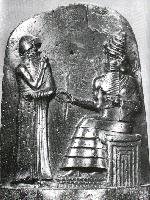
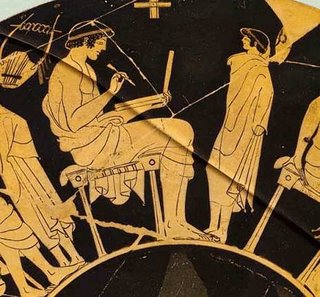
Augustine would not even have been physically isolated from his audience, as a modern preacher would be, who stands in a pulpit above a seated congregation. The congregation of Hippo stood throughout the sermon, while Augustine usually sat back in his cathedra. The first row, therefore, would have met their bishop roughly at eye level, at only some 5 yards' distance.This reminded me that the lecturer, preacher, or teacher of ancient times often sat while his audience stood, which sheds light on the passage in Luke 4:20, which describes Jesus sitting down after reading the scripture: "Rolling up the scroll, he handed it back to the attendant and sat down, and the eyes of all in the synagogue looked intently at him." He was sitting down in the teacher's seat, which would have been elevated (like the bishop's cathedra of Augustine's time, centuries later), while his auditors stood.
I surmise that the same practice lies behind Matthew's description in the Sermon on the Mount: "Seeing the crowds, he went up on the mountain, and when he sat down, his disciples came to him" (Matt. 5:1). We are to imagine Christ sitting on the mount, teaching, while his disciples stand and listen, at a slightly lower elevation.
The practice was ancient. Compare these pictures: the first from the Hammurapi stele of the 2nd millennium BCE (which portrays the seated god Shamash instructing a standing Hammurapi in the ways of justice) and a Greek vase, more than 1500 years later (which portrays a student standing before his teacher, who is consulting a
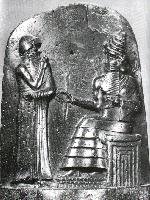

Friday, July 07, 2006
Vermes on the Qumran Concordance
There is not really much drama in the editing of a concordance, but Geza Vermes puts his finger on an important aspect of the recently published Dead Sea Scrolls Concordance. In the course of reviewing said volume, he rehearses the history of Scroll concordances, and mentions the important card-index concordance put forth by John Strugnell in 1988. This privately photocopied book was not meant to be used outside the circle of original Scroll editors and their students. However:
I don't know if Marty Abegg has any sense of sweet revenge, but I'm glad to see Vermes reminding people of how much Marty and his trusty computer have meant to the history of Qumran studies.
Vermes's verdict on the Concordance: "an outstanding achievement ... truly indispensable." It's always nice to hear such kind words about a project in which one has participated.
BIBLIOGRAPHY: Vermes's review appears in Journal of Jewish Studies 57 (Spring 2006), 177-179.
Not only did "illegal" copies circulate among scholars (I received one myself), but as those familiar with the history of Qumran studies well know, an "official" copy of the Concordance, deposited in the library of Hebrew Union College Cincinnati by Strugnell, instead of being kept under lock and key, accidentally found its way to the open shelves and was noticed there by the renowned Talmudist Ben Zion Wacholder. He and a computer-savvy graduate student of his realised that from the concordance it was possible to reconstruct the underlying texts. Their work published in September 1991 ... was the first major breach on the embargo rule imposed on the unpublished manuscripts by the original chief editor Roland de Vaux, and maintained by his successors. The Cincinnati coup was a major contributory factor in the so-called "liberation" of the Qumran scrolls in October 1991. And the name of the graduate student, without whose computer expertise the venture would not have succeeded and who at one stage was threatened with legal proceedings, is none other than Martin G. Abegg, the editor of the present work under review. No revenge could have been sweeter.
I don't know if Marty Abegg has any sense of sweet revenge, but I'm glad to see Vermes reminding people of how much Marty and his trusty computer have meant to the history of Qumran studies.
Vermes's verdict on the Concordance: "an outstanding achievement ... truly indispensable." It's always nice to hear such kind words about a project in which one has participated.
BIBLIOGRAPHY: Vermes's review appears in Journal of Jewish Studies 57 (Spring 2006), 177-179.
Wednesday, June 28, 2006
Brooke on Book by Cook (et al.)
G. J. Brooke reviews The Dead Sea Scrolls Concordance, Vol. I, on which I was a collaborator, in the Society for Old Testament Study Book List 2004: "a magnificent achievement." Thank you, George! He also says, "I have not yet found any errors." Well, keep looking, you will. Not many, I hope.
We are currently working on Vol. 2, a concordance of the biblical texts.
BIBLIOGRAPHY: Martin Abegg with James Bowley and Edward Cook, The Dead Sea Scrolls Concordance. I. The Non-Biblical Texts from Qumran. Leiden: Brill, 2003.
We are currently working on Vol. 2, a concordance of the biblical texts.
BIBLIOGRAPHY: Martin Abegg with James Bowley and Edward Cook, The Dead Sea Scrolls Concordance. I. The Non-Biblical Texts from Qumran. Leiden: Brill, 2003.
Tuesday, June 20, 2006
Bibliographical Note
For what it's worth, the newest issue of Near Eastern Archaeology has published my "Forgery Indictments and BAR: Learning from Hindsight," as well as other contributions to the SBL Forum that originally appeared on-line in March 2005. You can read it for free by finding the proper link on the right-hand side of this blog.
Fans of "Ralph" will recall that the article had its origin in a series of posts here in 2004-2005.
I'm a little ambivalent about the long Nachleben of this piece. It is not my career ambition to become known principally as an antagonist of Hershel Shanks, a man I like personally and respect professionally. Nevertheless, I think the points I made were important and I stand by them.
By the way, the magazine identifies me as "Research Consultant, West Semitic Research Project," which was true in March 2005, but now is not. (The grant under which I was working for WSRP has expired.) I should stress that the viewpoint of my article is not necessarily that of the WSRP.
BIBLIOGRAPHY: Edward M. Cook, "The Forgery Indictments and BAR: Learning from Hindsight," Near Eastern Archaeology 68/1-2 March-June 2005 [appeared 2006], pp. 73-75.
Fans of "Ralph" will recall that the article had its origin in a series of posts here in 2004-2005.
I'm a little ambivalent about the long Nachleben of this piece. It is not my career ambition to become known principally as an antagonist of Hershel Shanks, a man I like personally and respect professionally. Nevertheless, I think the points I made were important and I stand by them.
By the way, the magazine identifies me as "Research Consultant, West Semitic Research Project," which was true in March 2005, but now is not. (The grant under which I was working for WSRP has expired.) I should stress that the viewpoint of my article is not necessarily that of the WSRP.
BIBLIOGRAPHY: Edward M. Cook, "The Forgery Indictments and BAR: Learning from Hindsight," Near Eastern Archaeology 68/1-2 March-June 2005 [appeared 2006], pp. 73-75.
Monday, June 19, 2006
Here and There on a Monday
Father's Day: This weekend my lovely children took me to see Nacho Libre, which we all enjoyed hugely, unlike most critics. Since my daughter is getting married in August (to an excellent young man) and moving to California (where she will begin doctoral studies at Stanford), this may be the last Father's Day for a while for us all to be together. *sniff*
ECUSA: Looks like dark days in the ECUSA for orthodoxy. The Episcopalian Church is well on its way to becoming Unitarianism, With Mass. Am I concerned about Katherine, our new presiding bishop? Yes. Not because she's a woman — that's no big deal — but because her respect for Scripture and tradition seems to be weak, as far as I can tell. The leftists in the denomination, as this example shows, are not even bothering to pretend to be nice anymore.
ECUSA: Looks like dark days in the ECUSA for orthodoxy. The Episcopalian Church is well on its way to becoming Unitarianism, With Mass. Am I concerned about Katherine, our new presiding bishop? Yes. Not because she's a woman — that's no big deal — but because her respect for Scripture and tradition seems to be weak, as far as I can tell. The leftists in the denomination, as this example shows, are not even bothering to pretend to be nice anymore.
Friday, June 16, 2006
Facing the Caboose: Time-Orientation in Hebrew, Aramaic, and Aymara
An interesting story in Language Log about the Aymara language, which is reported to have a "reverse concept" of time, i.e. the past is considered "in front," while the future is considered "behind." Apparently other Asian and Pacific languages have the same feature.
It should be noted that Hebrew and Aramaic also have this perspective, to some extent. Observe, for instance, Biblical Hebrew yemei qedem, days of old/of long past; the word qedem incorporates the root q-d-m, meaning basically "to be in front of." And every beginning Hebrew student will know of the prepositions אחר and אחרי, which have a spatial meaning, "behind," and a temporal meaning, "after, afterwards, in the future."
In Aramaic, the situation is similar. Something that happened "previously" or "a long time ago" is said to have occurred (min) le-qadmin, using the cognate root q-d-m mentioned above; the preposition qodam "before, in front of" is well-known. In early Aramaic, the root אחר is also used to denote both "behind" and "futurity," but its use fades in later dialects in favor of the neologism bathar "after" (from b + athar, "in place of").
This is not a complete survey of all the time-related words and expressions in Aramaic and Hebrew, but it's enough to show that, cross-linguistically, Aymara is not alone. There is a certain psychological aptness to this system, in that what is in front of one can be seen, while that which is behind cannot be seen. In this respect, the past, which is known and visible, is like the front view, while the future — unseen and unknown — is like the unseen vista behind one's back. It's like sitting on a train facing the caboose.
It should be noted that Hebrew and Aramaic also have this perspective, to some extent. Observe, for instance, Biblical Hebrew yemei qedem, days of old/of long past; the word qedem incorporates the root q-d-m, meaning basically "to be in front of." And every beginning Hebrew student will know of the prepositions אחר and אחרי, which have a spatial meaning, "behind," and a temporal meaning, "after, afterwards, in the future."
In Aramaic, the situation is similar. Something that happened "previously" or "a long time ago" is said to have occurred (min) le-qadmin, using the cognate root q-d-m mentioned above; the preposition qodam "before, in front of" is well-known. In early Aramaic, the root אחר is also used to denote both "behind" and "futurity," but its use fades in later dialects in favor of the neologism bathar "after" (from b + athar, "in place of").
This is not a complete survey of all the time-related words and expressions in Aramaic and Hebrew, but it's enough to show that, cross-linguistically, Aymara is not alone. There is a certain psychological aptness to this system, in that what is in front of one can be seen, while that which is behind cannot be seen. In this respect, the past, which is known and visible, is like the front view, while the future — unseen and unknown — is like the unseen vista behind one's back. It's like sitting on a train facing the caboose.
Wednesday, June 14, 2006
ECUSA fiddles while Bible burns
At the Episcopal Convention in Columbus, they've already had a U2-charist, a communion service featuring the music of (although not the actual voices of) U2. Apparently it triggered
Well, whoop-de-do. Yep, those are all good things, I guess. But pardon me for questioning whether the Episcopalians (of which I am one, at least for now) ought to be joyously rubber-stamping vague UN "goals." Did Christ say, "Go ye into all the world and achieve universal primary education"? For all I know, some of the bishops may think exactly that. You never can tell with Episcopalian bishops.
Dear God, how the ECUSA could use a good swift kick in the pants right about now. I doubt whether anyone will give it to them.
a joyous celebration in response to the Episcopal Church embracing the goals set forth by the United Nations: eradicate extreme poverty and hunger, achieve universal primary education, promote gender equality, reduce child mortality, improve maternal health, combat HIV/AIDS, ensure environmental sustainability and create a global partnership for development.
Well, whoop-de-do. Yep, those are all good things, I guess. But pardon me for questioning whether the Episcopalians (of which I am one, at least for now) ought to be joyously rubber-stamping vague UN "goals." Did Christ say, "Go ye into all the world and achieve universal primary education"? For all I know, some of the bishops may think exactly that. You never can tell with Episcopalian bishops.
Dear God, how the ECUSA could use a good swift kick in the pants right about now. I doubt whether anyone will give it to them.
Monday, June 05, 2006
June 6: A beastly day?
Lots of mindless tittle-tattle on the Internet concerning the date tomorrow — 6/6/06. Ooooh! Isn't that the Number of the Beast, according to Revelation 13:18? What if something happens?
Fear not. The number of the beast is not 666 ("six six six"), it's six hundred and sixty-six. There's nothing ominous about the number 6 three times in a row; that's just the way we write that particular number in Western arithmetic. Is there anything scary about DCLXVI (= six hundred sixty-six in Roman numerals)?
Plus, it's not completely clear that 666 is the original number of the beast (see here), although it probably is.
Fear not. The number of the beast is not 666 ("six six six"), it's six hundred and sixty-six. There's nothing ominous about the number 6 three times in a row; that's just the way we write that particular number in Western arithmetic. Is there anything scary about DCLXVI (= six hundred sixty-six in Roman numerals)?
Plus, it's not completely clear that 666 is the original number of the beast (see here), although it probably is.
Monday, May 29, 2006
Warriors
Memorial Day in the US is for the remembrance of those who died fighting for their country. I don't know of anyone related to me who has died in battle, but there've been a few who did serve in the military and saw combat.
My great-great-great-uncle Andrew Kincannon (d. 1829), fought in the battle of King's Mountain (1780) against American Tories and the British.
My great-grandfather Joseph Pope Morgan ("Granpappy", d. 1933) served in the Confederate Army (3rd Mississippi) and was wounded in the battle of Chickamauga.
My step-grandfather Bill Erkelens (d. 1965), flew in bomber biplanes in World War I as the gunner. "How many German planes did you shoot down?" I asked him once, when I was a kid. He said, "Just one," and looked away. Not a good memory.
My uncle Joe Morgan (d. 1966), served in the Pacific Theater in World War II, most notably on the island of Peleliu.
My father, Charles G. Cook (d. 1985), was a bomber pilot (B-17's) during World War II. In 1948, he flew C-47's in the Berlin Airlift. Later, in the early '50's, he was stationed on Guam and was a "typhoon spotter," flying 27 missions into the center of typhoons to gather meteorological data.
My brother, Chuck Cook, was in Vietnam (I think actually Cambodia) as a radio communications specialist.
I'll also mention my wife Amy's illustrious ancestor, Nathaniel Chapman, who was one of the original Minutemen and fought at Bunker Hill. One of his children, John Chapman, became better known as Johnny Appleseed. (JA's half-brother, also named Nathaniel, is Amy's great-great-great-grandfather.)
Me? I gave up my student deferment in 1971; that year my lottery number was 189, and they didn't draft me. According to the rules in place then, if you weren't drafted the first year you were 1-A, you couldn't be drafted later. Although I had grave misgivings about Vietnam (who didn't?), I had no plans to dodge the draft or to declare myself a conscientious objector. If I had, my father might have done me serious harm, and I was more afraid of him than of the Viet Cong. But by the luck of the draw, I was passed by. Nothing to be proud of, but at least no one had to go in my place.
My great-great-great-uncle Andrew Kincannon (d. 1829), fought in the battle of King's Mountain (1780) against American Tories and the British.
My great-grandfather Joseph Pope Morgan ("Granpappy", d. 1933) served in the Confederate Army (3rd Mississippi) and was wounded in the battle of Chickamauga.
My step-grandfather Bill Erkelens (d. 1965), flew in bomber biplanes in World War I as the gunner. "How many German planes did you shoot down?" I asked him once, when I was a kid. He said, "Just one," and looked away. Not a good memory.
My uncle Joe Morgan (d. 1966), served in the Pacific Theater in World War II, most notably on the island of Peleliu.
My father, Charles G. Cook (d. 1985), was a bomber pilot (B-17's) during World War II. In 1948, he flew C-47's in the Berlin Airlift. Later, in the early '50's, he was stationed on Guam and was a "typhoon spotter," flying 27 missions into the center of typhoons to gather meteorological data.
My brother, Chuck Cook, was in Vietnam (I think actually Cambodia) as a radio communications specialist.
I'll also mention my wife Amy's illustrious ancestor, Nathaniel Chapman, who was one of the original Minutemen and fought at Bunker Hill. One of his children, John Chapman, became better known as Johnny Appleseed. (JA's half-brother, also named Nathaniel, is Amy's great-great-great-grandfather.)
Me? I gave up my student deferment in 1971; that year my lottery number was 189, and they didn't draft me. According to the rules in place then, if you weren't drafted the first year you were 1-A, you couldn't be drafted later. Although I had grave misgivings about Vietnam (who didn't?), I had no plans to dodge the draft or to declare myself a conscientious objector. If I had, my father might have done me serious harm, and I was more afraid of him than of the Viet Cong. But by the luck of the draw, I was passed by. Nothing to be proud of, but at least no one had to go in my place.
Sunday, May 21, 2006
Goodbye, Shelby
Yesterday our long-time family dog, Shelby, was put to sleep at the age of 15. We acquired him in the fall of 1990 as a puppy, when the kids were 7 and 3. Now they are 22 and 18, all grown up, and, as if his work was done, Shelby's body started to give out. He had a good long run as our friend, playmate, and little brother.
He was a mixed-breed dog of medium size, with a beagle-type head and ears, but with a hunter's deep chest and slender hips. It's a pity that none of us have ever been hunters, because he would have excelled at that; he knew how to point, and when he barked (not very often, for he was rather quiet), it was with the hound dog's arooo! and not the yike-yike-yike of the lapdog. Occasionally he would slip through the security system for independent forays, returning hours later with some strange dog's supper dish. And who will ever forget the time when he snuck into the kitchen and ate an entire plate of brownies, with no ill effects? He was the children's special friend, sleeping on their beds until his hips and legs became too fragile to manage even that small hop.
With most species, we share the planet as passengers share the same train (although no doubt the animal creation finds us an unusually loud, smelly, violent, and unruly group to travel with), and God's purpose and plan for them is a complete mystery; neither Scripture, tradition, nor reason give us any clue about the post-mortem fate of creatures, if any. But the species Canis domesticus seems to have evolved alongside Homo sapiens, and their fate — biologically, at least — seems intertwined with ours, their behaviors shaped by human habits.
Even the few hints about our own human destiny do not encourage the view that the Resurrection life is just this world all over again; and yet there must be some kind of continuity at some level. Otherwise talk about "the new creation" would be devoid of content, denoting only "unimaginable beings in some unimaginable mode of existence." Since there must be some continuity, perhaps it is not going too far to hope that these creatures, at least, may find a place in the new heaven and new earth; and that when we awake in newness of life, out of all the other wonders in store for us, one of them might be the sight of our glorified dogs jumping up to lick our faces.
In closing, I append a poem by Robinson Jeffers, called "The House Dog's Grave." Many thanks to Michael Gilleland, who recently included it in his blog.
I've changed my ways a little; I cannot now
Run with you in the evenings along the shore,
Except in a kind of dream; and you, if you dream a moment,
You see me there.
So leave awhile the paw-marks on the front door
Where I used to scratch to go out or in,
And you'd soon open; leave on the kitchen floor
The marks of my drinking-pan.
I cannot lie by your fire as I used to do
On the warm stone,
Nor at the foot of your bed; no, all the nights through
I lie alone.
But your kind thought has laid me less than six feet
Outside your window where firelight so often plays,
And where you sit to read - and I fear often grieving for me -
Every night your lamplight lies on my place.
You, man and woman, live so long, it is hard
To think of you ever dying.
A little dog would get tired, living so long.
I hope that when you are lying
Under the ground like me your lives will appear
As good and joyful as mine.
No, dears, that's too much hope: you are not so well cared for
As I have been.
And never have known the passionate undivided
Fidelities that I knew.
Your minds are perhaps too active, too many-sided...
But to me you were true.
You were never masters, but friends. I was your friend.
I loved you well, and was loved. Deep love endures
To the end and far past the end. If this is my end,
I am not lonely. I am not afraid. I am still yours.
He was a mixed-breed dog of medium size, with a beagle-type head and ears, but with a hunter's deep chest and slender hips. It's a pity that none of us have ever been hunters, because he would have excelled at that; he knew how to point, and when he barked (not very often, for he was rather quiet), it was with the hound dog's arooo! and not the yike-yike-yike of the lapdog. Occasionally he would slip through the security system for independent forays, returning hours later with some strange dog's supper dish. And who will ever forget the time when he snuck into the kitchen and ate an entire plate of brownies, with no ill effects? He was the children's special friend, sleeping on their beds until his hips and legs became too fragile to manage even that small hop.
With most species, we share the planet as passengers share the same train (although no doubt the animal creation finds us an unusually loud, smelly, violent, and unruly group to travel with), and God's purpose and plan for them is a complete mystery; neither Scripture, tradition, nor reason give us any clue about the post-mortem fate of creatures, if any. But the species Canis domesticus seems to have evolved alongside Homo sapiens, and their fate — biologically, at least — seems intertwined with ours, their behaviors shaped by human habits.
Even the few hints about our own human destiny do not encourage the view that the Resurrection life is just this world all over again; and yet there must be some kind of continuity at some level. Otherwise talk about "the new creation" would be devoid of content, denoting only "unimaginable beings in some unimaginable mode of existence." Since there must be some continuity, perhaps it is not going too far to hope that these creatures, at least, may find a place in the new heaven and new earth; and that when we awake in newness of life, out of all the other wonders in store for us, one of them might be the sight of our glorified dogs jumping up to lick our faces.
In closing, I append a poem by Robinson Jeffers, called "The House Dog's Grave." Many thanks to Michael Gilleland, who recently included it in his blog.
I've changed my ways a little; I cannot now
Run with you in the evenings along the shore,
Except in a kind of dream; and you, if you dream a moment,
You see me there.
So leave awhile the paw-marks on the front door
Where I used to scratch to go out or in,
And you'd soon open; leave on the kitchen floor
The marks of my drinking-pan.
I cannot lie by your fire as I used to do
On the warm stone,
Nor at the foot of your bed; no, all the nights through
I lie alone.
But your kind thought has laid me less than six feet
Outside your window where firelight so often plays,
And where you sit to read - and I fear often grieving for me -
Every night your lamplight lies on my place.
You, man and woman, live so long, it is hard
To think of you ever dying.
A little dog would get tired, living so long.
I hope that when you are lying
Under the ground like me your lives will appear
As good and joyful as mine.
No, dears, that's too much hope: you are not so well cared for
As I have been.
And never have known the passionate undivided
Fidelities that I knew.
Your minds are perhaps too active, too many-sided...
But to me you were true.
You were never masters, but friends. I was your friend.
I loved you well, and was loved. Deep love endures
To the end and far past the end. If this is my end,
I am not lonely. I am not afraid. I am still yours.
Friday, May 19, 2006
Au lieu de moi
Sorry I've been non-blogging lately, a trend that shows no signs of letting up. (Or is that "every sign of not letting up"? Oh well.)
In place of my own ideas, here's a couple of links from Slate. First, a review of the movie of The DaVinci Code. A quotation:
In place of my own ideas, here's a couple of links from Slate. First, a review of the movie of The DaVinci Code. A quotation:
To my mind, the most ineffable gnostic secret of all is how such hooey has managed to capture the imagination of tens of millions of people all around the world.Also, please note that Slate now has its own biblioblogger, sort of.
Thursday, May 11, 2006
Lost Again
Forget the Gospel of Judas, the DaVinci Code, the Dead Sea Scrolls — the most pored-over, closely read mystery text in the U.S. today is undoubtedly the Blast Door Map from Lost.
We learned one interesting thing last night; the "?" site is the Pearl station. That puts Locke and Eko at least one step ahead of the unknown map-maker, who labeled the site "Purpose unknown." Locke's fear that what they found at the station invalidates his button-pushing mission may (or may not) be addressed by the Latin tag attached to this station on the Map: Nil actum reputa si quid superest agendum, "Nothing is considered done if anything remains to be done."
One reading on the Map should be corrected; although everyone reads Credo nos in fluctu eodem esse (at about 2 o'clock on the map), the word eodem is not there. "I believe we are in a/the wave."
Speculation: I think the Others must live underground and travel by tunnel. I guess we're about to find out.
By the way, if you're not getting enough egghead in your Lost diet, you should know that there is an online Journal of "Lost" Studies.
We learned one interesting thing last night; the "?" site is the Pearl station. That puts Locke and Eko at least one step ahead of the unknown map-maker, who labeled the site "Purpose unknown." Locke's fear that what they found at the station invalidates his button-pushing mission may (or may not) be addressed by the Latin tag attached to this station on the Map: Nil actum reputa si quid superest agendum, "Nothing is considered done if anything remains to be done."
One reading on the Map should be corrected; although everyone reads Credo nos in fluctu eodem esse (at about 2 o'clock on the map), the word eodem is not there. "I believe we are in a/the wave."
Speculation: I think the Others must live underground and travel by tunnel. I guess we're about to find out.
By the way, if you're not getting enough egghead in your Lost diet, you should know that there is an online Journal of "Lost" Studies.
Thursday, May 04, 2006
Books 'n' Records
Just a few notes on what's on the bookshelf/CD player:
Last week I read The Power and the Glory, this week I'm reading The End of the Affair, both for the first time. Where have you been all my life, Graham Greene? ... Over the weekend I read King Dork, by Frank Portman, which was good, although my expectations were slightly higher than the book turned out to be. The kids in this young-adult novel, by the way, don't listen to CDs (it's vinyl instead), nor do they have cell phones, cars, iPods, or any of the other iconic impedimenta of today's youth. And yet it's supposed to take place in the present day? Try around 1985 instead ... The Fiery Furnaces have just come out with Bitter Tea, and I can't recommend it too highly. Just as plot is the backbone of fiction, and draughtsmanship of art, melody is the backbone of music — and no-one these days writes better melodies than FF's Matt Friedberger. The fact that he festoons them with all kinds of collaged sound effects, synth blats and beeps, backwards tapes, and cartoonish keyboard doodles matters not a whit (in fact, I like it): the tunes themselves adhere to the synapses with the delirious speed of ad jingles. But what ad jingle ever had lyrics like
The isolated lady,
an isolated older lady:
a dignified dame who keeps her own counsel,
in love with the out-of-the-way,
identifying with the unfamiliar,
contemptuously turns her back on the wicked world
with its vulgar delusions and correspondingly
scorns its regard.
("Whistle Rhapsody")
Very cool.
Last week I read The Power and the Glory, this week I'm reading The End of the Affair, both for the first time. Where have you been all my life, Graham Greene? ... Over the weekend I read King Dork, by Frank Portman, which was good, although my expectations were slightly higher than the book turned out to be. The kids in this young-adult novel, by the way, don't listen to CDs (it's vinyl instead), nor do they have cell phones, cars, iPods, or any of the other iconic impedimenta of today's youth. And yet it's supposed to take place in the present day? Try around 1985 instead ... The Fiery Furnaces have just come out with Bitter Tea, and I can't recommend it too highly. Just as plot is the backbone of fiction, and draughtsmanship of art, melody is the backbone of music — and no-one these days writes better melodies than FF's Matt Friedberger. The fact that he festoons them with all kinds of collaged sound effects, synth blats and beeps, backwards tapes, and cartoonish keyboard doodles matters not a whit (in fact, I like it): the tunes themselves adhere to the synapses with the delirious speed of ad jingles. But what ad jingle ever had lyrics like
The isolated lady,
an isolated older lady:
a dignified dame who keeps her own counsel,
in love with the out-of-the-way,
identifying with the unfamiliar,
contemptuously turns her back on the wicked world
with its vulgar delusions and correspondingly
scorns its regard.
("Whistle Rhapsody")
Very cool.
Friday, April 28, 2006
Please, No More Movies
OK, is this thing on? Hello? OK. Yes. I'd like to read a press release from the Association of Hollywood Moguls.
Hello, American people! We know you're out there, because, dang it, somebody keeps buying movie tickets. But actually, lately, that number's going down. And frankly, folks, that brings us to our main topic of this press release, the decline in ticket sales. We've actually come to a realization: most of the movies we make just suck. When we checked the summer schedule of movies coming out — frankly, even we got a little nauseous. We've got sequels to comic-book movies coming out, like Superman; we've got remakes and more remakes (yes, the rumors are true, we remade "The Poseidon Adventure"); we've got lame teen comedies full of fart jokes, and, um, even more sequels. Oh, and horror movies that are remakes of Japanese originals. For us, a high concept movie is "Snakes on a Plane."
The fact is, folks, we're just plain out of ideas for good movies. And we think you deserve better. So we've decided that until we've gathered enough ideas for a whole season's worth of good cinema, we're just not going to make any more movies.
I know what you're thinking, especially if you're a theater owner. But don't worry: we're going to re-release a lot classic movies, without remaking them, so that there will be plenty of films at your local cineplex. We just think that you haven't lived until you've seen "Casablanca" or "The Seven Samurai" on the big screen. Enjoy!
"What about us?" the actors have been saying. Don't worry, you crazy kids! We've lined up plenty of work for you. Most of you will be recording a ton of audiobooks, just to keep your voices in shape; the rest will be honing their actorly skills in "little theater" productions all over the country. We can't wait to see it! And, speaking of actorly skills, we also want to be the first to announce that several stars will be going back to Remedial Acting School! Yes! The first two scholarship recipients? Keanu Reeves and Ben Affleck.
How long will it take? We're not sure, but we think after about 5 years we may be able to start making a few interesting, intelligent, and exciting movies. We appreciate your patience until then, and we look forward to seeing you at next week's world premiere of "Citizen Kane." Thanks!
If only.
Hello, American people! We know you're out there, because, dang it, somebody keeps buying movie tickets. But actually, lately, that number's going down. And frankly, folks, that brings us to our main topic of this press release, the decline in ticket sales. We've actually come to a realization: most of the movies we make just suck. When we checked the summer schedule of movies coming out — frankly, even we got a little nauseous. We've got sequels to comic-book movies coming out, like Superman; we've got remakes and more remakes (yes, the rumors are true, we remade "The Poseidon Adventure"); we've got lame teen comedies full of fart jokes, and, um, even more sequels. Oh, and horror movies that are remakes of Japanese originals. For us, a high concept movie is "Snakes on a Plane."
The fact is, folks, we're just plain out of ideas for good movies. And we think you deserve better. So we've decided that until we've gathered enough ideas for a whole season's worth of good cinema, we're just not going to make any more movies.
I know what you're thinking, especially if you're a theater owner. But don't worry: we're going to re-release a lot classic movies, without remaking them, so that there will be plenty of films at your local cineplex. We just think that you haven't lived until you've seen "Casablanca" or "The Seven Samurai" on the big screen. Enjoy!
"What about us?" the actors have been saying. Don't worry, you crazy kids! We've lined up plenty of work for you. Most of you will be recording a ton of audiobooks, just to keep your voices in shape; the rest will be honing their actorly skills in "little theater" productions all over the country. We can't wait to see it! And, speaking of actorly skills, we also want to be the first to announce that several stars will be going back to Remedial Acting School! Yes! The first two scholarship recipients? Keanu Reeves and Ben Affleck.
How long will it take? We're not sure, but we think after about 5 years we may be able to start making a few interesting, intelligent, and exciting movies. We appreciate your patience until then, and we look forward to seeing you at next week's world premiere of "Citizen Kane." Thanks!
If only.
Tuesday, April 25, 2006
When Was the Gospel of Mark Written?
Since today is the feast day of St. Mark the Evangelist, I hearby announce, in his honor, that almost every scholarly discussion of the date of Mark's Gospel is wrong. I would like to state — with only a soupçon of exaggeration — that Mark was written within one year after the resurrection.
This statement cannot be proved wrong without assuming (a) that the Gospel makes widespread use of vaticinium ex eventu, that is, history disguised as prophecy; and (b) that the evangelist relied on a chain of oral tradition, whose crystallization requires "a long time". I submit that both of these assumptions are arbitrary. Assumption (a) imports a philosophical premise (prophecy cannot happen) into a literary argument; and assumption (b) assumes, usually without argument, that Christian tradition was immediately oral and only secondarily written (instead of, as is more probable, a mixture of both).
Obviously I am taking an extreme position to make a point. But can anyone point to indications within the Gospel that point to a date ca. 65 CE or later (the usual date given) without relying on the above assumptions?
This statement cannot be proved wrong without assuming (a) that the Gospel makes widespread use of vaticinium ex eventu, that is, history disguised as prophecy; and (b) that the evangelist relied on a chain of oral tradition, whose crystallization requires "a long time". I submit that both of these assumptions are arbitrary. Assumption (a) imports a philosophical premise (prophecy cannot happen) into a literary argument; and assumption (b) assumes, usually without argument, that Christian tradition was immediately oral and only secondarily written (instead of, as is more probable, a mixture of both).
Obviously I am taking an extreme position to make a point. But can anyone point to indications within the Gospel that point to a date ca. 65 CE or later (the usual date given) without relying on the above assumptions?
Wednesday, April 19, 2006
The End of Biblioblogdom?
I note that Jim West has announced the "dis-integration" of the biblioblogging community. He may well be correct, or not; I don't know. I do want to put in my two cents about my own decreased activity in the blogosphere, which Jim cites in two places, including the remark that I (among others) have been "strangely silent."
As I noted a while back,* I started a new, non-academic, job in November that keeps me busy 40 hours a week. When I'm not "at" work, I continue to do other work at home, fulfilling commitments to Oaktree Software and others, and trying to honor various writing contracts. I also have family and church activities that I would not like to neglect. There's just not much time for writing blog posts or even reading them.
If, as Jim asserts, the other "classic" bibliobloggers are blogging and communicating less, this may be a function of the expansion of Biblioblogdom. When I started blogging in November 2004, there were approximately 4.5 million blogs (according to Technorati); now there are 35.8 million. This exponential growth has been felt among biblioblogs as well. The community that started out small has grown too large to keep up with even in a passive read-only way, to say nothing of engaging in daily back-and-forth debates.
So ... life happens. It's okay. Let a thousand flowers bloom.
* I said in November 2005: "This meeting [SBL] caught me in the middle of a career reinvention, as I begin to renounce the threefold academic vow (poverty, bibliography, and jargon) and transition from full-time independent scholar to full-time cubicle dweller with philology as a hobby. This will also affect "Ralph"; as the demands on my time increase, blogging will become harder to fit in. But I won't quit. Watch this space."
As I noted a while back,* I started a new, non-academic, job in November that keeps me busy 40 hours a week. When I'm not "at" work, I continue to do other work at home, fulfilling commitments to Oaktree Software and others, and trying to honor various writing contracts. I also have family and church activities that I would not like to neglect. There's just not much time for writing blog posts or even reading them.
If, as Jim asserts, the other "classic" bibliobloggers are blogging and communicating less, this may be a function of the expansion of Biblioblogdom. When I started blogging in November 2004, there were approximately 4.5 million blogs (according to Technorati); now there are 35.8 million. This exponential growth has been felt among biblioblogs as well. The community that started out small has grown too large to keep up with even in a passive read-only way, to say nothing of engaging in daily back-and-forth debates.
So ... life happens. It's okay. Let a thousand flowers bloom.
* I said in November 2005: "This meeting [SBL] caught me in the middle of a career reinvention, as I begin to renounce the threefold academic vow (poverty, bibliography, and jargon) and transition from full-time independent scholar to full-time cubicle dweller with philology as a hobby. This will also affect "Ralph"; as the demands on my time increase, blogging will become harder to fit in. But I won't quit. Watch this space."
Monday, April 17, 2006
Gnosticism and the Jews
Misunderstandings and misapprehensions about the Gospel of Judas continue to flow. Secularist commentator Christopher Hitchens, who is apparently completely devoid of elementary knowledge of church history, remarks that acceptance of the Gospel of Judas would help to combat Christian anti-Semitism:
Christianity, of course, has much to repent of in its treatment of the Jews over the centuries. Nevertheless, when the Church rejected Gnosticism, it was taking a step away from anti-Semitism, not towards it, because the Gnostics despised the Jews, the Jewish God, and Jewish Scripture. As Hyam Maccoby writes,
Gnosticism's intense rejection of Judaism seems to have been overlooked in the modern revisionist rush to anoint the Gnostics as a "healthy corrective" to orthodox Christianity. If the Gnostic version of Christianity had prevailed, Judaism might not have survived.
The Judas gospel would make one huge difference if it was accepted. It would dispel the centuries of anti-Semitic paranoia that were among the chief accompaniments of the Easter celebration until approximately 30 years after 1945, when the Vatican finally acquitted the Jews of the charge of Christ-killing.
Christianity, of course, has much to repent of in its treatment of the Jews over the centuries. Nevertheless, when the Church rejected Gnosticism, it was taking a step away from anti-Semitism, not towards it, because the Gnostics despised the Jews, the Jewish God, and Jewish Scripture. As Hyam Maccoby writes,
While anti-Semitism (in the sense of intense dislike of Jews) was not uncommon in the ancient world, it was probably among the Gnostic sects that the most radical form of anti-Semitism originated — the view that the Jews are the representatives of cosmic evil, the people of the Devil. (The Mythmaker: Paul and the Invention of Christianity, p. 186)Maccoby continues by portraying St. Paul — most unreasonably, in my opinion — as himself an early Gnostic. However, Maccoby's principal thesis is correct.
Gnosticism's intense rejection of Judaism seems to have been overlooked in the modern revisionist rush to anoint the Gnostics as a "healthy corrective" to orthodox Christianity. If the Gnostic version of Christianity had prevailed, Judaism might not have survived.
Sunday, April 16, 2006

Monday, April 10, 2006
More on the Gospel of Judas
The ole Internet is just a-simmerin' these days with more Gospel of Judas stuff. Several blogs are rounding up links for one-stop-shopping for GJ news; I think I'll just mention Doc Cathey's post, and you can go from there.
One essay you should not miss is Adam Gopnik's contribution to the New Yorker, an excellent piece from a secular perspective. The New Yorker — darn their blue-state hides! — still has the best writing around, and Gopnik is always worth a read. His conclusion:
One essay you should not miss is Adam Gopnik's contribution to the New Yorker, an excellent piece from a secular perspective. The New Yorker — darn their blue-state hides! — still has the best writing around, and Gopnik is always worth a read. His conclusion:
Whether one agrees with Jefferson that this man [Jesus] lived, taught, and died, or with St. Paul that he lived and died and was born again, it is hard not to prefer him to the Jesus of the new Gospel, with his stage laughter and significant winks and coded messages. Making Judas more human makes Jesus oddly less so, less a man with a divine and horrible burden than one more know-it-all with a nimbus. As metaphor or truth, we’re sticking with the old story. Give us that old-time religion—but, to borrow a phrase from St. Augustine, maybe not quite yet.
Thursday, April 06, 2006
Is the Gospel of Judas "Troubling"?
All right. Here we go *sigh* with another Gnostic Gospel alert. Now the publication today of the Gospel of Judas is providing tons of grist for the junk-scholarship mill. Here's what the NYT has to say about this and other Gnostic Gospels:
The utter inability of the NYT to understand the import of this discovery is just amazing. Although elsewhere in the article, the authors seem to grasp that this "gospel" is a product of the second or third century AD/CE, they push the idea that somehow it provides information about the first century AD/CE and the historical Jesus.
And then the idea that some gospels were "edited out" of the canon — ! I run into this idea all the time among the uneducated, but to find the American newspaper of record buying into it is just annoying. Do they get all their information from Dan Brown?
I suppose it bears repeating: (1) none of the Gnostic gospels, which date from at least a century after the time of Christ, have any credible claim to provide evidence about the historical Jesus; (2) none of the early New Testament canons ever included any gnostic Gospels, therefore those Gospels could not have been "edited out"; (2) any theological perspective held by grown-ups on the formation of the canon should be able to accommodate both the governing hand of God and the presence of "historical and political forces."
Sigh.
As the findings [of Gnostic gospels] have trickled down to churches and universities, they have produced a new generation of Christians who now regard the Bible not as the literal word of God, but as a product of historical and political forces that determined which texts should be included in the canon, and which edited out.
For that reason, the discoveries have proved deeply troubling for many believers. The Gospel of Judas portrays Judas Iscariot not as a betrayer of Jesus, but as his most favored disciple and willing collaborator.
The utter inability of the NYT to understand the import of this discovery is just amazing. Although elsewhere in the article, the authors seem to grasp that this "gospel" is a product of the second or third century AD/CE, they push the idea that somehow it provides information about the first century AD/CE and the historical Jesus.
And then the idea that some gospels were "edited out" of the canon — ! I run into this idea all the time among the uneducated, but to find the American newspaper of record buying into it is just annoying. Do they get all their information from Dan Brown?
I suppose it bears repeating: (1) none of the Gnostic gospels, which date from at least a century after the time of Christ, have any credible claim to provide evidence about the historical Jesus; (2) none of the early New Testament canons ever included any gnostic Gospels, therefore those Gospels could not have been "edited out"; (2) any theological perspective held by grown-ups on the formation of the canon should be able to accommodate both the governing hand of God and the presence of "historical and political forces."
Sigh.
Saturday, April 01, 2006
Tyler's April Seal
Ha! Tyler Williams has a great April Fool's joke here. Good one!
Unfortunately, this post will probably linger on in cyberspace as a real discovery and eventually make its way into a Wikipedia article. Caveat lector.
Unfortunately, this post will probably linger on in cyberspace as a real discovery and eventually make its way into a Wikipedia article. Caveat lector.
Friday, March 31, 2006
A Token of Donne
Today is the feast day in the Anglican Communion of John Donne, priest, who, besides his accomplishments in divinity, was (on his good days) a poet the equal of Shakespeare. Celebrate his day by reading "The Token."
Saturday, March 25, 2006
Pot in the Bible?
In answer to a question from Michael Gilleland:
1. There is no credible evidence that the etymology of cannabis (Latin "hemp") is connected to Hebrew קנה בשם qeneh bosem (Exodus 30:23), literally "reed of sweet spice."
2. The best guess as to the identity of qeneh bosem, an ingredient in the incense used in the tabernacle, is that it was lemon grass (Cymbopogon citratus). (See the entry in Immanuel Löw's Flora der Juden, 1924-34.) Nobody knows for sure.
3. There is no evidence that Jesus used cannabis, marijuana, hemp, lemon grass, qeneh bosem, kalamos euodes (the Greek translation of qeneh bosem), or any compound of spices or incense in the process of healing, contrary to recent sensationalistic claims.
4. The only mentions of kalamos in the New Testament (Matt 11:7; 12:20; 27:29-30, 48; Mark 15:19, 36; Luke 7:24; 3 John 1:13; Rev 11:1; 21:15-16) are in the meaning "reed" or "pen." Kannabis is not mentioned in the NT.
5. The only unmistakable reference to Cannabis sativa that I can find in Hebrew or Aramaic are some obscure vocabulary items in Syriac: qanpa (obviously a loan from kannabis) and tanuma. (Courtesy of the Comprehensive Aramaic Lexicon.) These words are not used in the Peshitta (Syriac Bible). Qanpa is used in the late Syriac Ahiqar texts to refer to "ropes of hemp" (tunbei de-qanpa). They were weaving it, not smoking it. (Later: Sorry, I overlooked the Hebrew word qanbes — again a clear loan from kannabis and not the other way around — found in the Mishnah to mean "hemp." Again in the contexts in which it appears [Kilaim 2:5; 5:8; 9:1,7; Negaim 11:2], it refers to a material for making clothing or other household objects, not an ingredient of incense or healing.]
6. QED: Neither British tabloids nor Wikipedia are reliable sources of information.
1. There is no credible evidence that the etymology of cannabis (Latin "hemp") is connected to Hebrew קנה בשם qeneh bosem (Exodus 30:23), literally "reed of sweet spice."
2. The best guess as to the identity of qeneh bosem, an ingredient in the incense used in the tabernacle, is that it was lemon grass (Cymbopogon citratus). (See the entry in Immanuel Löw's Flora der Juden, 1924-34.) Nobody knows for sure.
3. There is no evidence that Jesus used cannabis, marijuana, hemp, lemon grass, qeneh bosem, kalamos euodes (the Greek translation of qeneh bosem), or any compound of spices or incense in the process of healing, contrary to recent sensationalistic claims.
4. The only mentions of kalamos in the New Testament (Matt 11:7; 12:20; 27:29-30, 48; Mark 15:19, 36; Luke 7:24; 3 John 1:13; Rev 11:1; 21:15-16) are in the meaning "reed" or "pen." Kannabis is not mentioned in the NT.
5. The only unmistakable reference to Cannabis sativa that I can find in Hebrew or Aramaic are some obscure vocabulary items in Syriac: qanpa (obviously a loan from kannabis) and tanuma. (Courtesy of the Comprehensive Aramaic Lexicon.) These words are not used in the Peshitta (Syriac Bible). Qanpa is used in the late Syriac Ahiqar texts to refer to "ropes of hemp" (tunbei de-qanpa). They were weaving it, not smoking it. (Later: Sorry, I overlooked the Hebrew word qanbes — again a clear loan from kannabis and not the other way around — found in the Mishnah to mean "hemp." Again in the contexts in which it appears [Kilaim 2:5; 5:8; 9:1,7; Negaim 11:2], it refers to a material for making clothing or other household objects, not an ingredient of incense or healing.]
6. QED: Neither British tabloids nor Wikipedia are reliable sources of information.
Wednesday, March 22, 2006
If you don't like the weather ...
Yesterday we had a big snowstorm, today it is bright and cloudless. It's time to bring out the old cliché, "If you don't like the weather in Cincinnati, just wait a few minutes." This particular meme, so beloved around here as a "local saying," I have heard in all of the many places I have lived. A quick Google search reveals the following exact quotes for this "local saying":
If you don't like the weather in Texas... Just blink!
If You Don't Like The Weather in Chicago. wait a minute.
If you don't like the weather in Michigan, wait five minutes.
Mark Twain wrote, "If you don't like the weather in New England, just wait a few minutes."
And remember, if you don't like the weather in St. Louis, just wait ten minutes.
Yup, if you don't like the weather in Texas, wait five minutes -- it'll change!
If you don't like the weather in Melbourne, just wait five minutes.
If you don't like the weather in Washington, well, just wait a minute.
If you don't like the weather in Boston, just wait a minute.
Will Rogers once quipped, "If you don't like the weather in Oklahoma, wait a minute and it'll change."
If you don't like the weather in Missouri just wait 5 minutes.
"If you don't like the weather in Buffalo, wait five minutes." Famous quote from past resident Mark Twain.
If you don't like the weather in the Sierra…wait a minute"
Everybody knows that if you don't like the weather in British Columbia, all you have to do is to wait five minutes.
If you don't like the weather in Florida, stick around for a few minutes, it'll change.
I guess it's true what they say here "if you don't like the weather in Utah, wait 20 minutes".
If you don't like the weather in North Carolina, wait a day.
We also say, 'If you don't like the weather in Scotland, then hang around for twenty minutes'.
I wonder ... do they haul out this "local saying" in Europe as well? Are there French or German equivalents? And what did Mark Twain really say?
If you don't like the weather in Texas... Just blink!
If You Don't Like The Weather in Chicago. wait a minute.
If you don't like the weather in Michigan, wait five minutes.
Mark Twain wrote, "If you don't like the weather in New England, just wait a few minutes."
And remember, if you don't like the weather in St. Louis, just wait ten minutes.
Yup, if you don't like the weather in Texas, wait five minutes -- it'll change!
If you don't like the weather in Melbourne, just wait five minutes.
If you don't like the weather in Washington, well, just wait a minute.
If you don't like the weather in Boston, just wait a minute.
Will Rogers once quipped, "If you don't like the weather in Oklahoma, wait a minute and it'll change."
If you don't like the weather in Missouri just wait 5 minutes.
"If you don't like the weather in Buffalo, wait five minutes." Famous quote from past resident Mark Twain.
If you don't like the weather in the Sierra…wait a minute"
Everybody knows that if you don't like the weather in British Columbia, all you have to do is to wait five minutes.
If you don't like the weather in Florida, stick around for a few minutes, it'll change.
I guess it's true what they say here "if you don't like the weather in Utah, wait 20 minutes".
If you don't like the weather in North Carolina, wait a day.
We also say, 'If you don't like the weather in Scotland, then hang around for twenty minutes'.
I wonder ... do they haul out this "local saying" in Europe as well? Are there French or German equivalents? And what did Mark Twain really say?
Friday, March 17, 2006
A Champion Once Again
I was fortunate enough to be selected a member of the Spelling Bee team at the company I work for, and yesterday we won the Literacy Network of Greater Cincinnati's 16th Annual Scripps Spelling Bee for Literacy. The full story is here. Yeah, baby! No, the LPK team did not wear costumes.
The last time I did anything like this was in 1967, when I won the Austin (Tx.) Junior High School spelling championship. Nice to know that I still got the mojo. And big-time props to my teammates, Bev and Al.
Below is a picture of me giving the black-power salute (after spelling alepidote), while Al Hidalgo looks on wonderingly.
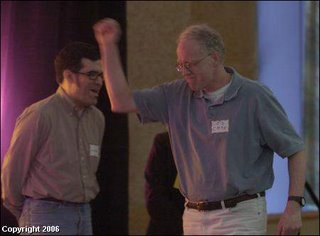
The last time I did anything like this was in 1967, when I won the Austin (Tx.) Junior High School spelling championship. Nice to know that I still got the mojo. And big-time props to my teammates, Bev and Al.
Below is a picture of me giving the black-power salute (after spelling alepidote), while Al Hidalgo looks on wonderingly.

Friday, March 10, 2006
Skinny-Dipping and the Fate of Nations
The death of John Profumo — a figure likely forgotten by many today — is big with biblical echoes. Profumo was a Conservative cabinet member in the British government in 1963, and was brought down by a sex scandal involving call-girl Christine Keeler. The NYT reports:
The whiskey glass
and the female ass
have brought many men
to a sorry pass.
It is also a biblical principle, however, that that is not necessarily the end of the story. I will assume that the later story of David is well-known to most of my readers. The later story of Profumo, on the other hand, was news to me. The NYT story notes that "after his fall ... he turned to charitable work among the poor in the hardscrabble East End of London":
She [Keeler] was 19. He was 48. As the story went, he first caught sight of her climbing naked out of a swimming pool.For those, like myself, who view the world as a vast biblical commentary, the story of Profumo is a gloss upon the sin of David and Bathsheba. 2 Sam. 11:2-4:
Now when evening came David arose from his bed and walked around on the roof of the king's house, and from the roof he saw a woman bathing; and the woman was very beautiful in appearance. So David sent and inquired about the woman. And one said, "Is this not Bathsheba, the daughter of Eliam, the wife of Uriah the Hittite?" David sent messengers and took her, and when she came to him, he lay with her.All of which is an illustration of the observation, first enunciated in ancient wisdom literature, which may be paraphrased as follows:
The whiskey glass
and the female ass
have brought many men
to a sorry pass.
It is also a biblical principle, however, that that is not necessarily the end of the story. I will assume that the later story of David is well-known to most of my readers. The later story of Profumo, on the other hand, was news to me. The NYT story notes that "after his fall ... he turned to charitable work among the poor in the hardscrabble East End of London":
But there was another side of the story: redemption. By working in the East End, washing dishes, tending alcoholics, Mr Profumo's friends said, he paid his dues. Lord Deedes, a friend, told the BBC today: "He atoned for his mistakes and I think will, on death, receive his reward for that."RIP.
Tuesday, February 28, 2006
A New Book on the Gospels by Garry Wills
Fr. Edward T. Oakes has a review here of a new book by Garry Wills, What Jesus Meant, which sounds interesting. I refer to Wills's book, not the sour review, which uses "crypto-Anglican" as a swear-word. Sounds like a compliment to me!
I've always liked Wills, and I particularly commend his Under God: Religion and American Politics. It sounds to me like Fr. Oakes finds Wills's Christianity a little too "mere" and not Catholic (i.e., not papist) enough. But I'm glad to see that GW's theology has not moved leftwards at the same rate as his politics. If he (GW) wants to move over to Episcopalianism, we could use his help.
I've always liked Wills, and I particularly commend his Under God: Religion and American Politics. It sounds to me like Fr. Oakes finds Wills's Christianity a little too "mere" and not Catholic (i.e., not papist) enough. But I'm glad to see that GW's theology has not moved leftwards at the same rate as his politics. If he (GW) wants to move over to Episcopalianism, we could use his help.
Wednesday, February 22, 2006
Girlish Confusion
Thanks to Targuman for this notice about Israel Drazin's version of Targum Onkelos. I have to mention that this paragraph mystifies me:
If Rabbi Drazin expects people to pay attention to his book because of this kind of tittle-tattle, I imagine he is in for a disappointment.
As Rabbi Drazin explained, Onkelos casts a light on the proper translation of texts elsewhere in the Bible. Thus in rendering Exodus 2:8, the ancient translator refers to Moses' sister Miriam as an almah, which Onkelos translates as "girl." The word is significant to Christians because Isaiah 7:14 speaks of an almah who "will become pregnant and bear a son"—a verse that Christians, rendering almah as "virgin," understand as referring to the Virgin Birth.Wha'? Onkelos is written in Aramaic, the Hebrew Bible is written in, well, Hebrew. The word that Onkelos uses in Exodus 2:8 is uleymta, meaning "girl" in Aramaic, while the Hebrew text has almah. The word uleymta is the common word for "girl" in the dialect of Onkelos (it also commonly translates na'arah "girl, lass"), while almah is rather rare in Hebrew. and its exact nuance is disputed. Although the two words are cognates, this has no bearing on the meaning of any text in which almah appears, except as confirming that Onkelos (and Jonathan in Tg. Isa. 7:14) thought that almah meant "girl" in those texts. For what it is worth, Onkelos translates Hebrew betula, "virgin," by uleymta in Deut. 32:25. Nothing very conclusive comes out of all this.
If Rabbi Drazin expects people to pay attention to his book because of this kind of tittle-tattle, I imagine he is in for a disappointment.
Sunday, February 19, 2006
Here and There
—There has appeared an interesting list of "100 best first lines from novels" here, and, in response, a list of "best last lines." I'll give it some thought, but I'm not sure I could better the first list (the second is still growing). I think I might add the opening sentence of Raymond Chandler's The Long Goodbye: "The first time I laid eyes on Terry Lennox he was drunk in a Rolls-Royce Silver Wraith outside the terrace of the Dancers." And I would certainly add, from Tom Sawyer:
—I finished my review of Ursula Schattner Rieser's L'araméen des manuscrits de la mer Morte. I am told that it will appear in the August 2006 issue of Journal for the Study of Judaism.
—I wanted to give a shout-out to Danny Zacharias for producing a nifty Unicode keyboard for Hebrew transliteration, available here. I used it in producing the review mentioned above; worked like a charm. Thanks, Danny.
"Tom!"It's not a novel, but "Gallia est omnis divisa in partes tres" from Caesar's Gallic War is a pretty famous opening.
No answer.
"Tom!"
No answer.
—I finished my review of Ursula Schattner Rieser's L'araméen des manuscrits de la mer Morte. I am told that it will appear in the August 2006 issue of Journal for the Study of Judaism.
—I wanted to give a shout-out to Danny Zacharias for producing a nifty Unicode keyboard for Hebrew transliteration, available here. I used it in producing the review mentioned above; worked like a charm. Thanks, Danny.
Subscribe to:
Posts (Atom)