BEST NON-FICTION BOOK (Scholarly): Again, I didn't read anything published this year. The closest I came was in reading Joe Fitzmyer's 3rd edition of his commentary on the Genesis Apocryphon (2004; good) and Klaus Beyer's revised volume 2 of Die Aramäische Texte vom Toten Meer (2004; ditto). But the Ralphie goes to Alan Millard's Reading and Writing in the Time of Jesus (2000), an excellent survey, and subtly subversive of a number of scholarly shibboleths.
BEST FICTION: I read and enjoyed King Dork (2006) by Frank Portman, but the best novel I read all year was one I read the same week in May: The End of the Affair, by Graham Greene. Very moving.
BEST GRAPHIC FICTION: So many to choose from. Marvel's Civil War series is great, if published at a glacial pace; also great is the current story arc of Ultimate Fantastic Four written by Mark Carey. I also have to mention the must-read Hatter M; my nephew Greg Cook works on that book as "Cartographic Chronicler and Historian." The Ralphie, however, goes to Brian K. Vaughan's Y: The Last Man. No, it's not a male fantasy; it's an exciting quest tale that illuminates, and deconstructs, a number of assumptions (both male and female) about what the world would look like if all the men died (except one). Vaughan has recently been hired as a writer for ABC's drama Lost.
That's it for this year, folks!
Wednesday, December 27, 2006


Monday, December 25, 2006
Happy Birthday, O pale Galilean
Thou hast conquered, O pale Galilean; the world has grown grey from thy breath
The skeptical Swinburne, under the guise of a pagan critique of Christianity, really was writing against, I suppose, the dull pieties of Victorian Anglicanism, but his attitude crops up quite a bit still. The grey world? yet as I look out my window, the neighborhood is a blaze of brightly colored lights, glistening decorations, and crazy plastic figurines. These things are only the echoes or the outskirts of genuine religion; but could a life-denying faith really engender such a merry display?
The other day in the New York Times, an unrepentantly Jewish writer talked about how she and her husband celebrated Christmas for the first time:
Happy birthday, Lord. And many more.
—A. C. Swinburne, Hymn to Proserpine
The skeptical Swinburne, under the guise of a pagan critique of Christianity, really was writing against, I suppose, the dull pieties of Victorian Anglicanism, but his attitude crops up quite a bit still. The grey world? yet as I look out my window, the neighborhood is a blaze of brightly colored lights, glistening decorations, and crazy plastic figurines. These things are only the echoes or the outskirts of genuine religion; but could a life-denying faith really engender such a merry display?
The other day in the New York Times, an unrepentantly Jewish writer talked about how she and her husband celebrated Christmas for the first time:
I love that as soon as I told a Catholic friend what I was up to, she invited me to a gingerbread-house decorating party. How fun is that? And why wasn’t I invited before? What does a gingerbread house have to do with Jesus?It reminded me for some reason of a passage from Azar Nafisi's Reading Lolita in Tehran, when one of her students told of the religious instruction in the university after the Islamic Revolution:
...
Some nights, I put on our Starbucks Christmas CD, light a fire, turn on the tree and play with the different settings, put liquid smoke in the train’s smokestack and turn on the choo-choo sound effects and then I sit back and enjoy my first Christmas, in all its kitschy splendor. I feel a little guilty when I look at our lone menorah on the mantel (the only evidence of my faith other than my guilt), but I ask you: how can this much pleasure be wrong?
On one side [the teacher] had written, in large white letters, MUSLIM GIRL, and drawn a vertical line in the middle of the board. On the other side, in large pink letters, he wrote CHRISTIAN GIRL. He had then asked the class if they knew the differences between the two. One was a virgin, he said at last, after an uncomfortable silence, white and pure, keeping herself for her husband and her husband only. Her power came from her modesty. The other, well, there was not much one could say about her except that she was not a virgin. To Yassi's surprise, the two girls behind her, both active members of the Muslim Students' Association, had started to giggle, whispering, No wonder more and more Muslims are converting to Christianity.I know that neither woman's experience is religious, or has anything to do with "authentic" Christianity; but it has everything to do with the world that Christianity made. After 2000 years, there are still plenty of people out there, on the outside looking in, who have the impression that such a world, with its colored lights and gingerbread, has something to do with pleasure and liberation. The pale Galilean, who was criticized for enjoying food and drink too much (Luke 7:34), might, after all, have had something to do with that.
Happy birthday, Lord. And many more.
Sunday, December 17, 2006
Third Annual Ralphies (2): Film
BEST MOVIE: Boy, what a lousy year for movies, just as we knew it would be. I enjoyed Nacho Libre and Pirates of the Caribbean 2, but they're not really Film of the Year material. The one movie I was anxious to see, For Your Consideration, turned out to be a disappointment. So, I hate to get all haughty and everything, but I just can't award a Ralphie this year for Best Movie. However, I can start a new category:
WORST MOVIE: Lots of competition here. But I'd have to give it to Strangers with Candy, which is not only the worst movie I've seen this year, but possibly the worst movie I've ever seen. Like, in my life. I started checking my watch to see how much torture I had to endure after five minutes. It's even worse than the second worst movie ever, which I also happened to watch this year on DVD: Broken Flowers.
BEST TV SHOW: I've built my schedule around two shows this year, Lost (still great) and Heroes (also terrific). But the Ralphie goes to The Office. It's the only show I watch with Amy, whose taste otherwise runs towards earnest PBS documentaries. So, huge kudos to Carell & Co. just for luring my wife to network television.
WORST MOVIE: Lots of competition here. But I'd have to give it to Strangers with Candy, which is not only the worst movie I've seen this year, but possibly the worst movie I've ever seen. Like, in my life. I started checking my watch to see how much torture I had to endure after five minutes. It's even worse than the second worst movie ever, which I also happened to watch this year on DVD: Broken Flowers.
BEST TV SHOW: I've built my schedule around two shows this year, Lost (still great) and Heroes (also terrific). But the Ralphie goes to The Office. It's the only show I watch with Amy, whose taste otherwise runs towards earnest PBS documentaries. So, huge kudos to Carell & Co. just for luring my wife to network television.
Thursday, December 14, 2006
Atheists vs. Liberals
Heave an egg outside a Pullman window anywhere in the United States today, and you will probably hit an atheist. In fact, I hope you do. There is a new prominence of what I term, drawing on my theological training, Mean Atheism. I refer to such writers as Richard Dawkins and Sam Harris, who are taking the old Village Atheist tradition to the ... well, to the global village. Yeah, that's it: the Global Village Atheists.
For orthodox Christians, it's all rather tiring. Didn't we just get done arguing down The DaVinci Code and guaranteeing that the movie would be the lamest and least successful Tom Hanks vehicle since Bonfire of the Vanities? We buried that sucka! Yeah! But now *sigh* there's a new shipment of nitwits that are just begging for the old double-barrel rational refutation treatment. It's exhausting. Can't we get a break?
You know what I say? I say, Let the liberals handle it this time. We orthodox folks are going to take some time off, and we'd really like some of the usual left-wing religious suspects to take this on for us. How about Katherine Jefferts-Schori, new Presiding Bishop of the Episcopal Church? How about it, Kathy, you up for a fight? Why don't you take on Sam Harris? How about you, John Shelby Spong? Marcus Borg? Elaine Pagels? Dom Crossan, why don't you get in the ring with Richard Dawkins? Or John Hick: yes, you. Right now, start refuting. You do think there's something to all this existence of God business, don't you? Well, do us all a favor and crush some of these guys, or at least soften 'em up until the rest of us get back from Christmas vacation? Huh? Whaddya say?
No response? I thought so. Wimps.
For orthodox Christians, it's all rather tiring. Didn't we just get done arguing down The DaVinci Code and guaranteeing that the movie would be the lamest and least successful Tom Hanks vehicle since Bonfire of the Vanities? We buried that sucka! Yeah! But now *sigh* there's a new shipment of nitwits that are just begging for the old double-barrel rational refutation treatment. It's exhausting. Can't we get a break?
You know what I say? I say, Let the liberals handle it this time. We orthodox folks are going to take some time off, and we'd really like some of the usual left-wing religious suspects to take this on for us. How about Katherine Jefferts-Schori, new Presiding Bishop of the Episcopal Church? How about it, Kathy, you up for a fight? Why don't you take on Sam Harris? How about you, John Shelby Spong? Marcus Borg? Elaine Pagels? Dom Crossan, why don't you get in the ring with Richard Dawkins? Or John Hick: yes, you. Right now, start refuting. You do think there's something to all this existence of God business, don't you? Well, do us all a favor and crush some of these guys, or at least soften 'em up until the rest of us get back from Christmas vacation? Huh? Whaddya say?
No response? I thought so. Wimps.
Wednesday, December 13, 2006
Third Annual Ralphies (1): Music
I've decided to do the Ralphies in a series this year, in order to prolong the agony (yours, not mine). Today's Ralphies are for music.
SONG OF THE YEAR: A lot of good songs this year. Who doesn't love "Crazy"? And even if you hated it, you couldn't escape it. Also "Teach Me Sweetheart" by the Fiery Furnaces was probably one of the best this wonderful group has ever done. But the award goes to .... "Code Monkey" by Jonathan Coulton. Irresistible.
ALBUM OF THE YEAR: Bitter Tea by the Fiery Furnaces. So good my mind is still boggled by it.
BEST BOB DYLAN ALBUM OF THE YEAR: Snake Farm, by Ray Wylie Hubbard. Honorable mention: Modern TImes, by Bob Dylan (OK to listen to, but the lyrics and music are pretty lazy and derivative).
SONG OF THE YEAR: A lot of good songs this year. Who doesn't love "Crazy"? And even if you hated it, you couldn't escape it. Also "Teach Me Sweetheart" by the Fiery Furnaces was probably one of the best this wonderful group has ever done. But the award goes to .... "Code Monkey" by Jonathan Coulton. Irresistible.
ALBUM OF THE YEAR: Bitter Tea by the Fiery Furnaces. So good my mind is still boggled by it.
BEST BOB DYLAN ALBUM OF THE YEAR: Snake Farm, by Ray Wylie Hubbard. Honorable mention: Modern TImes, by Bob Dylan (OK to listen to, but the lyrics and music are pretty lazy and derivative).
Thursday, November 30, 2006
Ralph Turns Two
"Ralph" is 2 years old today. It's been a quiet year, but 2006 did see the single biggest day in RTSR history, in terms of hits, links, and chat-room chatter, caused by this post. It also saw Bloglines subscriptions reach an all-time high of 66 (and then begin falling; current number is 61).
Beginning tomorrow: Year 3 A. R.
Beginning tomorrow: Year 3 A. R.
Sunday, November 26, 2006
I've been busy.
Sorry for the non-blogging. Since I've had a full-time non-academic job this year, most of the available writing time that I've had (not much) has been devoted to other compositions:
- a Dictionary of Qumran Aramaic; so far the draft reaches from aleph to het;
- a review of Ursula Schattner-Rieser's L'araméen des manuscrits de la mer Morte for Journal for the Study of Judaism, now published;
- an article for Aramaic Studies, "The 'Kaufman Effect' in the Pseudo-Jonathan Targum," now in page proofs, to be published in volume 4/2;
- a 2000-word entry for the Dictionary of Early Judaism on "Aramaic, Jewish use of in the Second Temple Period"; I spent Thanksgiving vacation finishing that one.
Saturday, November 11, 2006
Armistice Day
From Paul Fussell's The Great War and Modern Memory (1975):
There is one unforgettable vignette which if true is fine, and which if apocryphal is even better. It is Herbert Essame's memory of the German machine-gunner signaling the closing of a long run on November 11, 1918: "On the Fourth Army front, at two minutes to eleven, a machine gun, about 200 yards from the leading British troops, fired off a complete belt without a pause. A single machine-gunner was then seen to stand up beside his weapon, take off his helmet, bow, and turning about walk slowly to the rear."
Friday, November 03, 2006
Bright Fountain
Today is the feast day in the Anglican Communion of Richard Hooker, priest, author of On the Laws of Ecclesiastical Polity. Hooker's remarkable book is still influential in the Communion among both liberals and conservatives, and his extraordinary prose style — the finest, in my opinion, of the Elizabethan period — reminds us that he was a contemporary of Shakespeare. There were giants in the earth in those days.
Here is an excerpt, in which Hooker argues (against the Puritans) for the value of secular learning:
There is in the world no kind of knowledge whereby any part of truth is seen, but we justly account it precious, yea, that principal truth, in comparison whereof all other knowledge is vile, may receive from it some kind of light. Whether it be that Egyptian and Chaldean wisdom mathematical, wherewith Moses and Daniel were furnished; or that natural, moral, and civil wisdom, wherewith Solomon excelled all men, or that rational and oratorial wisdom of the Grecians, which the Apostle St. Paul brought from Tarsus, or that Judaical, which he learned at Jerusalem sitting at the feet of Gamaliel, to detract from the dignity thereof were to injury even God himself, who, being that light which none can approach unto, hath sent out these lights whereof we are capable, even as so many sparkles resembling the bright fountain from which they rise.
"To injury," by the way, is not a misprint; just a sign of how the language has changed since 1589.
Here is an excerpt, in which Hooker argues (against the Puritans) for the value of secular learning:
There is in the world no kind of knowledge whereby any part of truth is seen, but we justly account it precious, yea, that principal truth, in comparison whereof all other knowledge is vile, may receive from it some kind of light. Whether it be that Egyptian and Chaldean wisdom mathematical, wherewith Moses and Daniel were furnished; or that natural, moral, and civil wisdom, wherewith Solomon excelled all men, or that rational and oratorial wisdom of the Grecians, which the Apostle St. Paul brought from Tarsus, or that Judaical, which he learned at Jerusalem sitting at the feet of Gamaliel, to detract from the dignity thereof were to injury even God himself, who, being that light which none can approach unto, hath sent out these lights whereof we are capable, even as so many sparkles resembling the bright fountain from which they rise.
"To injury," by the way, is not a misprint; just a sign of how the language has changed since 1589.
Friday, October 27, 2006
Some Hebrew Phrases in the Qumran Texts
I've just recently run across an article by Phillip Davies, "Death, Resurrection and Life after Death in the Qumran Scrolls" (in Judaism in Late Antiquity, Vol. IV, Leiden, 2000). Davies is always worth reading, even when one disagrees with him.
However, this notice is just to gratefully acknowledge that, on. p. 197, Davies refers to my translation of raz nihyeh in the Dead Sea Scrolls, i.e., "The Secret of the Way Things Are," as "perhaps the most felicitous" of modern attempts to render the phrase in English. While we were revising our various sections for the second edition, I gave serious thought to doing away with "the secret of the way things are," but in the end I decided not to change it (although I did revise the work given that title, and divided it up differently).
Not everyone has been positive about our original renderings. Other phrases that I gave another long, hard look at are "Leader of the Nation" for nesi ha-edah (conventionally translated "Prince of the Congregation") and "Flattery-Seekers" for dorshe halaqot (usually "seekers after smooth things"). Both of these came from a dissatisfaction with the conventional renderings, and in the end, they were retained in the revised edition.
Nesi ha-edah, a messianic designation, is based on a biblical phrase (in Num. 31:13, Josh. 9:15, etc.) that older translators rendered as "princes of the congregation," but which more modern ones give as "leaders of the community/assembly." "Prince" is not a happy equivalent for nasi, and, at Qumran at least, edah in general designates the whole of Israel (and not just the sectarians). Therefore > "Leader of the Nation."
My problem with "seekers after smooth things" is that in modern English the phrase conveys no clear meaning. However, Hebrew halaqot is often used in the bible to denote "flatteries" or perhaps "pleasant untruths" (a key background text for this is Isa. 30:10); hence, "flattery seekers," a derogatory reference to an opposing sect, probably the Pharisees. It might be that halaqot was chosen as a dig at the opponent's love of halakhot (legal rulings), but this is not proven, since the latter word is not attested in the Hebrew of this period.
However, this notice is just to gratefully acknowledge that, on. p. 197, Davies refers to my translation of raz nihyeh in the Dead Sea Scrolls, i.e., "The Secret of the Way Things Are," as "perhaps the most felicitous" of modern attempts to render the phrase in English. While we were revising our various sections for the second edition, I gave serious thought to doing away with "the secret of the way things are," but in the end I decided not to change it (although I did revise the work given that title, and divided it up differently).
Not everyone has been positive about our original renderings. Other phrases that I gave another long, hard look at are "Leader of the Nation" for nesi ha-edah (conventionally translated "Prince of the Congregation") and "Flattery-Seekers" for dorshe halaqot (usually "seekers after smooth things"). Both of these came from a dissatisfaction with the conventional renderings, and in the end, they were retained in the revised edition.
Nesi ha-edah, a messianic designation, is based on a biblical phrase (in Num. 31:13, Josh. 9:15, etc.) that older translators rendered as "princes of the congregation," but which more modern ones give as "leaders of the community/assembly." "Prince" is not a happy equivalent for nasi, and, at Qumran at least, edah in general designates the whole of Israel (and not just the sectarians). Therefore > "Leader of the Nation."
My problem with "seekers after smooth things" is that in modern English the phrase conveys no clear meaning. However, Hebrew halaqot is often used in the bible to denote "flatteries" or perhaps "pleasant untruths" (a key background text for this is Isa. 30:10); hence, "flattery seekers," a derogatory reference to an opposing sect, probably the Pharisees. It might be that halaqot was chosen as a dig at the opponent's love of halakhot (legal rulings), but this is not proven, since the latter word is not attested in the Hebrew of this period.
Wednesday, October 18, 2006
James Barr
James Barr died on October 14, according to a report on the Agade list. Barr was the author of many important works in biblical studies, most notably The Semantics of Biblical Language (1961), Comparative Philology and the Text of the Old Testament (1968), Fundamentalism (1978), History and Ideology in the Old Testament (2000), and others too numerous to mention. All of them are marked by keen intelligence, vigor of thought, and a clear prose style.
I had lunch with Barr once, years ago, at the UCLA faculty club, with Stanislav Segert and Vinton Dearing. I don't remember what was talked of, though I am sure that, callow grad student that I was, my own tongue remained tied throughout the course of the meal. I do remember that Dearing asked me some question about translation technique, which I dodged by passing the buck to Barr. Of the four of us who ate together that day, I am the only one still living.
After lunch Barr spoke to Segert's graduate seminar on Genesis 2-3. His thoughts on this subject were later to be published as The Garden of Eden and the Hope of Immortality (1993). His own immortality in the field of biblical studies is guaranteed, and it is to be hoped that the new generation of students will not neglect his writings either as a source or as a model.
I had lunch with Barr once, years ago, at the UCLA faculty club, with Stanislav Segert and Vinton Dearing. I don't remember what was talked of, though I am sure that, callow grad student that I was, my own tongue remained tied throughout the course of the meal. I do remember that Dearing asked me some question about translation technique, which I dodged by passing the buck to Barr. Of the four of us who ate together that day, I am the only one still living.
After lunch Barr spoke to Segert's graduate seminar on Genesis 2-3. His thoughts on this subject were later to be published as The Garden of Eden and the Hope of Immortality (1993). His own immortality in the field of biblical studies is guaranteed, and it is to be hoped that the new generation of students will not neglect his writings either as a source or as a model.
Wednesday, September 27, 2006
More Dylan Thefts
Henry Timrod made some news a couple of weeks ago by getting some of his lines quoted, or re-used, by Bob Dylan in his new album Modern Times. Timrod was a Confederate poet whose works are now in the public domain. Apparently Bob consciously or unconsciously snipped a few florid Victorian phrases and dropped them into some of the old-timey songs on his record. I don't think there's anything really wrong with that; it's not like he took whole passages and used them wholesale.
And yet Dylan, in his memoir Chronicles, comes pretty close to doing exactly that with other authors. Look carefully at this short passage:
Compare that to this longer passage from Marcel Proust's Within a Budding Grove, especially the passages in italics:
I don't think there can be any doubt that Bob had to have consciously taken these sentences and, with some revision, passed them off as his own.
Another example is from a book that I imagine Dylan knows well, Huckleberry Finn:
Now what are we to think of these "borrowings"? I know that borrowing and revising tunes and song lyrics is standard practice in folk and blues music, and Dylan has done plenty of that, quite openly, as have others. That doesn't bother me. But in a sustained piece of prose that is not meant to be sung or played, but taken as the author's own composition, it is not standard practice. In the instances given above, I think Bob comes pretty close to real plagiarism, and for all I know there are more instances in Chronicles yet to be identified. Frankly, as a Dylan fan from way back, I'm a little disappointed. Say it ain't so, Bob.
UPDATE: A couple more.
Jack London, Children of the Frost:
Jack London, Tales of the Klondyke:
UPDATE II: Yet more:
Sax Rohmer, Dope (1919), A tiny spaniel lay beside the fire, his beady black eyes following the nervous movements of the master of the house.
Chronicles, p. 167: A tiny spaniel lay at the guy's feet, the dog's beady black eyes following the nervous movements of his master.
London, Children of the Frost: And then they are amazingly simple. No complexity about them, no thousand and one subtle ramifications to every single emotion they experience. They love, fear, hate, are angered, or made happy, in common, ordinary, and unmistakable terms.
Chronicles, p. 169: Yet to me, it's amazingly simple, no complications, everything pans out. As long as the things you see don't go by in a blur of light and shade, you're okay. Love, fear, hate, happiness all in unmistakable terms, a thousand and one subtle ramifications.
UPDATE III (Oct. 2): Jack London, Tales of the Klondyke: Through this the afternoon sun broke feebly, throwing a vague radiance to earth, and unreal shadows.
Chronicles, p. 112: The afternoon sun was breaking, throwing a vague radiance to the earth.
Jack London, White Fang: He carried himself with pride, as though, forsooth, he had achieved a deed praiseworthy and meritorious.
Chronicles, p. 63: He didn't need to say much—you knew he had been through a lot, achieved some great deed, praiseworthy and meritorious, yet unspoken about it.
R. L. Stevenson, Providence and the Guitar: As Leon looked at her, in her low-bodied maroon dress, with her arms bare to the shoulder, and a red flower set provocatively in her corset, he repeated to himself for the many hundredth time that she was one of the loveliest creatures in the world of women.
Chronicles, p. 127: I bought a red flower for my wife, one of the loveliest creatures in the world of women.
And yet Dylan, in his memoir Chronicles, comes pretty close to doing exactly that with other authors. Look carefully at this short passage:
Walking back to the main house, I caught a glimpse of the sea through the leafy boughs of the pines. I wasn't near it, but could feel the power beneath its colors. (Chronicles, p. 162)
Compare that to this longer passage from Marcel Proust's Within a Budding Grove, especially the passages in italics:
But when, Mme. de Ville-parisis’s carriage having reached high ground, I caught a glimpse of the sea through the leafy boughs of trees, then no doubt at such a distance those temporal details which had set the sea, as it were, apart from nature and history disappeared ... But on the other hand I was no longer near enough to the sea which seemed to me not a living thing now, but fixed; I no longer felt any power beneath its colours, spread like those of a picture among the leaves, through which it appeared as inconsistent as the sky and only of an intenser blue.
I don't think there can be any doubt that Bob had to have consciously taken these sentences and, with some revision, passed them off as his own.
Another example is from a book that I imagine Dylan knows well, Huckleberry Finn:
Every night we passed towns, some of them away up on black hillsides, nothing but just a shiny bed of lights; not a house could you see. ... There warn't a sound there; everybody was asleep.And now look at Chronicles, p. 165:
One night when everyone was asleep and I was sitting at the kitchen table, nothing on the hillside but a shiny bed of lights ...My last exhibit (a less exact quote) comes from a book called Really the Blues (1946) by Mezz Mezzrow and Bernard Wolfe, in which a hipster introduces "his chick" to Mezzrow:
Baby this that powerful man with that good grass that'll make you tip through the highways and byways like a Maltese kitten. Mezz, this is my new dinner and she's a solid viper.And now, part of Dylan's description of his friend Ray's girl, Chloe Kiel:
She was cool as pie, hip from head to toe, a Maltese kitten, a solid viper — always hit the nail on the head. I don't know how much weed she smoked, but a lot. (Chronicles, p. 102)And later in Really the Blues, a black man was "sitting there actually talking to a white woman cool as pie."
Now what are we to think of these "borrowings"? I know that borrowing and revising tunes and song lyrics is standard practice in folk and blues music, and Dylan has done plenty of that, quite openly, as have others. That doesn't bother me. But in a sustained piece of prose that is not meant to be sung or played, but taken as the author's own composition, it is not standard practice. In the instances given above, I think Bob comes pretty close to real plagiarism, and for all I know there are more instances in Chronicles yet to be identified. Frankly, as a Dylan fan from way back, I'm a little disappointed. Say it ain't so, Bob.
UPDATE: A couple more.
Jack London, Children of the Frost:
"Rum meeting place, though," he added, casting an embracing glance over the primordial landscape ...Chronicles, p. 167: I cast an embracing glance over the primordial landscape ...
Jack London, Tales of the Klondyke:
Another tremendous section of the glacier rumbled earthward. The wind whipped in at the open doorway ...Chronicles, p. 217: Wind whipped in the open doorway and another kicking storm was rumbling earthward.
UPDATE II: Yet more:
Sax Rohmer, Dope (1919), A tiny spaniel lay beside the fire, his beady black eyes following the nervous movements of the master of the house.
Chronicles, p. 167: A tiny spaniel lay at the guy's feet, the dog's beady black eyes following the nervous movements of his master.
London, Children of the Frost: And then they are amazingly simple. No complexity about them, no thousand and one subtle ramifications to every single emotion they experience. They love, fear, hate, are angered, or made happy, in common, ordinary, and unmistakable terms.
Chronicles, p. 169: Yet to me, it's amazingly simple, no complications, everything pans out. As long as the things you see don't go by in a blur of light and shade, you're okay. Love, fear, hate, happiness all in unmistakable terms, a thousand and one subtle ramifications.
UPDATE III (Oct. 2): Jack London, Tales of the Klondyke: Through this the afternoon sun broke feebly, throwing a vague radiance to earth, and unreal shadows.
Chronicles, p. 112: The afternoon sun was breaking, throwing a vague radiance to the earth.
Jack London, White Fang: He carried himself with pride, as though, forsooth, he had achieved a deed praiseworthy and meritorious.
Chronicles, p. 63: He didn't need to say much—you knew he had been through a lot, achieved some great deed, praiseworthy and meritorious, yet unspoken about it.
R. L. Stevenson, Providence and the Guitar: As Leon looked at her, in her low-bodied maroon dress, with her arms bare to the shoulder, and a red flower set provocatively in her corset, he repeated to himself for the many hundredth time that she was one of the loveliest creatures in the world of women.
Chronicles, p. 127: I bought a red flower for my wife, one of the loveliest creatures in the world of women.
Monday, September 11, 2006
Nine Eleven

And Jesus answering said unto him, Seest thou these great buildings? there shall not be left one stone upon another, that shall not be thrown down.
-Mark 13:2
Well, God is in heaven
And we all want what's his
But power and greed and corruptible seed
Seem to be all that there is.
—Bob Dylan, "Blind Willie McTell"
Defenseless under the night
Our world in stupor lies;
Yet, dotted everywhere,
Ironic points of light
Flash out wherever the Just
Exchange their messages:
May I, composed like them
Of Eros and of dust,
Beleaguered by the same
Negation and despair,
Show an affirming flame.
—W. H. Auden, "September 1, 1939"
Tuesday, September 05, 2006
Dylan & Dan Tucker
Not all the words and music here are Dylan's. . . . But Dylan surrounds these borrowings with his own brilliant and uncanny poetry: "I'm walking with a toothache in my heel" ...This reviewer of Dylan's Modern Times obviously never learned "Old Dan Tucker" in elementary school.
Now old Dan Tucker's fine old man
Washed his face in a fryin' pan
Combed his head with a wagon wheel
And died with a toothache in his heel
What are they teaching kids these days?
Monday, August 28, 2006
At the Reception
After the wedding, the reception. It features an Irish band, all friends of the couple, including some groomsmen. Irish bouzouki, uileann pipes, fiddle, tin whistle, guitar. They set up in a little courtyard outside the reception room. I listen for a while, then wander back inside. My radiant daughter and her husband (her husband!) are greeting the guests at each table.
The reception is at a posh banquet center north of Cincinnati. There are maybe half a dozen other wedding receptions going on at the same time in other rooms. The walls are thick and each area is far enough from the others to keep the sound from leaking through.
But you have to walk past the others to reach the restrooms. As I walk down the hallway, I have glimpses of other receptions, other lives: a darkened room with people dancing to "Rock Me like a Hurricane"; another with some kind of activity that looks like the Chicken Dance; another with some kind of ethnic music (Hispanic?) ...
After I visit the facilities, I step outside. The rain has held off all day and now it doesn't look like it will arrive before the weekend is over. Good. I take a breath of fresh air and think about the ceremony. It went off without a hitch, and I smile as I think about the two of them looking each other right in the eye and making promises as big as mountains.
I step back inside the banquet center. From now on, everything will be different. There is a tray of pink carnations in the hall, waiting for yet another reception. I steal one to give to my wife, and walk back past the other lives to the Irish music.
The reception is at a posh banquet center north of Cincinnati. There are maybe half a dozen other wedding receptions going on at the same time in other rooms. The walls are thick and each area is far enough from the others to keep the sound from leaking through.
But you have to walk past the others to reach the restrooms. As I walk down the hallway, I have glimpses of other receptions, other lives: a darkened room with people dancing to "Rock Me like a Hurricane"; another with some kind of activity that looks like the Chicken Dance; another with some kind of ethnic music (Hispanic?) ...
After I visit the facilities, I step outside. The rain has held off all day and now it doesn't look like it will arrive before the weekend is over. Good. I take a breath of fresh air and think about the ceremony. It went off without a hitch, and I smile as I think about the two of them looking each other right in the eye and making promises as big as mountains.
I step back inside the banquet center. From now on, everything will be different. There is a tray of pink carnations in the hall, waiting for yet another reception. I steal one to give to my wife, and walk back past the other lives to the Irish music.
Tuesday, August 08, 2006
A Wedding Toast
A recent conversation with my daughter:
ELIZABETH: Dad, you know you're offering a toast at the wedding reception. Have you thought about what you will say?
SELF: Indeed I have, Elizabeth. First I'll start with a joke, both witty and urbane, to put the audience at ease, and then I'll give a quotation — either from the classics or Scripture, I haven't decided. From there I'll go on to my experiences as a parent, its joys and trials, with some reflections on the contemporary assault on family values and the threats to marriage as an institution in America today. Then I'll talk about you, your growth as a person, placed in the context of the post-war emancipation of American womanhood. Then I'll segue to the emergence of your love from Brian, and his for you, with reference to Bergson's concept of emergent evolution. I intend to finish with a vivid evocation of the bright vision of God as portrayed in the last book of the Paradiso, and how all things, including marital bliss, find their true meaning in the context of that "eternal fountain," the "love that moves the sun and the other stars."
ELIZABETH: You've only got two minutes.
SELF: I'll cut it down a bit.
ELIZABETH: Dad, you know you're offering a toast at the wedding reception. Have you thought about what you will say?
SELF: Indeed I have, Elizabeth. First I'll start with a joke, both witty and urbane, to put the audience at ease, and then I'll give a quotation — either from the classics or Scripture, I haven't decided. From there I'll go on to my experiences as a parent, its joys and trials, with some reflections on the contemporary assault on family values and the threats to marriage as an institution in America today. Then I'll talk about you, your growth as a person, placed in the context of the post-war emancipation of American womanhood. Then I'll segue to the emergence of your love from Brian, and his for you, with reference to Bergson's concept of emergent evolution. I intend to finish with a vivid evocation of the bright vision of God as portrayed in the last book of the Paradiso, and how all things, including marital bliss, find their true meaning in the context of that "eternal fountain," the "love that moves the sun and the other stars."
ELIZABETH: You've only got two minutes.
SELF: I'll cut it down a bit.
Wednesday, August 02, 2006
One Book Meme
I see that Chris Brady has tagged me, and I owe him a follow-up. So here goes:
1. One book that changed your life:
Tough choice. I'll say Mere Christianity, by C. S. Lewis. Helped me out as a teenager when I really needed a rational approach to Christianity.
2. One book that you’ve read more than once:
Heaps and heaps of them. Do I have to pick just one? I'll pick the most recent: Boswell's Life of Johnson.
3. One book you’d want on a desert island:
Let's see, something really long and involving, escapist, heavy ... War and Peace? I've started it more than once and never could finish it. The whole desert island experience would give the opportunity to make it all the way through.
4. One book that made you laugh:
David Foster Wallace, A Supposedly Fun Thing that I'll Never Do Again.
5. One book that made you cry:
Books don't make me cry; movies sometimes do.
6. One book that you wish had been written:
Secrets of a Long Successful Life, by Edward Cook
7. One book that you wish had never been written:
Pet Sematary, by Stephen King. Still gives me nightmares 20 years later.
8. One book you’re currently reading:
I always have a lot going at once. I'll just mention Parliament of Souls, by Stephen R. L. Clark, one of my favorite philosophers.
9. One book you’ve been meaning to read:
See #3.
10. Now tag five people:
Oh, geez. I don't even know five people. But I'll tag these and see what happens: PastorJeff. Locustyears, Brandon.
1. One book that changed your life:
Tough choice. I'll say Mere Christianity, by C. S. Lewis. Helped me out as a teenager when I really needed a rational approach to Christianity.
2. One book that you’ve read more than once:
Heaps and heaps of them. Do I have to pick just one? I'll pick the most recent: Boswell's Life of Johnson.
3. One book you’d want on a desert island:
Let's see, something really long and involving, escapist, heavy ... War and Peace? I've started it more than once and never could finish it. The whole desert island experience would give the opportunity to make it all the way through.
4. One book that made you laugh:
David Foster Wallace, A Supposedly Fun Thing that I'll Never Do Again.
5. One book that made you cry:
Books don't make me cry; movies sometimes do.
6. One book that you wish had been written:
Secrets of a Long Successful Life, by Edward Cook
7. One book that you wish had never been written:
Pet Sematary, by Stephen King. Still gives me nightmares 20 years later.
8. One book you’re currently reading:
I always have a lot going at once. I'll just mention Parliament of Souls, by Stephen R. L. Clark, one of my favorite philosophers.
9. One book you’ve been meaning to read:
See #3.
10. Now tag five people:
Oh, geez. I don't even know five people. But I'll tag these and see what happens: PastorJeff. Locustyears, Brandon.
Friday, July 28, 2006
The End of the World
A recent conversation in our house:
WIFE: Ha ha, some people are looking at the Mideast troubles and predicting the end of the world.
SELF: I wish.
WIFE: What?! You wish it were the end of the world?!
SELF: Do I wish for the consummation of human history, a new heavens and a new earth, the return of Our Lord? You bet I do.
WIFE: But I'm working on my doctorate.
WIFE: Ha ha, some people are looking at the Mideast troubles and predicting the end of the world.
SELF: I wish.
WIFE: What?! You wish it were the end of the world?!
SELF: Do I wish for the consummation of human history, a new heavens and a new earth, the return of Our Lord? You bet I do.
WIFE: But I'm working on my doctorate.
Wednesday, July 12, 2006
The Seated Teacher
While reading Peter Brown's biography Augustine of Hippo, I was struck by this passage describing Augustine the preacher:
I surmise that the same practice lies behind Matthew's description in the Sermon on the Mount: "Seeing the crowds, he went up on the mountain, and when he sat down, his disciples came to him" (Matt. 5:1). We are to imagine Christ sitting on the mount, teaching, while his disciples stand and listen, at a slightly lower elevation.
The practice was ancient. Compare these pictures: the first from the Hammurapi stele of the 2nd millennium BCE (which portrays the seated god Shamash instructing a standing Hammurapi in the ways of justice) and a Greek vase, more than 1500 years later (which portrays a student standing before his teacher, who is consulting alaptop folding tablet).
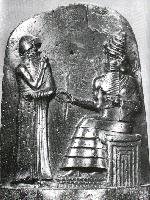
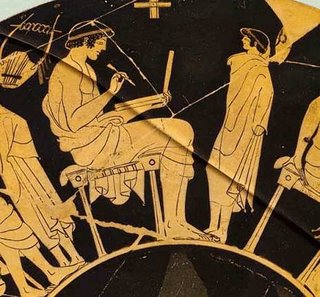
Augustine would not even have been physically isolated from his audience, as a modern preacher would be, who stands in a pulpit above a seated congregation. The congregation of Hippo stood throughout the sermon, while Augustine usually sat back in his cathedra. The first row, therefore, would have met their bishop roughly at eye level, at only some 5 yards' distance.This reminded me that the lecturer, preacher, or teacher of ancient times often sat while his audience stood, which sheds light on the passage in Luke 4:20, which describes Jesus sitting down after reading the scripture: "Rolling up the scroll, he handed it back to the attendant and sat down, and the eyes of all in the synagogue looked intently at him." He was sitting down in the teacher's seat, which would have been elevated (like the bishop's cathedra of Augustine's time, centuries later), while his auditors stood.
I surmise that the same practice lies behind Matthew's description in the Sermon on the Mount: "Seeing the crowds, he went up on the mountain, and when he sat down, his disciples came to him" (Matt. 5:1). We are to imagine Christ sitting on the mount, teaching, while his disciples stand and listen, at a slightly lower elevation.
The practice was ancient. Compare these pictures: the first from the Hammurapi stele of the 2nd millennium BCE (which portrays the seated god Shamash instructing a standing Hammurapi in the ways of justice) and a Greek vase, more than 1500 years later (which portrays a student standing before his teacher, who is consulting a

Friday, July 07, 2006
Vermes on the Qumran Concordance
There is not really much drama in the editing of a concordance, but Geza Vermes puts his finger on an important aspect of the recently published Dead Sea Scrolls Concordance. In the course of reviewing said volume, he rehearses the history of Scroll concordances, and mentions the important card-index concordance put forth by John Strugnell in 1988. This privately photocopied book was not meant to be used outside the circle of original Scroll editors and their students. However:
I don't know if Marty Abegg has any sense of sweet revenge, but I'm glad to see Vermes reminding people of how much Marty and his trusty computer have meant to the history of Qumran studies.
Vermes's verdict on the Concordance: "an outstanding achievement ... truly indispensable." It's always nice to hear such kind words about a project in which one has participated.
BIBLIOGRAPHY: Vermes's review appears in Journal of Jewish Studies 57 (Spring 2006), 177-179.
Not only did "illegal" copies circulate among scholars (I received one myself), but as those familiar with the history of Qumran studies well know, an "official" copy of the Concordance, deposited in the library of Hebrew Union College Cincinnati by Strugnell, instead of being kept under lock and key, accidentally found its way to the open shelves and was noticed there by the renowned Talmudist Ben Zion Wacholder. He and a computer-savvy graduate student of his realised that from the concordance it was possible to reconstruct the underlying texts. Their work published in September 1991 ... was the first major breach on the embargo rule imposed on the unpublished manuscripts by the original chief editor Roland de Vaux, and maintained by his successors. The Cincinnati coup was a major contributory factor in the so-called "liberation" of the Qumran scrolls in October 1991. And the name of the graduate student, without whose computer expertise the venture would not have succeeded and who at one stage was threatened with legal proceedings, is none other than Martin G. Abegg, the editor of the present work under review. No revenge could have been sweeter.
I don't know if Marty Abegg has any sense of sweet revenge, but I'm glad to see Vermes reminding people of how much Marty and his trusty computer have meant to the history of Qumran studies.
Vermes's verdict on the Concordance: "an outstanding achievement ... truly indispensable." It's always nice to hear such kind words about a project in which one has participated.
BIBLIOGRAPHY: Vermes's review appears in Journal of Jewish Studies 57 (Spring 2006), 177-179.
Subscribe to:
Posts (Atom)