Sunday, February 12, 2006

Comic Books (ii): Marked

A while back I wrote about C. S. Lewis's expressed desire to write something about the Gospel story that avoided its "stained glass associations," in order to hear it fresh again. Most people would think, I imagine, that he succeeded in the Narnian Chronicles, at least partly by creating an entirely new world in which to place the story.

But what if you wanted to make the actual Gospel narratives live again? is there any way of avoiding 2000 years of "churchy" connotations while re-telling the gospel itself? Many have tried, few have succeeded. One of the best attempts in the 20th century was Dorothy Sayers's Man Born to be King, a series of radio plays broadcast in Britain during World War II and, in my opinion, one of the most moving of all modern re-tellings of the story of Christ. One reason that MBTBK succeeded where most (e.g.) Jesus movies fail is that it was written for a medium (the spoken voice) that avoids many of the pitfalls of over-familiar religious iconography. Even so, there was a lot of controversy at the time over Sayers's "irreverent" portrayal of Christ.

To my mind, Steve Ross's graphic novel Marked, a retelling of the Gospel of Mark, is another worthy attempt. Ross faced the same problem as Lewis and Sayers, with the additional burden of using a medium (line art) that could not avoid decisions about how or whether to re-use any of the conventions of Christian visual art. He dealt with this problem by putting the narrative in a modern-day setting that is yet not simply a portrayal of our world — the government is a quasi-fascistic Big-Brother entity, technology is everywhere, yet demon possession is common, and an exploitative religion works hand-in-glove with the authorities. Hence Ross dispenses with the need to be "historically accurate," while retaining certain features of the Gospel that are narratively important. He also is able to do something you can only do in comics, namely dispense almost totally with rendering background or scenery, foregrounding the action for narrative vitality, the characters moving and speaking most frequently against a white field or with only vaguely sketched buildings or landscape. This enables the story to seem timeless, yet to retain some minimum sense of place. This in itself is not unlike the biblical narrative, in which most action is foregrounded in similar fashion.

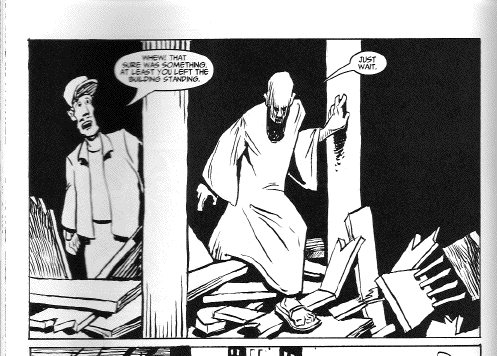
The plot is a combination of faithfulness to the overall shape of Mark's gospel combined with considerable freedom in details. As in the gospel, there is no nativity story, and the book ends as abruptly as Mark does (without the interpolated longer ending), with a resurrection but no resurrection appearances. His choice of "look" for Jesus is interesting. The traditional appearance is gone, replaced by a bald, vaguely Asian-looking guy. I like it. This panel is in the aftermath of the cleansing of the temple:

Actually, the Jesus-classic look does make an appearance later on, but as the aspect of Barabbas. I'm not sure what this is meant to convey; perhaps nothing more than Ross's desire to stand things on their heads. He plays around with traditional iconography without actually using it, or using it in different ways. At the Last Supper we are shown the interior of Jesus' cup, and it looks like the Host floating in a cup of wine. But the next panel shows us that it's the moon's reflection:
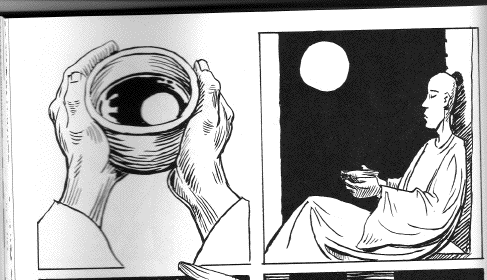
In the panels that follow, the cup falls and breaks while Jesus is arrested and beaten, while the moon continues to shine. There is nothing else besides this symbolism to correspond to the Words of Institution.

Ross also uses other icons that have some resonance, non-religious ones employed in religious ways. For instance, here is a scene from the Transfiguration, Jesus with Moses and Elijah.

And I don't think I'm too far off in seeing this trio not simply as Christ, Moses, and Elijah, but also Father, Son and Holy Spirit. Less effective is his employment of a clown — kind of a creepy one — as the angel at the tomb.

There is an interesting review and interview with Ross here at the SBL Forum. It reveals that Ross is an Episcopalian of the modernist variety, one among (regrettably) many in our denomination who seem to believe that the most valuable part of the catechism is the questions. This may account for the fact that his overall portrait of Jesus is lacking something commanding, authoritative, and royal — the Messiah of Marked doesn't quite understand what's happening to him. Not the impression one gets from the actual Gospel. But in general I really like what he's done, and the achievement, taken as a whole, is fresh and appealing. It has the potential to sneak past a lot of prejudice against the gospel narrative and set it before modern eyes as a story of Something new breaking into a world sadly in need of redemption.

Saturday, January 28, 2006

Brokeback: a Chick Flick?

Brokeback Mountain is being touted as an issues film of the kind that divides red-staters from blue-staters, and is considered likely to raise the temperature on debates about gay marriage and other related issues.

I haven't seen it nor do I intend to. Not because of its theme, or because of its political subtext. No, I'm avoiding Brokeback because it sounds like a chick movie. Consider: a movie about "relationships," with passions running high, emotions oozing all over the place, and at the center of it two hunky guys displaying all the "googly feelings" (my wife's phrase) that women wish their husbands and boyfriends would emit on a more regular basis. You think that Heath Ledger and Jake Gyllenhaal are going to show up on testosterone-fueled venues like SportsCenter or The Man Show? Unlikely; but they've already been on Oprah, the primary cultural authority on all things womanly in our land. And who wrote the original story? Yep, a woman. This is not a movie about gay men as much as it is a wish-fulfillment movie about men for women.

As for me, when I go to a cowboy movie, there better be lots of shooting (with guns), and hopefully the bad guy will wind up getting killed (guess I better not say "blown away"). Throw in some Indians, too, and if the love that dare not speak its name wants to be there, it can buy a ticket like the rest of us.

So, you ladies enjoy yourselves. Hey, what time's the Super Bowl?

Thursday, January 26, 2006

Comic Books (i): Comics as Narrative

I'm a big fan of comic books, and I've bored many people by trying to convince them that comic books/sequential art/graphic novels are, or can be, high art in the same realm of creativity as books, drama, or films.

As narrative, books have one drawback, in that so much has to be described — the appearance of characters, the landscape, the setting. The writer has a lot of leeway in how much to describe; he can be impressionistic or very detailed, and a good writer can make these passages part of the whole experience. But some immediacy is necessarily lost, and the narrative flow is always in danger when description has to happen.

Films have the opposite drawback; although they are the most intense art form in terms of immediacy, they are unable to portray easily anything "below the surface" — characters' thoughts, back stories, necessary background info. They don't have to describe characters: there they are. But what are they thinking? That's one reason, I think, why "great books," which depend so much on the depth of information provided, often make poor movies. Only the principal actual events can be transferred to film (and this is my big beef with the Lord of the Rings movies — marvelous spectacle, but so much of the feeling of the "dark backward and abysm of time" and the historical texture of Middle-Earth was lost).

Graphic storytelling can evade both of these problems. The comics have always been closely linked to film in the way "shots" are set up, angles and perspectives shifted and varied, and color variations used as signifiers. But they're also linked to literature by the employment of the written word, which gives them a possible depth unmatched by film. We can tell what people are thinking, and this is a good thing to know for lots of stories; but we don't have to stop for 5 paragraphs for a description of the protagonist's clothes, or how the clouds looked that day.

Plus, to a degree unmatched either in literature or film, the reader can control the pace of the story. With a movie, you are in the director's hands, and you will see the story unfold at his rate, not yours. With a book, you can stop or slow down, or go back to repeat a scene, but there are no visual landmarks (e.g., "where was that conversation that, it now seems clear, provided crucial information for the scene now unfolding? Chapter 10 or Chapter 12?" or "wait, I thought John was the father, not the brother ... where's the place he was talking about the family?"). With comics, you can slide up and down the temporal scale with greater ease just by flipping back. (Of course, with DVDs, the experience of movie-watching is changing.)

Comics also have the advantage over movies of being able to engage in first-person narration. Movies do attempt this occasionally, as in High Fidelity with John Cusack (a pretty faithful version of Nick Hornby's book); but of necessity, the action has to stop while the actor actually addresses the camera (as Cusack did) or relies on voice-overs. But in comics, the first-person "voice" comes through the written word; when combined with the visuals, it works pretty well, as in Harvey Pekar's American Splendor. (The movie, however, perforce had to become a movie about Pekar instead of a narration by Pekar. It worked as a movie, but was semiotically different than the comic book original.)

Of course, comics themselves have drawbacks. They have to be physically bigger than pure literature, so that the illustrations can have a proper impact; for practical reasons this tends to limit their size and length. (Jeff Smith's wonderful Bone, which I recommend to all lovers of fantasy, is the size of a telephone book.) Also, purely by the accidents of history, they have been associated with juvenile literature — superheroes, etc. Personally, I still enjoy the pure super hero comic (especially Brian Bendis's Ultimate Spiderman); but there are abundant signs that the genre is beginning to transcend its origins, even when it doesn't necessarily break away from them. (Alan Moore's Watchmen is a prime example.)

All of this is by way of introduction to a discussion of Steve Ross's graphic novel version of the Gospel of Mark, Marked, which I hope to talk about in my next post.

Monday, January 16, 2006

Past Watchful Dragons

I see from a recent catalog that there are several new books about the Chronicles of Narnia coming out. Well, let a thousand flowers bloom, as Mao once said; but I've always been a little amused by the number of books that are published "explaining" C.S. Lewis, that clearest of writers. Those who want to understand CSL are better off reading him than any of his commentators, however worthy.

I'll make two exceptions to that generalization, at least as far as Narnia books are concerned. One is Paul Ford's Companion to Narnia, which is very informative and a fun read in itself (the author was a classmate of mine at Fuller in the 'seventies); and the other is Walter Hooper's Past Watchful Dragons (1979), now apparently out of print (and drawing outrageously high prices on the used-book sites). Hooper's book should have been read by the media types who talked loosely (and complainingly) about the "Christian allegory" in the Narnia movie. He quotes Lewis deftly on the subjects of allegory and symbolism, explaining the differences, and adds some value for Lewis-readers by incorporating some of Lewis's unpublished material (including a longish draft of what was to become The Magician's Nephew).

Hooper's title comes from something Lewis wrote about his purposes in writing the Chronicles.

I thought I saw how stories of this kind could steal past certain inhibitions which had paralyzed much of my own religion in childhood. Why did one find it so hard to feel as one was told one ought to feel about God or about the sufferings of Christ?

I thought the chief reason was that one was told one ought to. An obligation to feel can freeze feelings. And reverence itself did harm. The whole subject was associated with lowered voices, almost as if it were something medical. But supposing that by casting all these things into an imaginary world, stripping them of their stained-glass and Sunday school associations, one could make them for the first time appear in their real potency? Could one not thus steal past those watchful dragons? I thought one could.
Unfortunately, for Christians and non-Christians both, Narnia is itself rapidly acquiring its own "Sunday school associations" (something that Hooper saw might happen and warned against) and the media dragons were out in full force, determining that no "religious Right" propaganda should pass unscathed. Hopefully there are more Christian artists out there who can make new stories that are dragon-resistant.

Monday, January 09, 2006

Women and Blogging Redux

Stephen Carlson calls attention here to the question of women and blogging in the legal profession. Ann Althouse also has a post on the same topic and prompted by the same article. Those who have followed the discussion about women and biblioblogging will note the similarities in the issues raised and the lack of clarity about what to "do" about the problem.

Wednesday, January 04, 2006

Abraham and Isaac

Long ago, in a far-away country, there lived a very old man named Abraham. He was so old that he was bent over with age and shuffled when he walked; and his long white beard nearly touched the ground.

This Abraham was known far and wide for his faith in God. He had never disobeyed the divine voice, even when it told him to do things contrary to all reason. Because of this Abraham was a special favorite of God.

Another remarkable thing about Abraham was that, old as he was, he had a little son. Isaac, as he was called, was his father's pride and joy. Whenever Abraham saw Isaac playing, his old legs wanted to caper with him and his wrinkled old face creased even more with laughter.

One night, after everyone had gone to bed, Abraham heard the Divine Voice again....

The next morning Abraham looked even older and his beard whiter than ever. He called his son Isaac and said to him, "We must make a journey to the mountain of God. And there we must make a sacrifice."

Isaac's eyes shone with pleasure. "And am I to go too, father?"

"Yes," said Abraham, "you must come with me."

Isaac ran, beaming, to tell the servants to make ready for a journey. And Abraham's legs this time did not ache to run with him.

The mountain of God was not far from their home, but Abraham's shuffling gait made the journey last several days. But at last, no matter how slowly the old man walked, they saw the mountain of God before them.

"Stay here," Abraham told the servants, "and we will come back by and by."

Isaac's heart was bursting with excitement and with love for his old father. But oh, how slowly the old man went up the mountain!

"Father," said Isaac, "where is the lamb for the sacrifice?"

"It is waiting for us on top of the mountain." And the two of them walked on together.

Finally, they reached the flat summit of the mountain of God, where the altar was. There Abraham made ready the wood, unsheathed the knife, and set a burning branch near him to light the sacrifice.

Then he turned to his son, fingering the knife with his gnarled fingers. And Isaac looked into Abraham's eyes; and despite his love, he was afraid.

But, with a sigh, Abraham lowered the knife. "No," he said, "this cannot be done. Without you, I cannot live."

Then he raised his eyes to heaven. "And without You, I cannot live."

He sighed again. "Therefore, O Lord, I beseech thee — let old Abraham die in Isaac's place. Do You need a sacrifice? Take me instead.

"But know this, oh my Heavenly Father — I cannot and will not harm the boy."

Isaac stared, astonished, as his old father began to try to climb up on the altar, and then he rushed forward to try to pull him down and off the stones. They struggled together weakly, the old man and the little boy, both of them weeping. Suddenly the Divine Voice filled the air around them, and they became still.

"Abraham," it said. "You have passed the test."

Then a great light shone around them, dazzling their eyes; and so great was the weight of that light that they were unable to stand and fell on their knees; but their hearts were filled with joy.

When the echoes of the Voice died away and their eyes had regained their sight and their legs had regained their strength, the father and the son rose and saw before them a slaughtered lamb burning on the altar. The two of them held hands and watched it for a little while, listening to the pop of the burning branches and the hiss of burning flesh. Then, turning around, they made their way down the mountain in peace.

UPDATE (1/9): I wrote this piece years ago and I don't remember the thought process that led up to it or any other concomitant circumstances. Therefore in a sense I read it as a stranger. But I am sure that I had no desire to set up my story as replacing the biblical one or as a negative comment on it. Rather I see it as a midrash, written by a man who loves his children dearly and whose faith is minuscule compared to Abraham's. What would happen to such a man who was tested as Abraham was? The answer — so I feign — is that God might still accept such a man, even in his failure, by receiving what he is able to give (love for his offspring and the desire, if not the ability, to obey God) and by supplying the sacrifice that the "unfaithful believer" (or the "disobedient servant") is not able to give.

I appreciate the comments, both complimentary and critical. Certainly I intended no irreverence. Looking back on the story, my main criticism is that it is too sentimental, a fault that the biblical writer avoided while remaining sensitive to the human emotions of his protagonists. Now there was a writer!

Friday, December 30, 2005

2005

The story is told of James Joyce, who, when an ardent fan begged to "kiss the hand that wrote Ulysses," said, "No. It did lots of other things, too."

The same is true of 2005, or of any other year. Any attempt to summarize or assess one solar revolution in terms of its most tragic (or joyful) headlines will miss, even from an earthly point of view, much that will later be seen to be of key importance, and overemphasize much that will be soon forgotten. And from the heavenly point of view, the only true history is that which traces how the world, and each individual soul in it, moves towards, or away from, the Beatific Vision. There is only one reliable Narrator of that history, and His work remains unpublished.

For myself, 2005 was a year that fell well short of my personal hopes and expectations; but for most of my loved ones, it was splendid. This is a bargain I would willingly make year after year.

To all the readers of "Ralph," I wish a happy, and blessed, 2006.

Saturday, December 24, 2005

Merry Christmas to All


Welcome, all wonders in one night!
Eternity shut in a span,
Summer in winter, day in night,
Heaven in earth, and God in man.
Great Little One! Whose all-embracing birth
Lifts earth to heaven, stoops heaven to earth.
—Richard Crashaw, On the Nativity

A very merry Christmas to all readers of "Ralph."

(The image above is a painting by James Janknegt; go here and pick up a print of one of his wonderful pieces.)

Saturday, December 17, 2005

Second Annual Ralphies

It's time for the 2nd Annual Ralphies. (Last year's Ralphies can be found here.) Feel free to join in.

Best NONFICTION BOOK I read this year: Fergus Millar, The Roman Near East, 31 B.C.—A.D. 337 (Harvard, 1993). Anyone who is interested in the New Testament, the Dead Sea Scrolls, early Christianity, early Judaism, or the sociolinguistics of late antiquity should read and absorb this book.

Best FICTION BOOK of the year: This is probably the only book I read that was actually published in 2005, but it deserves the award anyway: Harry Potter and the Half-Blood Prince. My first impression can be read here.

Best MOVIE of the year: The Lion, the Witch, and the Wardrobe. I'm hardly objective, since I'm a big C. S. Lewis fan. But I can say this: Not only was I not disappointed, I was deeply moved.

Best CD of the year: (I'm still learning not to say "album" or "record.") Illinois, by Sufjan Stevens. Nothing else released in 2005 comes close to this extraordinary collection. Still, Chavez Ravine by Ry Cooder is worth mentioning, as is Faded Seaside Glamour by the Delays. (You don't need links, do you? Can't you find these yourselves? OK, here.)

Song of the year: "Nearer than Heaven," by the Delays. Sublime, glorious pop music. Find a sample on this page. (Update: listen to the whole thing streaming here under "Audio.")

OK? Tag! Any blogger who reads this post is It; let's hear your own lists.

UPDATE (12/19): Thanks for the comments below. Further lists have been created by Rick Brannan (see Rick, I got your name right this time) and Joe Cathey, as well as Chris Riley in the comments. (To check out Chris's excellent art and photography, see his blog.) As for Jim Davila's suggested category: I'm not sure I read a book in my field that was published in 2005, although many looked very interesting. In fact, I hope to read Jim's book before much more time elapses.

UPDATE (12/29): More lists, from Targuman and Loren at The Busybody. Super! Keep 'em coming.

UPDATE (12/31): More Ralphies from Danny Zacharias, Jim Davila, and MattDanTodd. Also, in case you thought my taste in music was idiosyncratic or perverse, check out the Best CD choice of 2005 from Pitchfork, the online arbiter of all things cool and nondweeby.

UPDATE (1/2): Last but definitely not least: Tyler Williams weighs in, complete with cool 3-D rendering of a "Ralphie" award. Awesome.

Thursday, December 15, 2005

The Targums on Accordance

Readers of "Ralph" may be interested in my survey of the Targums and the Targum modules that I worked on for Accordance. Accordance is the best (IMHO) Bible software program available today, no matter what they say in Bellingham, WA.

Friday, December 09, 2005

A Lost Scrap of Tobit from the Schoyen Collection


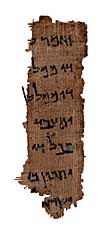
It has been little noticed that the website of the Schoyen Collection contains a hitherto unpublished scrap of 4Q196, a papyrus copy of the Aramaic version of the book of Tobit. (Edit 2019: A high resolution photo of the fragment has been taken down from the Schoyen Collection website.)

The Schoyen site stated that the fragment is part of Fragment 14 of 4Q196, but this can hardly be true. Fragment 14 contains parts of Tobit chapter 6, and the present fragment, as the site correctly notes, contains part of Tobit chapter 14. Evidently "Chapter 14" and "Fragment 14" were at some point confused when the site catalog was being composed. In fact, the Schoyen fragment belongs between Fragments 18 (Tobit 13:12-14:3) and 19 (Tobit 14:7) of 4Q196. It contains part of Tobit 14:4.

Here is a transcription of the text followed by a translation:

ואמר ל
די ממל
די ממלל
יתעבד
בכל די
יתבין ב
ישׂראל

1. ] and he said to [
2. ] that [Nahum] is speak[ing
3. ] that [the prophets] speak [
4. ] will take place [
5. ] in all that [
6. ] dwelling in [the] l[and
7. ] Israel [

There's not a whole lot new here. The Schoyen fragment overlaps with 4Q198 frg. 1, and has a slightly different reading at line 2: די ממלל, where 4Q198 has די מלל. The Greek translations of Tobit are closer to 4Q198, translating "that Nahum (or Jonah) spoke" instead of "is speaking." Line 3 also suggests the reading ממללין "(they) speak" instead of the text J. Fitzmyer (in DJD) reconstructed for 4Q198 מללו "(they) spoke."

The Schoyen site notes that the Tobit text is "rather different from the Septuagint and shorter." This is a little misleading. There are in fact two Greek versions of Tobit, one of them the "standard" Septuagint text, and another significantly longer version, preserved in Codex Sinaiticus and a few other witnesses. As a rule, the Aramaic and Hebrew versions of Tobit found at Qumran show more affinity (although not exclusively) with the Long Recension.

Tobit 14:3-4 in the Long Recension (NRSV): When he was about to die, he called his son Tobias and the seven sons of Tobias and gave this command: “My son, take your children and hurry off to Media, for I believe the word of God that Nahum spoke about Nineveh, that all these things will take place and overtake Assyria and Nineveh. Indeed, everything that was spoken by the prophets of Israel, whom God sent, will occur. None of all their words will fail, but all will come true at their appointed times. So it will be safer in Media than in Assyria and Babylon. For I know and believe that whatever God has said will be fulfilled and will come true; not a single word of the prophecies will fail. All of our kindred, inhabitants of the land of Israel, will be scattered and taken as captives from the good land; and the whole land of Israel will be desolate ...

In this particular fragment, once again the affinity is with the Long Recension, but the Qumran text here must have been somewhat shorter than the Semitic Vorlage of the Long Recension (VLR). We know that the lines of 4Q196 average about 50 characters/spaces per line, but a reconstruction of the VLR that includes all that is in the Greek will not yield the right line lengths. (A PDF of my reconstruction of the VLR for this verse is available by request via email; the old link has rotted.)

Maybe the most interesting thing about this text is its provenance. According to the site, the text was sold by Kando in 1972 to an "American priest, later serving in Switzerland," who had it until 1995, when it was presumably sold to Martin Schoyen. Kind of makes you wonder what else is out there, doesn't it?

POSTSCRIPT (Dec. 2019):  This fragment is now considered a modern forgery; see A. Justnes, "Fake Fragments, Flexible Provenances: Eight Aramaic 'Dead Sea Scrolls' from the 21st Century," pp. 242-271 in Vision, Narrative, and Wisdom in the Aramaic Texts from Qumran: Essays from the Copenhagen Symposium, 14–15 August, 2017 (eds. M. Bundvad & K. Siegismund; Leiden: Brill, 2020).

BIBLIOGRAPHY: Discoveries in the Judean Desert: Qumran Cave 4, XIV: Parabiblical Texts, Part 2 (1995) contains Joseph Fitzmyer's exemplary publication of Qumran Tobit (pp. 1-76).

Saturday, December 03, 2005

Paul the Punster Compared to Harold Bloom and Diogenes

In the New York Times recently, a reviewer of Harold Bloom's latest book remembers the Yale professor's hostility to Christianity:

I never thought I would hear a professor publicly proclaim - at Yale, no less - the great, private Jewish gripe that in layman's terms might be expressed: Christianity stole our watch and has spent 2,000 years telling us what time it is. Bloom punningly referred to the New Testament in Hebrew as "Brit haHalasha" ("weak covenant"), instead of "Brit haHadasha" ("new covenant").
Bloom's pun — not a terribly good one — falls into a long line of reciprocal Jewish-Christian insults, although Christians, as the majority religion, have no doubt committed far more.

One of the oldest comes from the Apostle Paul, in the letter to the Philippians (3:2), where he says, "Beware of the katatomé." This is a play on the word peritomé, "circumcision," which, in Paul, often refers not to Judaism as such, but to the Jewish-Christian party that insisted on circumcision as necessary to Christianity. Katatomé comes from katatemno, "to cut into pieces, gash, slice up." This pun is perhaps more hostile than Bloom's, but they are both working out of the same tradition.

I'm always interested in seeing how wordplay is translated. In this case, a good translation would make it plain that circumcise, circumcision is being punned upon. The results over the years have been mixed. The Peshitta translated as pesaq besra, "the cutting of the flesh," which may have the additional overtone of "castration." The Vulgate has videte concisionem, which makes it into the King James as "Beware the concision." Unfortunately no one knows any more what "concision" means.

The NEB loses the pun but keeps the meaning: "Beware those who insist on mutilation — 'circumcision' I will not call it." The NAS has "Beware of the false circumcision," which is weak, I think, while the NRSV has "Beware of those who mutilate the flesh," which loses the verbal connection with circumcision completely (the NIV is similar). The Jerusalem Bible has "watch out for the cutters." My own clumsy suggestion would be something like: "Beware of the 'circumslicers.' "

By the way, the BAGD lexicon (s.v. katatomé) cites as a parallel to Paul a saying of Diogenes preserved in Diogenes Laertius : "He called the scholé (school) of Euklides cholé (gall) and the diatribé (lectures) of Plato katatribé (waste of time)." In my opinion, the old Cynic, as a punster, had it all over the apostle and the professor.

Wednesday, November 30, 2005

Happy Blog-Day to Me

Today is "Ralph"'s blog-day. The first post appeared on November 30, 2004.

It's been an interesting year. As I noted in the CARG session in Philadelphia, I thought blogging might limit the sense of isolation I felt as an independent scholar working at home, and it did, to some extent. The conversations that take place online are "real" conversations, as real as any exchange of letters in the old days, only faster. But, besides that motivation, I didn't know exactly what I wanted to do with a blog when I started, and I still don't, not really. I periodically have the itch to write, but not necessarily the time or the patience to write something long, so writing a readable and interesting (at least to me) blog post a few times a week is both a good exercise for the writing muscles and a convenient way to scratch the writing itch.

I told myself when I began that I would be "true to Ralph," by which I meant that I would write only about what interested me, and on topics that I might have some kind of insight to contribute, not just to fill up space or attract readers. I determined early on not to blog about either politics or sports; the first bores me, and the second bores everyone else. Other than that, I've ranged far and wide and I have not tried to limit myself to a narrow set of topics (although I keep returning to the Bible and its languages). But despite my best intentions, looking back, I wonder why I bothered writing some posts, and can only plead that blogging sometimes became an end in itself. "Blogito ergo sum." My intent, if not always my practice, however, has remained firm, and I still will try to remain "true to Ralph." I hope all of you will keep coming by from time to time to see if I succeed.

Friday, November 25, 2005

Scattered Thoughts on AAR-SBL (Part II)

— I was tired and grumpy throughout most of the meeting this year, although I tried to hide it. It was the byproduct of a 10-hour commute from Cincinnati that turned into a 13-hour commute (we musta took a wrong turn at Albuquerque). The occasional floor sleeping didn't help. If I was unpleasant to anyone, forgive me. But seeing many friends, both old and new, made the trip worthwhile, even if I was not at my best.

— That may have affected my receptivity in the sessions; but I still came away with the feeling that most people don't know how to present papers, and I'm beginning to think that it's always going to be that way. There's got to be a better method of absorbing new scholarship than listening to someone read a paper in a rapid monotone in a crowded, overheated room. I suggest, at the very least, these steps:
(1) Graduate students must submit to the session chairs a version of what they plan to present; if it's too long, it should be either rejected or returned to the applicant for revision. I say "grad students" because they were the principal offenders (although I hasten to add that I heard more than one excellent paper by grad students). The SBL should also provide training, either live or online, for those who wish to present at the annual meeting.
(2) Each section or group should have its own website, where planning and organization can take place, including updates on the actual room location. Preliminary papers can also be posted there; or presenters can upload their handouts before the meeting.
(3) Insufficient use has been made up to now of recording or podcasting. It seems to me that there are plenty of low-tech options for recording and making presentations available after the meeting in MP3 or other formats. These could be made available on the section websites or through other means. This would help alleviate the problem of inattention (can one really listen to five papers in a row?), overcrowding (ever missed a paper because there was no room to sit down?), or scheduling (some of the sessions I was interested in took place at the same time as the CARG panel).

— I enjoyed the Biblioblogging session, mainly because it was fun to see the actual human beings in meatspace who are responsible for the blogs I read daily. But here's a little two-part eyewitness test for you. (1) When the panel session began, what was the order of seating, starting from Mark Goodacre? My memory is that it was this: Mark Goodacre, Rick Brennan, Stephen Carlson, Torrey Seland, Jim Davila, me (Ed Cook), Tim Bulkeley, AKMA, and Jim West. (2) When the question "How many here are bloggers?" was asked, what percentage (roughly) raised their hands? I feel that it was no more than 50%, but I believe Stephen Carlson has blogged that it was "almost everyone." Any other opinions?

— This meeting caught me in the middle of a career reinvention, as I begin to renounce the threefold academic vow (poverty, bibliography, and jargon) and transition from full-time independent scholar to full-time cubicle dweller with philology as a hobby. This will also affect "Ralph"; as the demands on my time increase, blogging will become harder to fit in. But I won't quit. Watch this space.

Wednesday, November 23, 2005

Scattered Thoughts on AAR-SBL (Part I)

Worst word to hear from a boring speaker who has already exceeded his time limit:: "Furthermore, ..."

Best phrase to hear from a boring speaker who has already exceeded his time limit:: "In conclusion, ..."

I learned a new word: "rhizomatic," used by AKMA in the Biblioblog session.

I learned how to pronounce: Hypotyposeis. It's pronounced like a disease.

Most heart-warming sight: The Pilgrim literally jumping up and down in excitement at her first glimpse of the book exhibits.

Blankest look: Joe Cathey, when I told him my hands were registered as lethal weapons.

Funniest glitch: When the audio feed from the Union Theological Seminary breakfast was piped into the Fuller Theological Seminary breakfast, and vice versa.

Unfunniest glitch: When the hotel refused to provide bedding for the third person in our 3-person room, we took turns sleeping on the floor.

Amount of money I spent on books: $49.00.

Thursday, November 17, 2005

C U in Philly

I'll be leaving for Philadelphia tomorrow for the AAR-SBL Annual Meeting — so blogging on "Ralph", already light, will stop altogether for about a week. I know others plan to blog from Philadelphia, and I might try that if I'm inspired, but I doubt it.

For those interested in the session on "biblioblogging," both of the main papers, by Jim Davila and Rick Brennan, have been posted. As for the panel discussion — well, you'll just have to be there.

Wednesday, November 09, 2005

The End of The Magus

In an odd coincidence, on Saturday, the day I finished reading The Magus, its author John Fowles died. The New York Times obituary can be found here. The Magus is the only book of Fowles's that I have read, and my hat is off to him for writing a book of great interest, great influence, and sustained moral seriousness — although his ultimate viewpoint on life is not one that I share. (Another odd feature is the rare link from a major news outlet to "Ralph" via Fowles's passing.)

I find it interesting that many people find the ending of the book frustratingly obscure or deliberately ambivalent. (Caution: Spoilers ahead.) The Times review says:
And in "The Magus," the story of a young Englishman who gets caught up in the frightening dramatic fantasies of a strangely powerful man on an Aegean island, he again wrote an ending of self-conscious ambiguity, leaving the hero's future an open puzzle that readers are challenged to solve for themselves.
Well, as much as one hates to disagree with the New York Times, I did not find the ending all that ambiguous. In terms of plot (though not of metaphysics or of morals) the biggest question is: Will Nicholas and Allison get back together? When they meet, at the end of the book, that is the issue before them. Although no explicit resolution is given, Fowles gives a rather broad hint, by ending with a famous quote from an ancient Latin poem, the Perevigilium Veneris:

cras amet qui numquam amavit
quique amavit cras amet

I would translate this, rather literally, as "tomorrow let him love who never yet loved / and may whoever has loved love again tomorrow." The Loeb edition has "To-morrow shall be love for the loveless, and for the lover tomorrow shall be love." Finally, Eugene Ehrlich in Amo Amas Amat and More, translates as follows:

May he love tomorrow who has never loved before;
And may he who has loved, love tomorrow as well.

In terms of the plot, this seems pretty clear to me. "The one who has never loved" is Nicholas, who is basically a selfish jerk, who, by the end of the novel, is learning what it means to love; while "the one who has loved" (quique amavit) is Allison, who (with all her many faults) has loved Nicholas better than he deserved. Surely the implication is that they both will finally find mutual love and together have a future (cras)?

Have people found the resolution ambiguous because they were unable to read Latin? In fact, in the foreword to the revised edition of The Magus, Fowles suggests as much, saying that the "general intent [of the ending] has never seemed to me as obscure as some readers have evidently found it — perhaps because they have not given due weight to the two lines from the Perevigilium Veneris that close the book ..."

In my opinion, then, the "deliberate ambiguity" is just not there (or is less than usually supposed), and this leads me to see Fowles as a somewhat more traditional storyteller (at least in this case) than others saw him, and perhaps than he saw himself. But it is clear, in any case, that the world has lost a thoughtful and thought-provoking artist.

Friday, November 04, 2005

For the Weekend

Dr. Chris Brady, blogger and targum scholar, is the subject of a Microsoft profile here. Way to go, Chris!

Which reminds me. CB is a fan of Sufjan Stevens, who is no doubt the only alternative rocker to mention "going to the Bible study" in his lyrics. A bunch of Sufjan's Christmas music is available here.

Wednesday, November 02, 2005

Tom Finley on Prof. Segert

My remembrance of Stanislav Segert has now appeared, slightly revised, on the SBL website. Tom Finley, also a former student of Segert, sent me this e-mail in response, which is published here with his permission:

I also was one of Dr. Segert's students. He was the second man on my doctoral committee, and I got the PhD in 1979 (writing on Western Akkadian). I appreciate very much the memorial statements you made about him. I also remember him as a gentleman scholar who had an encyclopedic mind for the northwest Semitic languages. He would give us his Ugaritic materials in pre-publication form and have us critique them for English style. One had to get used to his accent at first but after awhile it became easier to understand him most of the time. He enjoyed his students very much and was always ready to lavish attention on them. At times he had us over to his house. Each quarter I was at UCLA he had a Hebrew Bible course where each of us would contribute to whatever form of the text we could handle: the Syriac, the Targums, the Greek, the Latin. Dr. Segert could handle it all. If my memory serves me correctly, I think he mentioned that he had two doctorates, one in Semitics but the other in classics. He was quite comfortable with Greek and Latin. I remember him saying once that English was his third language, behind Czech and German. He also told us that the communists fired him from the university in Prague because he taught that Jesus was a real person, and that violated the communist dogma. I guess I have to say that studying under Dr. Segert was one of the great experiences of my life. Because of my own life circumstances my interests have steered away from Akkadian, my main area of study at UCLA, to Hebrew and Aramaic, the very interests that Dr. Segert was most versed in. Thank you for your very appropriate comments. He is indeed irreplaceable and will be sorely missed.

Shalom,
Tom Finley
Chair, Dept. of Old Testament & Semitics
Talbot School of Theology/Biola University

Friday, October 28, 2005

Lost as Godgame

The term godgame is defined by the Encyclopedia of Fantasy as "a tale in which an actual game (which may incorporate broader implications) is being played without the participants' informed consent, and which (in some sense) is being scored by its maker." A key figure in the godgame is the "owner of the game (a Magus, a magister ludi, a god." The author of the entry gives two examples: Shakespeare's Tempest and John Fowles's The Magus. I would add at least two more: the film The Truman Show and the current TV series Lost. (Another example of a godgame without fantastic elements is the film Trading Places, with Dan Ackroyd and Eddie Murphy.)

All four of these works take place on islands, which, by virtue of their isolation, are well suited for the staging of godgames. All of them have their own unique features; for instance, in The Truman Show, although there is one Prospero/Magus figure (played by Ed Harris), everyone on the island is complicit in the game except Truman (Jim Carrey). I am currently in the middle of reading The Magus, so I don't know how it's going to turn out, or who is complicit in the game (not the reader!).

In the first season of Lost, my working hypothesis was that the island was some kind of region of the afterlife — a province of purgatory — and that the castaways somehow had to overcome their faults to "escape." But at this point in the second season, I'm convinced that a godgame of some kind is in progress. Of course, we don't yet know what the game is or who the Prospero/Magus is. One fascinating possibility is that the Magus is, unbeknownst to us, one of the characters we are already familiar with. I don't think Locke (Terry O'Quinn; my favorite character) is the Magus, but I think he might somehow be complicit in the game as a helper of some kind. Anybody else have any thoughts?

BIBLIOGRAPHY: John Clute, "Godgame," Encyclopedia of Fantasy (ed. J. Clute and J. Grant; St. Martin's, 1997), 414-415.


UPDATE (10/31): Some interesting comments below. From Jim Davila's comment, I learned that the word "godgame" is also used for virtual-reality scenarios, whether philosophical (such as the brains-in-vats meme) or fictional (like The Matrix). I must admit that using it this way seems like an extension away from the original concept, but usage is usage. Therefore I would propose two different kinds of godgame: the kind I described above, in which people know they are caught up in some kind of manipulation, but don't know who is doing it or why; and the second kind, in which perception or reality itself is a construct, a fact unknown to all or most of the participants. Let us call the first kind the Labyrinth, or Narratives of Misdirection; the prototype in Western literature is The Book of Job. And the second kind can be called the Matrix, or Narratives of Misperception; its prototype is Plato's "allegory of the cave." As Jim notes, the Matrix type provides interesting parallels to Gnosticism, while the Labyrinth type is more typical, religiously, of mainstream Judaism or Christianity ("God has a wonderful plan for your life" that you are unaware of). (I intend no irreverence.)

Joe surmises below that the island in Lost is itself the Magus. I must admit that I don't understand this suggestion. In what way can the island be thought of as sentient, and what could its motivations be? Locke speaks of the island that way, but I presume that he's speaking out of his own arguably confused preconceptions.

Interestingly, there is at least one theory out there that the castaways are in fact victims of a Matrix type godgame. (Look through the "theories" threads here.) My idea is, however, that a Labyrinth style godgame is going on, and that the island is a real island, not a digital construct. I haven't yet worked out how to integrate my theory with the persistent hints in the script that most of the castaways have some kind of psi Talents: telepathy, precognition, etc. But that's what makes it fun.

Monday, October 24, 2005

Embetter: Perfectly Cromulent

Michael Gilleland objects to GW's use of the word "embetter" in his speech on Oct. 18th:
We're going after criminal organizations and coyotes that traffic in human beings. These people are the worst of the worst. They prey on innocent life. They take advantage of people who want to embetter their own lives....
Personally, I think it's a perfectly cromulent word, created on the [EN + adjective] formation, such as "embiggen": "A noble spirit embiggens the smallest man." (The EN is realized, at a surface level, as EM because of partial assimilation to the word-initial bilabial in "big" and "better.")

Thursday, October 20, 2005

Leaves from the Neighborhood


The top one is from another street; the bottom one is from our front yard. Autumn has arrived.

Monday, October 17, 2005

Buy This Book Now


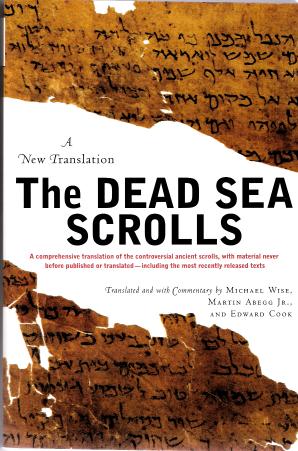
The new edition of Wise-Abegg-Cook just arrived; I think it looks pretty nice.

We revised each and every one of the texts in the first edition to reflect the latest readings and scholarly publications, as well as adding new texts (including complete translations of the Qumran witnesses to Enoch, Jubilees and the Targum to Job). It also has running heads and a new index.

For those who loathed our titles for the scrolls — sorry. They're still there, as are the blurbs from Karen Armstrong and Dom Crossan. The paperback costs $24.95, so there's no reason for you not to order one (or two — why not one for each member of your family?) immediately.

The scroll on the cover, by the way, is 4Q109 (4Q Qohelet).

UPDATE: I've been encouraged to add links to online stores. You got it: Order the book here or here. Buy this one as well while you're at it. :)

Thursday, October 13, 2005

Yom Kippur

Last night, at sunset, was the beginning of Yom Kippur, the Day of Atonement. I wish all the Jewish friends of Ralph an easy fast.

It is interesting to note that the expression yom kippur as such is not found in the oldest Jewish literature. In the Bible, Mishnah, Dead Sea Scrolls, Talmudim and Midrashim, the phrase denoting the Day of Atonement is yom ha-kippurim, or, in Aramaic, yoma de-kippurei. The earliest use I can find of the later, short expression is in the Tosafists (glossators) to the Babylonian Talmud, which would place its origin in the early medieval period.

Kippurim is a tantum plurale ("only plural") in Biblical Hebrew, a word occurring only in the plural. Pluralia tantum are often used in Hebrew to denote abstract notions, like "atonement," alumim, "youth," tanhumim, "consolation." etc. They are less frequent in later forms of the language, which might account for the eventual changeover to the singular in yom kippur.

Tuesday, October 11, 2005

Surviving the Annual Meeting

As noted in previous posts, the annual meeting of the AAR-SBL is coming up soon (Nov. 19-22) in Philadelphia. As always, I am beginning to give some thought about how to survive the meeting.

Usually, when I arrive, I am in a gung-ho mood to attend as many papers, have as many discussions, and buy as many books as possible. After about a day or so — by about Sunday afternoon — when I've endured any number of dull recitations and gone around the book exhibit about a dozen times — I start feeling like this: I've gotta get out of here. Please, no more cerebral discussions. No more eggheads. No more tweed coats, natty beards, or ostentatiously brandished credentials. I feel like Dolly Parton, because everyone you meet at the annual meeting looks at your chest (where your name badge is) before they look at your face. That's when I hunger for "real" people wearing jeans and T-shirts and for talk that concerns football, what the kids are up to, trading one-liners from Family Guy or theories about Lost.

Through trial and error, I've discovered that the best way to head off "meeting burnout" — the desire to run back to the real world (I know — a concept that bristles with problems) — is to take a short vacation from the annual meeting in the midst of it. Lately I've taken off one night to go and listen to live music at a local club. If that's not available, I take an entire afternoon (or morning) off, dress in mufti, and walk around the local downtown, window shopping, drinking coffee (or a few Cold Ones), or sitting on a park bench. Most of the time, when I get back to the Land of Brainiacs, I'm tanned, rested, and ready to be smart again.

Is this a common experience, or is it just me? How do you survive the annual meeting?

Friday, October 07, 2005

Hair of the Ugaritic Dog

I've been reading some Ugaritic lately, in connection with various duties, and I finally got around to working through the text KTU 1.114, the famous one where El, the head of the pantheon, gets drunk at a banquet (marzeah) and has to be helped home while slipping in his own waste; lovely.

The real point of this text is found in the last few lines, which contains, by common interpretation, a recipe for hangover: "On his brow one should put hairs of a dog, the top of a pqq-plant and its stem. Mix it with the juice of virgin oil" (trans. T. J. Lewis).

I laughed when I read that. Hair of the dog, indeed! Could it be that the old expression for a morning-after shot of spirits, "hair of the dog," has its origin in the Ancient Near East? If so, I'm not the first one to discover it. Dennis Pardee writes:

This atypical myth [KTU 1.114] is followed by a prose recipe for alcoholic collapse that features the first known connection between drunkenness and the "hair of the dog": "What is to be put on his forehead: hairs of a dog. And the head of the PQQ (a type of plant) and its shoot he is to drink mixed together with fresh olive oil."

The same thing is suggested in the Dictionary of the Ancient Near East, s.v. "Drunkenness":
The "morning-after" symptoms were treated with various substances, including "the hair of the dog," as described in an Ugaritic text where the god El suffers from the effects of excessive consumption.
But it won't do. "Hair of the dog" as a hangover remedy is derived from the longer expression "hair of the dog that bit you." The origin lies in an Anglo-American folkloric remedy, not for hangover, but for rabies: if bitten by a dog, one was to take some of the dog's hair and either eat it or otherwise apply it to the wound:
[Remedies for rabies] have included eating grass from a churchyard, consuming some of the "hair of the dog that bit you" fried in oil with a little rosemary, and even eating parts of the dog itself (typically the heart or the liver). (Cassell's Dictionary of Superstitions)
The concept of homeopathic cure, along with the expression itself, was transferred to the hangover remedy — which is not literal dog hair, but a glass of something alcoholic (in my experience, a Bloody Mary is usually recommended).

So the idea that KTU 1.114 is the earliest use of "hair of the dog" for hangover can't be correct. In fact, the idea that the Ugaritic recipe is intended for hangover is itself an inference; it is nowhere stated in the text.

Here's another possibility. In an earlier section of the text, while El is being carried home, a mysterious figure named Habayu appears: "Habayu then berates (?) (נגשׁ) him, he of two horns and a tail." What exactly is Habayu doing to El? The word translated "berates" has also been taken to mean "press, drive," but none of these makes much sense. I am wondering if נגשׁ simply means here "gore," as it does in Palestinian Aramaic. The translation then would be: "Habayu gores him, the one with two horns and a tail." And that would explain why in the next lines El "collapses like one dead, like those who descend to the underworld," and it would explain why Habayu's horns are mentioned: Habayu is some kind of ox or ram.

So maybe this recipe is not for hangover at all, but for the much more serious condition of having been gored or butted by a horned animal. But I would not recommend it in either case.

BIBLIOGRAPHY: Text and translation of KTU 1.114: "El's divine feast," trans. T. J. Lewis, Ugaritic Narrative Poetry (Scholars Press, 1997), pp. 193ff.

Tuesday, October 04, 2005

Metafembiblioblogging, and a Dream

In my post "What Should We Talk About?" I asked, in passing, "Why are there so few female bibliobloggers?" and this casual question actually ignited more responses than the rest of the post. Mark Goodacre suggests that the answer lies in a lethal "combination between the male-dominated academy and the nerdy, geeky male electronic world." Loren Rosson suggests that one component is that blogging feeds the male ego. A commenter on Loren's site suggests that in fact it is because "blogging itself is ambivalently recieved [sic] by the academic community ... Putatively, if women must work harder to get jobs and tenure in the academcy [sic], why would a (hypothetical) academic female 'waste' time writing a blog instead of a peer-reviewed article when the latter will likely advance her career more readily?" An anonymous female commenter on Mark's site asks, "I am confused about why you think the world needs more female bibliobloggers though. What is the significance of the female aspect? Is it just to make the stats look better? So there is someone there to cover feminism?" Several commenters (male and female) have suggested that females are too busy doing other useful things to waste time blogging, which begs a lot of questions.

My answer? Beats me. The answer probably lies in a combination of factors that "over-determine" the relative dearth of female bibliobloggers. I think this could be an interesting topic to explore at SBL though, and as we've already seen, the topic leads into many other useful topics such as "why blog?" and the role of blogging in academia in general. Hopefully opinions will be forthcoming from the audience as well as from the dead-white-male panel. Oh, wait, we're not dead. OK, just white male.

Speaking of female bloggers, I recommend to you this post from the Pilgrim. It may or may not be relevant to this topic but her experience is worth pondering.

And speaking of bloggers in general and Mark Goodacre in particular, Mark had the temerity to make an appearance last night in a long and complicated dream of mine. At one point I was suddenly sharing the back of a taxicab with Mark (whom I've never met) as we drove down Oxford's High Street (where I've never been).

I asked Mark, "So why did you take the job at Duke instead of taking a job at Oxford?"

He took a long drag on his cigarette and regarded me coolly from behind his dark glasses. "Because," he said, "only the chef is allowed to enter the kitchen."

Which makes a whole lot of sense, when you think about it.

Saturday, October 01, 2005

Stanislav Segert (1921-2005)

Yesterday Bill Schniedewind of UCLA emailed with the sad news that UCLA's Prof. Stanislav Segert, the great scholar of the North-West Semitic languages, and my own venerated teacher and Doktorvater, died yesterday after a short hospitalization. He was 84.

Segert was the last great grammarian of the Semitic languages in the polymathic European tradition of Dillmann, Brockelmann, and Noeldeke. He is perhaps best known in the US for his textbook Basic Grammar of the Ugaritic Language (1984), but in my opinion his finest work is his Altaramäische Grammatik (1975). He also wrote a fundamental Grammar of Phoenician and Punic (1976). Besides these works he wrote still unpublished grammars of Syriac and Biblical Aramaic for classroom use.

His hundreds of articles include many on the Qumran texts, and dozens more on aspects of Ugaritic studies. His study of the language of the Moabite stone ("Die Sprache der moabitischen Königinschrift," Archiv Orientalni, 1961) is still the best survey of that dialect.

Not only was Segert a great scholar, he was a great gentleman. His erudition was exceeded only by his courtesy, and any suggestion of scholarly hostility or odium theologicum caused him great pain. When someone in class once mentioned to him the falling out that had taken place between two European archaeologists, his only comment was, "Ah! Let us hope that no very great time will pass until they will once again be friends." His epitaph might well be: He died without enemies.

After Samuel Johnson died in 1784, William Hamilton wrote, "He has made a chasm which not only nothing can fill up, but which nothing has a tendency to fill up. Johnson is dead. Let us go to the next best. There is nobody; no man can be said to put you in mind of Johnson."

The same is true of Segert. He is gone, and he is irreplaceable. His books and articles remain for those to learn from who will; I will continue to study them, but even more than these, I will treasure the memory of his kindness and gentleness. As both a scholar and a man, he was a giant.


BIBLIOGRAPHY: Further biographical details and a full bibliography through 1989 can be found in the Festschrift Sopher Mahir: Northwest Semitic Studies Presented to Stanislav Segert (Eisenbrauns, 1990).

UPDATE (10/3): Jim Davila has added a personal tribute to Prof. Segert.

Thursday, September 29, 2005

What Should We Talk About?

There's a biblioblogging session coming up in Philadelphia at the AAR-SBL meeting, as a session of the Computer Assisted Research Group. Two papers will be given, by Jim Davila and Rick Brennan. Then follows 80 minutes of panel discussion by 5 (or is it 6?) panel members, of which I am one.

What should we talk about?

We'll introduce ourselves, I imagine, and say a few words about our blogs. We will no doubt say some things about what Rick and Jim have said. What else should we talk about? Open (source) studies? Blogging and the nature of public scholarly discourse? Peer review? Blogging and conformity? How to kill time while waiting for Blogger to upload your post? What's better, news or opinion or baby pictures? Why are there so few female bibliobloggers? What's the point of it all? Who's your favorite team?

One thing I hope we don't talk about is the term "biblioblogger." There the term is, and we're stuck with it. And I hope we don't discuss "what is a biblioblogger," or the forgery scandal, or minimalism, or the historical Jesus, or what our desks look like, or which character from the Simpsons we are, or such worthy-but-irrelevant topics.

If each of us talks for 5-10 minutes about ourselves, that'll kill a lot of time. That could be good or bad.

I don't know. Got any ideas? Suggestions welcome.

Tuesday, September 27, 2005

Fat Yanks

It's interesting to read in tandem the blogs of Mark Goodacre and Michael Pahl. Mark has moved from Birmingham, UK to Durham, NC, while Michael has moved from (somewhere in) Canada to Birmingham, UK. These passages particularly struck me. First from Michael:

Food portions are smaller, which partly explains why people are smaller. There's no 'Super-Size Me' here--a trip to Burger King at the Bullring gave us regular-size drinks that were equivalent to smalls in North America, and just enough fries instead of far too many. The American obesity epidemic is one cultural export which is 'largely' absent here (couldn't resist that!).
And from Mark:
After our first weekend living in America, I feel a little like Morgan Spurlock in Supersize Me, though I'm happy to say that our diet has been more interesting and varied than his in that film; I just find that I eat so much more here, and less of the right things, and need to find ways of curbing this.
Here's my question: Is this true just of fast-food restaurants in Europe, or in general? Or is it a UK thing? I spent a week in Holland and Belgium last year, and I don't recall ever noticing that the portions served were smaller. In fact, at the Vismarkt in Groningen, I got a serving of (excellent) fish n'chips so large that I couldn't finish it. But, while abroad, I never ate at any American-style fast food restaurants. (Interestingly, I noticed a lot more Burger Kings in Holland than "Maison McD.")

Here's a shot of moi in Groningen last year:

Friday, September 23, 2005

Weekend Reading

Hi, everybody. No, I'm fine, I've just got writer's blogk. In lieu of my own brilliance, here's a funny piece from the New Yorker. An excerpt:

“Today,” the Lord God said, “let’s do land.” And lo, there was land.

“Well, it’s really not just land,” noted Vishnu. “You’ve got mountains and valleys and—is that lava?”

“It’s not a single statement,” said the Lord God. “I want it to say, ‘Yes, this is land, but it’s not afraid to ooze.’ ”

“It’s really a backdrop, a sort of blank canvas,” put in Apollo. “It’s, like, minimalism, only with scale.”

“But—brown?” Buddha asked.

“Brown with infinite variations,” said the Lord God. “Taupe, ochre, burnt umber—they’re called earth tones.”

“I wasn’t criticizing,” said Buddha. “I was just noticing.”

Read it all.

Sunday, September 18, 2005

NTCS Again Available

As Christian Brady noted in an earlier comment, the website for the Newsletter for Targum and Cognate Studies is now available once again, thanks to his efforts.

For those who are interested, my Psalms Targum translation is also once again available. Many thanks to Chris for hosting these pages on his personal site.

Thursday, September 15, 2005

The Redolent Metaphor

Mark Liberman at Language Log discusses the expression "to stink in the nostrils" as a metaphor for hatred, revulsion, or disapproval. After two cups of coffee, he had still not tracked down an "authoritative model" for it.

Did this expression emerge into common use during the 17th century, and stay in the phrasal vocabulary of the English language to this day, without any authoritative model at all?

I was able to find at least one source before the 17th century: One of the Marprelate tracts (1589) ("for feare of smelling in the nostrels of her Maiestie & the State") and possibly a century earlier in the Book of the Knight of La Tour-Landry : compiled for the instruction of his daughters : translated from the original French into English in the reign of Henry VI, 1484:

  • the synne of lechery stinkithe afore God and his aungeles
  • the unlefull synne of lecherye, the whiche stinkithe and crompithe vnto heuene

—although there are no "nostrils" in that text.

But neither one of these texts is authoritative in the way that Liberman would like. I could have sworn that this expression was Biblical, but as Liberman shows, there is no exact model in the early English translations (although Hebrew be'ash, hib'ish "to stink, cause to stink" = to incur dislike, is well known).

Unless the metaphor is a natural evolution from Biblical models, I'm also stumped for an "authoritative model," unless the French original of the Book of the Knight points to a continental source. Is there any classical or medieval scholar out there who can trace this back into French or Latin literature?

Tuesday, September 13, 2005

In David's Palace

Back by popular demand: another excerpt from "David and Abishag." This one goes out to Dr. Joe Cathey, with best wishes for his continued good health.

The scene: Gur the harpist has an appointment in Jerusalem, in the palace of David.


No day dawned in Jerusalem without the the renewal of the sounds of hammers, saws, cranes, wheels, pulleys, and shouting workmen. Jerusalem, the ancestral citadel of the Yebusi kings, was being made over into the capital of the House of David.

Dominating the hill south of the old Yebusi tower was the royal palace, built in the Tyrian style with massive blocks of limestone, hugely piled, course upon course, with a few great square entrances. The severe, gigantesque impression of the exterior was softened, in some of the living quarters, by occasional facings and moldings carved out of cedar. Nevertheless the edifice as a whole still looked — and was, in parts — raw and unfinished.

Gur sighed as he entered the west entrance of the palace compound. The new palace (still "new" after 25 years) was undeniably imposing, but David and his minions had absolutely no sense of style. Those inner walls, now — could not some plaster be laid over the naked stone and some pictures and designs painted on them? Cedar was all very well, but even the few rooms that were completely paneled in wood seemed austere and dark. But that was the Phoenicians for you — swift, elegant little ships on the sea, but great clumsy buildings on land.

And David was not so very different from his Tyrian allies. Not that he, or any Israelite, would be caught dead in a ship: no, indeed. But David was no more a city dweller than they were — he was a soldier, and a farmer, and would rather live in a campaign tent, or at least a country villa, than in a house made of ashlars and cedar wood. His palace, and the other royal buildings going up in Jerusalem, owed more to David's image of what belonged to royalty than to his personal inclinations.

Even so, there was still something of the farmhouse about the palace of David — donkeys, sheep, and camels were often quartered in the lower rooms next to their keepers instead of in a stable; and sometimes horses were found tied to pillars in the entrance portico. Roosters were likely to walk out from behind a chair at any time, even in the throne room. The scent of manure mingled with the odor of cooking food and unwashed bodies.

However, a palace was a palace, and had advantages, thought Gur, as he sat in an anteroom and let a slave wash his feet. In Egypt the slave would have a bowl to dip his feet in, some sweet-smelling stuff to rub on them, and a cloth to dry them off. Here the slave just poured water from a jar over his feet and let the water run over the flagstones, then he handed Gur a fistful of hay to clean and dry them off himself. And instead of giving him house sandals, the slave clapped his road shoes together, making the dust fly, and then handed them back. Still, Gur thought, I'll take these cool stone walls and country servants over Yawab's camp tent with no walls at all any day.

He was then ushered into a dining room at the upper levels, one with a balcony facing west to catch the breeze, if there was one. The appointments were no more lavish than elsewhere, but here all was neat and clean, and the table was laid with wine, snow-cooled water, figs, dates, and pomegranates, while fresh fish roasted on a grill nearby. A harp and stool were set out ready for him.

Saturday, September 10, 2005

Texas vs. Ohio State

Tonight is the Texas-Ohio State football game. I graduated from Texas, as did my father before me. My daughter is a senior at Ohio State.

Does this cause family tension? Absolutely not. We are not the kind of family to let petty sports events cause interpersonal problems. Also, Elizabeth just doesn't really care who wins.

But do I care who wins? My attitude can best be summed up by recalling that a Baptist church in Fayettevile, Arkansas, years ago, put up a message on its marquee prior to the annual Texas-Arkansas bloodletting: FOOTBALL IS ONLY A GAME. ONLY SPIRITUAL THINGS ARE ETERNAL. NEVERTHELESS, BEAT TEXAS.

Change that last sentiment to BEAT OHIO STATE and you've captured my viewpoint exactly. I am of the opinion that sporting events are entirely too important in today's society, and football in particular is too often violent and crass, encouraging inappropriate displays of partisan bitterness.

Nevertheless, Hook 'em, Horns! Whoo-hoo! Crush the Buckeyes!!

Thursday, September 08, 2005

Looting and Proverbs 6:30

Here and there on the web, one may occasionally find a discussion of looting in New Orleans together with a citation of Proverbs 6:30: "Men do not despise a thief, if he steal to satisfy himself when he is hungry." The proverb nicely captures a widespread moral intuition (which I fully share) that "looting" by the hungry or thirsty is not morally culpable, or is less culpable than looting out of sheer greed.

There is, however, a minority report on this verse (in various commentaries) that takes it as a question: "Do not men despise a thief, even if he steals to satisfy himself when he is hungry?" I think this is an unlikely reading of the Hebrew, and no widely used English translations that I've seen have followed this understanding. Still, the fact that it has been made means that the majority report contains at least a modicum of interpretation. (Note also the LXX version: "It is not surprising if a thief is caught, when he steals," etc. The translator apparently departed altogether from the text in the beginning of the verse.)

Three other points about the verse: (1) It appears to be descriptive, not prescriptive. The writer is describing what in fact people do, not necessarily how they should behave. Otherwise he would have written al tavuzu, "do not despise," instead of lo yavuzu, "they do not despise." (2) The real point of the paragraph in which the verse is embedded (Prov. 6:20-35) is: Don't commit adultery. Thievery is mentioned, by way of contrast, as an offense that can be forgiven in some circumstances, and compensation can be made (v. 31), but adultery is never forgotten or forgiven. (3) This larger context makes an implicit appeal to the habits of a "village culture" where everyone pretty much knows everyone else's business, even their most intimate misdeeds. The weight of the exhortation lies not on culpability as such, but on avoiding shame, dishonor, and reproach.

I guess my point is this: It's hard to simply lift verses out of the Bible and use them as ethical prooftexts or simple moral guidance for a situation. They don't come away cleanly, ready for re-use elsewhere; even the plainest of them are stuck to their literary and cultural contexts in persistent and unexpected ways. This is true even of this verse of Proverbs, which in isolation seems to say pretty much what we agree with in any case. I'm not saying the Bible is not a source of moral understanding, just that the raw text needs to be cooked up with some historical and critical understanding before it is ready to be used.

For a rational-theological approach to the question, Thomas Aquinas deals with "Whether it is lawful to steal through stress of need?" here.

Tuesday, September 06, 2005

Some Book Reviews

I've discovered a number of book reviews I've written for Catholic Biblical Quarterly available at FindArticles.com.

For those who are interested, here are some of them:

Diggers at the Well: Proceedings of a Third International Symposium on the Hebrew of the Dead Sea Scrolls and Ben Sira. Edited by T. Muraoka and J.F. Elwolde.

The Bible at Qumran: Text, Shape, and Interpretation. Edited by Peter W. Flint.

The Dead Sea Scrolls at Fifty: Proceedings of the 1997 Society of Biblical Literature Qumran Section Meetings.Kugler, Robert A. and Eileen M. Schuller, eds.

The Scrolls and the Scriptures: Qumran Fifty Years After. Edited by Craig A. Evans and Stanley E. Porter.

Die Qumran-Essener. Die Texte vom Toten Meer. Band 1, Die Texte der Hohlen 1-3 und 5-11. Band 2, Die Texte der Hohle 4, by Johann Maier (Uni-Taschenbicher 1862-63; Munich/Basel: Ernst Reinhardt, 1995).

The Scepter and the Star: The Messiahs of the Dead Sea Scrolls and Other Ancient Literature, John J Collins.


In the near future, I'll add the links to the area at the right.

Friday, September 02, 2005

High Water Blues: Remembering 1927

This blog makes the apt comparison between the Katrina disaster and the Mississippi Flood of 1927.

The flood (caused by river flooding, not hurricane-related effects) made a strong impression on African Americans, especially in music. Most notably, Charlie Patton wrote "High Water Everywhere":

Look-a here the water now, Lordy,
Levee broke, rose most everywhere
The water at Greenville and Leland,
Lord, it done rose everywhere
Boy, you can't never stay here
I would go down to Rosedale,
but, they tell me there's water there


And Memphis Minnie wrote "When the Levee Breaks," memorably re-recorded by Led Zeppelin in the '70's:

Cryin' won't help you, prayin' won't do you no good,
Now, cryin' won't help you, prayin' won't do you no good,
When the levee breaks, mama, you got to move.


Blind Lemon Jefferson wrote "Rising High Water Blues":

People, since it's raining, it has been for nights and days
People, since it's raining, has been for nights and days
Thousands people stands on the hill, looking down were they used to stay

Children stand there screaming: mama, we ain't got no home
Oh, mama we ain't got no home
Papa says to the children, "Backwater left us all alone"

Backwater rising, come in my windows and door
The backwater rising, come in my windows and door
I leave with a prayer in my heart, backwater won't rise no more


And Barbecue Bob Hicks wrote "Mississippi Heavy Water Blues":

Lord, Lord, Lord, I’m so blue, my house was washed away
and I’m cryin’ how long ‘fore another pay day?
That’s why I’m cryin’ Mississippi heavy water blues.


Most recently, Randy Newman wrote and recorded "Louisiana 1927":

The river rose all day
The river rose all night
Some people got lost in the flood
Some people got away alright
The river have busted through clear down to Plaquemines
Six feet of water in the streets of Evangeline


You can donate for disaster relief at the Red Cross site.

Thursday, September 01, 2005

After Katrina

The disaster on the Gulf Coast continues to defy almost all comment. To our prayers and to our checkbooks; there doesn't seem to be much else to do.

I've heard (through channels) from my Cook relatives in Hattiesburg, MS; all are well and holding on, despite the lack of water, power, or phone.

No doubt many of my readers have friends or relatives in New Orleans and vicinity. Information about Tulane University can be found here; the latest post says that there are no known casualties among staff, faculty, or students. Further information can be found at the SBL website. Our special thoughts and prayers go out to Chris Brady, blogger and Tulane faculty member, and longtime friend of "Ralph." Chris and his family are safe.

The least important casualty of Katrina is my "Psalms Targum in English" (link at right), which is hosted on the Tulane server. No doubt it will re-appear in due course, but it's of little consequence.

"Behold, God is great, and we know him not" (Job 36:26).

UPDATE (9/2): Chris has left a comment below; good to hear from you, CB.

Evan's narrative of evacuation here is must reading.

Tuesday, August 30, 2005

Open Studies, Peer Review, and Kuhnian Paradigms

I see that my initial question about "open studies" has spawned a number of discussions, most notably concerning the role of peer review in open scholarship. I want to say a few words about peer review and its role in our field, especially since Jim West has denounced peer review and its defenders in a vitriolic post, which has prompted a blunt (and in my view wholly justified) response from Jim Davila.

A few years ago Richard Schedinger published "Kuhnian Paradigms and Biblical Scholarship: Is Biblical Studies a Science?" in JBL. In it he argued that Biblical studies was not a science, and therefore loose appeals for "paradigm shifts" in the Kuhnian sense were out of court. He averred that Kuhn's description of paradigms applied only to the natural sciences such as physics and biology; since Biblical studies, as one of the humanities, was not ruled by research-determining paradigms, it had, essentially, no "big" paradigms to shift, only groups of more or less equal competing paradigms. He concluded:

Biblical studies, as a discipline situated squarely within the humanities, must embrace diversity, a multiplicity of paradigms, and the living conversation between scholars that this diversity makes possible.

I think the most charitable interpretation of Jim West's post is that he sees Biblical studies as Schedinger does, only more so. But Jim (West) also implies that there are no standards by which to judge a good or bad idea (other than the "test of time," whatever that is — error is just as persistent as truth), and that any attempt to do so (via peer review) is a "popularity contest" or an illegitimate exercise of power by those who "control" the discipline. (The bitterness of West's post makes me wonder if there is some kind of unpleasant personal experience behind it.)

But I think that Schedinger (and by extension, West) are wrong; or, at least, not completely right. It is true that Biblical studies is not a science judged by the model of the physical sciences, or by the model of Kuhnian research-determining paradigms. Nevertheless, it is a science, like at least some of the other humanities, in that it is, or should be, based on disciplined, rational, and systematic enquiry and established and accepted canons of research. Actually the German word for "science," Wissenschaft, encompasses this meaning, and Biblical studies really is scientific (wissenschaftlich) in this sense.

And in fact Biblical studies (which I will not abbreviate by its initials) also has its "big" paradigms. Schedinger cites the case of biology vs. creationism to illustrate the difference between paradigmatic biology and non-biology. He says, "If one is a creationist, one cannot, by definition, be a biologist. There is no inter-paradigm debate within the bounds of the biological community." (Some may not like this illustration; but let it go, OK? It's Schedinger's, not mine.) But then he implies that the humanities don't have these kinds of boundary line cases. They do, however. In modern history, Holocaust revisionists are not considered real historians at all. In ancient history, a Velikovskian catastrophist or someone who believes in a literal Atlantis is also not considered a historian at all, but a crackpot. In the English department, anyone who argued that someone besides Shakespeare wrote Shakespeare's plays would not be considered a real scholar.

In the same way, Biblical archaeology or Biblical studies has cases of "junk scholarship." I submit that the case of the Temple is one. As I argued in an earlier post, those who argue that there simply was no First Temple are perpetrating "junk history." And that is what peer review and other scholarly gate-keeping conventions are for: to keep out the junk and the nonsense. When I open JBL, I may read many things I disagree with, even some things that I think are jargon-ridden, shallow, trendy, and ill-written. But I know I'm not going to read anything that suggests that the Ezekiel held converse with space aliens, or that Adam and Eve spoke Latin, or that Jesus was married to Mary Magdalen and later went to Tibet. (For that I have the Internet.)

I believe that Jim Davila, in his original post discussing this issue, was saying the same thing: that First-Temple-deniers are not perpetrating scholarship at all. It is not that they have failed to produce evidence powerful enough to overturn a scholarly consensus, but they have failed to be scientific (wissenschaftlich) at all in providing sustained, disciplined, and rational engagement with the field as a whole or the historical understandings that make the field possible.

The question of how this all relates to open scholarship (or whatever it's called) is difficult. If "open" means "anybody can play," then it's not going to be worth much. Therefore I submit that a worthwhile collaborative "open studies" initiative has to come up with some way of maintaining a level of scientific scholarship. And that's going to mean some kind of gatekeeping or peer review.

BIBLIOGRAPHY: Robert Shedinger, "Kuhnian Paradigms and Biblical Scholarship: Is Biblical Studies a Science?" Journal of Biblical Literature 119 (2000) 453-471.

Sunday, August 28, 2005

Open Source Studies: a question

I know that there is a plan to gather bibliobloggers in Philadelphia for a lunch meeting to discuss "open source" biblical studies. (Most recently from Tim Bulkeley.)

Before I commit to this lunch, I have one question: What is open-source biblical studies?

This is not a rhetorical question.

UPDATE (8/29): Tim Bulkeley provides more light here — and many thanks to those who provided comments. This whole movement (or initiative, or whatever) is something I favor; but whether I have time in the near future to participate in any particular project is very doubtful.

Wednesday, August 24, 2005

Three Cheers for Zimpher

The big news here is the resign-or-be-fired ultimatum given to Bob Huggins, University of Cincinnati basketball coach, by Nancy Zimpher, UC president. Paul Daugherty, the excellent sports columnist of the Cincinnati Enquirer, says this:

At most schools where coaches loom godlike and untouchable, presidents leave well enough alone. They enjoy the national acclaim. They tolerate the Faustian deal they cut to achieve it. They know that challenging a big-time coach is more trouble than it's worth.

Zimpher didn't look at it like that. She challenged a Cincinnati icon and won. Her victory will be judged by how she handles the reconstruction.
...
In Zimpher's world, academic and athletic success are twin sons of the same mother. The Aug. 8 letter, again: "UC believes it can better advance its mission by building a winning program around scholar-athletes who earn degrees that will allow them to succeed not only in athletics but more importantly in life generally."

Large goal, that.

Also one that a university president has every right to set. If Zimpher were president of UC men's hoops, then hang her from the highest backboard for this. She ain't. You can say she has thrown the basketball program into darkness. You can say she has thrown Huggins' loyalty to the curb. What you cannot say is that, as president, Zimpher isn't obliged to do what she feels is in the best interests of the entire place.

People in Zimpher's camp say that, behind the scenes, Huggins has urged big donors to close their wallets. They argue that a spiteful Huggins prolonged the fight knowing he would take the buyout eventually, that he waited as long as he did to hurt the basketball program.

Believe what you want. Regardless, if UC were to retain its self-respect, Zimpher had to win.
Three cheers for Nancy Zimpher.

Bob Huggins took UC basketball back to the big time, but at a cost. The graduation rate of the players is abysmal, and inversely proportional to the length of their rap sheet. Not only that, but he never could quite ... get .. to the Final Four. (Did he, once, years ago? Memory fails.) Plus, he's one of those screaming, shouting, abusive coaches, with a record of DUI's. Good riddance.

The lumpen Cincinnati sports fans will crucify her, though. The vitriol on the sports talk shows has to be heard to be believed.

Tuesday, August 23, 2005

Poor David

This is an excerpt from a novel that I gave up writing years ago. It is set in the time of King David. There has just been a sheep-shearing followed by a feast at which my shy young heroine, Abishag of Shunem, was listening to the harpist from Judah sing some famous songs. She is a shepherdess, and Shumi is the head shepherd of the flock; he was elsewhere during the feast.

The next day Abishag went in search of Shumi and found him trimming goats' horns in one of the folds. Leaning over the fence was the old harpist.

"Ya, Abishag," said Shumi. "This man is Gur, the harpist."

"I bless you by Yahweh," said Abishag politely.

Gur nodded and eyed Abishag appreciatively. They all stood silent for a moment. Then Abishag blurted, "I heard you last night."

"Did you indeed?" said Gur. "I'm sorry I didn't see you there."

"Song of Deborah again?" asked Shumi.

"Oh dear, yes. Can't avoid playing it in these parts. They still love Deborah and Barak up here. Pity there's no song about Gid'on — him that folks here call Yarub-Baal. Wouldn't they love that in Shunem!"

"That they would," said Shumi, still filing a horn.

"I had quite a success with a new one, though — all about Shaul and Gilboa. The tears were falling like shekels, not a dry eye."

"Is it true, what you said," Abishag said shyly, "about the King composing it?"

"Well, as to that," said the harpist, "who knows? He does make up songs, or used to, you know, odes and hymns and things. He was himself a harpist, they say, long ago, when he came to Shaul's court."

"I thought he was a shepherd," said Shumi. "Isn't that how the story goes?"

Gur laughed. "There are so many stories about David, who can tell which one is true? Like all that talk around the fire last night about him killing Shaul's family. Down in Judah they say Yawab is to blame and that David's hands are clean."

"Still," said Shumi, "you must admit that Yawab is David's man. If Yawab got rid of the house of Shaul, he did it either with or without David's orders. If with, then David is the true murderer. If without, then David can't control his men and is a weak king. Either way, David looks bad."

"But if a son of Shaul's house survived, David might not be king. Wouldn't that be a greater loss?" asked Gur. Shumi shrugged his shoulders.

"Poor David," said Abishag. The men burst out laughing and Abishag reddened. "I just meant," she stammered, "that nothing that he did or could do would put things right. How awful for him."

"That's what it means to have power, my dear," said Gur. "To have many choices, most of them hard. Even the right choices usually end up making an enemy of somebody."

"'Poor David,'" laughed Shumi. "You sounded so sad."

Sunday, August 21, 2005

Uncle Poison

The New Yorker of Aug. 22 has an interesting article on Bruce Lawrence of Duke University who is studying the Arabic writings of Osama bin Laden. Of several noteworthy points, this one especially caught my eye:

[Lawrence] even detects a dark sense of humor in bin Laden's writings. "In one of the translations, he talks about Uncle Sam. In Arabic, Uncle Sam is 'Amm Sam' — it rhymes, you see. The Arabic word samm means poison, and an uncle, in Arabic, is supposed to be someone you can trust."

Wow — who knew that the Evil One was an inveterate punster? In fact, OBL's insulting wordplay is right in line with hoary Near Eastern tradition, which likes to find negative meanings in the names of supposedly bad folk. One might mention, among several examples from the Hebrew Bible, the name Jezebel, Heb. iyzevel, probably originally containing a reference to zevul, "prince," a title of Baal. But the wicked queen's name was pronounced so as to recall the word zevel, "dung." In rabbinic times, the failed rebel Simon Bar Kosiba was referred to as Bar Koziba, "son of the liar" (after having been known more positively as Bar Kokhba, "son of the star").

The words themselves in "uncle poison" have interesting Semitic connections, as well. Arabic amm is cognate to Hebrew עם, am, "people." Hebrew has generally lost all connection to the supposedly primitive significance of the word, which is, as in Arabic, "paternal uncle." But there are a few personal names in ancient Israel that retain the meaning; e.g., Ammishaddai (Num. 1:12) probably means "Shaddai (the Almighty) is my uncle." (If the culture had stayed on this track, we might now be talking about the "unclehood" of God, instead of His "fatherhood.")

The word "poison" (Arabic samm) is, I surmise, a loanword from Aramaic. In the North-West Semitic dialects, sam(m) means "spice" (Biblical Hebrew, as in Ex. 25:6, etc.), "medicine" (post-Biblical Hebrew, as in m.Yoma 8:6), "paint," "dye," "fluid," "drug," etc. Aramaic sources use the expression samma de-mota, "death drug" for "poison," and this latter meaning, with the headword only, was borrowed by Arabic speakers (just as English speakers borrowed the meaning and headword chef of the French expression chef de cuisine, "head cook").

Can't we come up with a good retort? Like "Osama bin Rotten," or the like?

UPDATE: Michael Gilleland has a crappy followup.

Thursday, August 18, 2005

Another Stolen Artifact

A report out of Israel says that an artifact from the Second Jewish Revolt has been recovered from antiquities smugglers:

The IAA, the Customs Authority and the Postal Authority worked together to prevent a precious artifact, a lead weight, from being smuggled out of the country. The weight dates back to the time of Bar Kochba (the second century AD) and is decorated with traditional Jewish symbols, including a palm tree and menorah.
...
The IAA was able to locate the sender, a former antiquities salesman, who wanted to send the valuable artifact to his colleagues in America. More antiquities were revealed in his apartment. Police say there have been other smuggling attempts, and the investigation has expanded to the US.

This reminds us irresistibly of the recently discovered Leviticus fragments, also said to be from the Bar Kokhba period. Were they looted at the same time and the same place? Will we ever know?

Although the news story says that the inscription (not legible in the photograph) refers to "Shimon bar Kokhba," I would be surprised if the inscription used the form "Kokhba" — the authentic name known from contemporary sources is "Kosiba." And the coins (so far as I know) refer only to "Shimon" or "Shimon, leader of Israel." (Corrections on this point will be gladly received.)

Who are the smuggler's contacts in the US? Anybody know?

UPDATE: Not really news, apparently, already noted in Paleojudaica months ago.