The term godgame is defined by the Encyclopedia of Fantasy as "a tale in which an actual game (which may incorporate broader implications) is being played without the participants' informed consent, and which (in some sense) is being scored by its maker." A key figure in the godgame is the "owner of the game (a Magus, a magister ludi, a god." The author of the entry gives two examples: Shakespeare's Tempest and John Fowles's The Magus. I would add at least two more: the film The Truman Show and the current TV series Lost. (Another example of a godgame without fantastic elements is the film Trading Places, with Dan Ackroyd and Eddie Murphy.)
All four of these works take place on islands, which, by virtue of their isolation, are well suited for the staging of godgames. All of them have their own unique features; for instance, in The Truman Show, although there is one Prospero/Magus figure (played by Ed Harris), everyone on the island is complicit in the game except Truman (Jim Carrey). I am currently in the middle of reading The Magus, so I don't know how it's going to turn out, or who is complicit in the game (not the reader!).
In the first season of Lost, my working hypothesis was that the island was some kind of region of the afterlife — a province of purgatory — and that the castaways somehow had to overcome their faults to "escape." But at this point in the second season, I'm convinced that a godgame of some kind is in progress. Of course, we don't yet know what the game is or who the Prospero/Magus is. One fascinating possibility is that the Magus is, unbeknownst to us, one of the characters we are already familiar with. I don't think Locke (Terry O'Quinn; my favorite character) is the Magus, but I think he might somehow be complicit in the game as a helper of some kind. Anybody else have any thoughts?
BIBLIOGRAPHY: John Clute, "Godgame," Encyclopedia of Fantasy (ed. J. Clute and J. Grant; St. Martin's, 1997), 414-415.
UPDATE (10/31): Some interesting comments below. From Jim Davila's comment, I learned that the word "godgame" is also used for virtual-reality scenarios, whether philosophical (such as the brains-in-vats meme) or fictional (like The Matrix). I must admit that using it this way seems like an extension away from the original concept, but usage is usage. Therefore I would propose two different kinds of godgame: the kind I described above, in which people know they are caught up in some kind of manipulation, but don't know who is doing it or why; and the second kind, in which perception or reality itself is a construct, a fact unknown to all or most of the participants. Let us call the first kind the Labyrinth, or Narratives of Misdirection; the prototype in Western literature is The Book of Job. And the second kind can be called the Matrix, or Narratives of Misperception; its prototype is Plato's "allegory of the cave." As Jim notes, the Matrix type provides interesting parallels to Gnosticism, while the Labyrinth type is more typical, religiously, of mainstream Judaism or Christianity ("God has a wonderful plan for your life" that you are unaware of). (I intend no irreverence.)
Joe surmises below that the island in Lost is itself the Magus. I must admit that I don't understand this suggestion. In what way can the island be thought of as sentient, and what could its motivations be? Locke speaks of the island that way, but I presume that he's speaking out of his own arguably confused preconceptions.
Interestingly, there is at least one theory out there that the castaways are in fact victims of a Matrix type godgame. (Look through the "theories" threads here.) My idea is, however, that a Labyrinth style godgame is going on, and that the island is a real island, not a digital construct. I haven't yet worked out how to integrate my theory with the persistent hints in the script that most of the castaways have some kind of psi Talents: telepathy, precognition, etc. But that's what makes it fun.
Friday, October 28, 2005


Monday, October 24, 2005
Embetter: Perfectly Cromulent
Michael Gilleland objects to GW's use of the word "embetter" in his speech on Oct. 18th:
formation, such as "embiggen": "A noble spirit embiggens the smallest man." (The EN is realized, at a surface level, as EM because of partial assimilation to the word-initial bilabial in "big" and "better.")
We're going after criminal organizations and coyotes that traffic in human beings. These people are the worst of the worst. They prey on innocent life. They take advantage of people who want to embetter their own lives....Personally, I think it's a perfectly cromulent word, created on the [EN + adjective]
Thursday, October 20, 2005
Leaves from the Neighborhood

The top one is from another street; the bottom one is from our front yard. Autumn has arrived.
Monday, October 17, 2005
Buy This Book Now
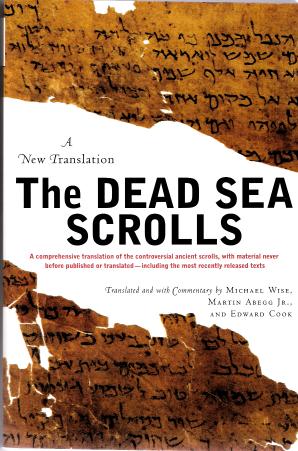
The new edition of Wise-Abegg-Cook just arrived; I think it looks pretty nice.
We revised each and every one of the texts in the first edition to reflect the latest readings and scholarly publications, as well as adding new texts (including complete translations of the Qumran witnesses to Enoch, Jubilees and the Targum to Job). It also has running heads and a new index.
For those who loathed our titles for the scrolls — sorry. They're still there, as are the blurbs from Karen Armstrong and Dom Crossan. The paperback costs $24.95, so there's no reason for you not to order one (or two — why not one for each member of your family?) immediately.
The scroll on the cover, by the way, is 4Q109 (4Q Qohelet).
UPDATE: I've been encouraged to add links to online stores. You got it: Order the book here or here. Buy this one as well while you're at it. :)
Thursday, October 13, 2005
Yom Kippur
Last night, at sunset, was the beginning of Yom Kippur, the Day of Atonement. I wish all the Jewish friends of Ralph an easy fast.
It is interesting to note that the expression yom kippur as such is not found in the oldest Jewish literature. In the Bible, Mishnah, Dead Sea Scrolls, Talmudim and Midrashim, the phrase denoting the Day of Atonement is yom ha-kippurim, or, in Aramaic, yoma de-kippurei. The earliest use I can find of the later, short expression is in the Tosafists (glossators) to the Babylonian Talmud, which would place its origin in the early medieval period.
Kippurim is a tantum plurale ("only plural") in Biblical Hebrew, a word occurring only in the plural. Pluralia tantum are often used in Hebrew to denote abstract notions, like "atonement," alumim, "youth," tanhumim, "consolation." etc. They are less frequent in later forms of the language, which might account for the eventual changeover to the singular in yom kippur.
It is interesting to note that the expression yom kippur as such is not found in the oldest Jewish literature. In the Bible, Mishnah, Dead Sea Scrolls, Talmudim and Midrashim, the phrase denoting the Day of Atonement is yom ha-kippurim, or, in Aramaic, yoma de-kippurei. The earliest use I can find of the later, short expression is in the Tosafists (glossators) to the Babylonian Talmud, which would place its origin in the early medieval period.
Kippurim is a tantum plurale ("only plural") in Biblical Hebrew, a word occurring only in the plural. Pluralia tantum are often used in Hebrew to denote abstract notions, like "atonement," alumim, "youth," tanhumim, "consolation." etc. They are less frequent in later forms of the language, which might account for the eventual changeover to the singular in yom kippur.
Tuesday, October 11, 2005
Surviving the Annual Meeting
As noted in previous posts, the annual meeting of the AAR-SBL is coming up soon (Nov. 19-22) in Philadelphia. As always, I am beginning to give some thought about how to survive the meeting.
Usually, when I arrive, I am in a gung-ho mood to attend as many papers, have as many discussions, and buy as many books as possible. After about a day or so — by about Sunday afternoon — when I've endured any number of dull recitations and gone around the book exhibit about a dozen times — I start feeling like this: I've gotta get out of here. Please, no more cerebral discussions. No more eggheads. No more tweed coats, natty beards, or ostentatiously brandished credentials. I feel like Dolly Parton, because everyone you meet at the annual meeting looks at your chest (where your name badge is) before they look at your face. That's when I hunger for "real" people wearing jeans and T-shirts and for talk that concerns football, what the kids are up to, trading one-liners from Family Guy or theories about Lost.
Through trial and error, I've discovered that the best way to head off "meeting burnout" — the desire to run back to the real world (I know — a concept that bristles with problems) — is to take a short vacation from the annual meeting in the midst of it. Lately I've taken off one night to go and listen to live music at a local club. If that's not available, I take an entire afternoon (or morning) off, dress in mufti, and walk around the local downtown, window shopping, drinking coffee (or a few Cold Ones), or sitting on a park bench. Most of the time, when I get back to the Land of Brainiacs, I'm tanned, rested, and ready to be smart again.
Is this a common experience, or is it just me? How do you survive the annual meeting?
Usually, when I arrive, I am in a gung-ho mood to attend as many papers, have as many discussions, and buy as many books as possible. After about a day or so — by about Sunday afternoon — when I've endured any number of dull recitations and gone around the book exhibit about a dozen times — I start feeling like this: I've gotta get out of here. Please, no more cerebral discussions. No more eggheads. No more tweed coats, natty beards, or ostentatiously brandished credentials. I feel like Dolly Parton, because everyone you meet at the annual meeting looks at your chest (where your name badge is) before they look at your face. That's when I hunger for "real" people wearing jeans and T-shirts and for talk that concerns football, what the kids are up to, trading one-liners from Family Guy or theories about Lost.
Through trial and error, I've discovered that the best way to head off "meeting burnout" — the desire to run back to the real world (I know — a concept that bristles with problems) — is to take a short vacation from the annual meeting in the midst of it. Lately I've taken off one night to go and listen to live music at a local club. If that's not available, I take an entire afternoon (or morning) off, dress in mufti, and walk around the local downtown, window shopping, drinking coffee (or a few Cold Ones), or sitting on a park bench. Most of the time, when I get back to the Land of Brainiacs, I'm tanned, rested, and ready to be smart again.
Is this a common experience, or is it just me? How do you survive the annual meeting?
Friday, October 07, 2005
Hair of the Ugaritic Dog
I've been reading some Ugaritic lately, in connection with various duties, and I finally got around to working through the text KTU 1.114, the famous one where El, the head of the pantheon, gets drunk at a banquet (marzeah) and has to be helped home while slipping in his own waste; lovely.
The real point of this text is found in the last few lines, which contains, by common interpretation, a recipe for hangover: "On his brow one should put hairs of a dog, the top of a pqq-plant and its stem. Mix it with the juice of virgin oil" (trans. T. J. Lewis).
I laughed when I read that. Hair of the dog, indeed! Could it be that the old expression for a morning-after shot of spirits, "hair of the dog," has its origin in the Ancient Near East? If so, I'm not the first one to discover it. Dennis Pardee writes:
The same thing is suggested in the Dictionary of the Ancient Near East, s.v. "Drunkenness":
So the idea that KTU 1.114 is the earliest use of "hair of the dog" for hangover can't be correct. In fact, the idea that the Ugaritic recipe is intended for hangover is itself an inference; it is nowhere stated in the text.
Here's another possibility. In an earlier section of the text, while El is being carried home, a mysterious figure named Habayu appears: "Habayu then berates (?) (נגשׁ) him, he of two horns and a tail." What exactly is Habayu doing to El? The word translated "berates" has also been taken to mean "press, drive," but none of these makes much sense. I am wondering if נגשׁ simply means here "gore," as it does in Palestinian Aramaic. The translation then would be: "Habayu gores him, the one with two horns and a tail." And that would explain why in the next lines El "collapses like one dead, like those who descend to the underworld," and it would explain why Habayu's horns are mentioned: Habayu is some kind of ox or ram.
So maybe this recipe is not for hangover at all, but for the much more serious condition of having been gored or butted by a horned animal. But I would not recommend it in either case.
BIBLIOGRAPHY: Text and translation of KTU 1.114: "El's divine feast," trans. T. J. Lewis, Ugaritic Narrative Poetry (Scholars Press, 1997), pp. 193ff.
The real point of this text is found in the last few lines, which contains, by common interpretation, a recipe for hangover: "On his brow one should put hairs of a dog, the top of a pqq-plant and its stem. Mix it with the juice of virgin oil" (trans. T. J. Lewis).
I laughed when I read that. Hair of the dog, indeed! Could it be that the old expression for a morning-after shot of spirits, "hair of the dog," has its origin in the Ancient Near East? If so, I'm not the first one to discover it. Dennis Pardee writes:
This atypical myth [KTU 1.114] is followed by a prose recipe for alcoholic collapse that features the first known connection between drunkenness and the "hair of the dog": "What is to be put on his forehead: hairs of a dog. And the head of the PQQ (a type of plant) and its shoot he is to drink mixed together with fresh olive oil."
The same thing is suggested in the Dictionary of the Ancient Near East, s.v. "Drunkenness":
The "morning-after" symptoms were treated with various substances, including "the hair of the dog," as described in an Ugaritic text where the god El suffers from the effects of excessive consumption.But it won't do. "Hair of the dog" as a hangover remedy is derived from the longer expression "hair of the dog that bit you." The origin lies in an Anglo-American folkloric remedy, not for hangover, but for rabies: if bitten by a dog, one was to take some of the dog's hair and either eat it or otherwise apply it to the wound:
[Remedies for rabies] have included eating grass from a churchyard, consuming some of the "hair of the dog that bit you" fried in oil with a little rosemary, and even eating parts of the dog itself (typically the heart or the liver). (Cassell's Dictionary of Superstitions)The concept of homeopathic cure, along with the expression itself, was transferred to the hangover remedy — which is not literal dog hair, but a glass of something alcoholic (in my experience, a Bloody Mary is usually recommended).
So the idea that KTU 1.114 is the earliest use of "hair of the dog" for hangover can't be correct. In fact, the idea that the Ugaritic recipe is intended for hangover is itself an inference; it is nowhere stated in the text.
Here's another possibility. In an earlier section of the text, while El is being carried home, a mysterious figure named Habayu appears: "Habayu then berates (?) (נגשׁ) him, he of two horns and a tail." What exactly is Habayu doing to El? The word translated "berates" has also been taken to mean "press, drive," but none of these makes much sense. I am wondering if נגשׁ simply means here "gore," as it does in Palestinian Aramaic. The translation then would be: "Habayu gores him, the one with two horns and a tail." And that would explain why in the next lines El "collapses like one dead, like those who descend to the underworld," and it would explain why Habayu's horns are mentioned: Habayu is some kind of ox or ram.
So maybe this recipe is not for hangover at all, but for the much more serious condition of having been gored or butted by a horned animal. But I would not recommend it in either case.
BIBLIOGRAPHY: Text and translation of KTU 1.114: "El's divine feast," trans. T. J. Lewis, Ugaritic Narrative Poetry (Scholars Press, 1997), pp. 193ff.
Tuesday, October 04, 2005
Metafembiblioblogging, and a Dream
In my post "What Should We Talk About?" I asked, in passing, "Why are there so few female bibliobloggers?" and this casual question actually ignited more responses than the rest of the post. Mark Goodacre suggests that the answer lies in a lethal "combination between the male-dominated academy and the nerdy, geeky male electronic world." Loren Rosson suggests that one component is that blogging feeds the male ego. A commenter on Loren's site suggests that in fact it is because "blogging itself is ambivalently recieved [sic] by the academic community ... Putatively, if women must work harder to get jobs and tenure in the academcy [sic], why would a (hypothetical) academic female 'waste' time writing a blog instead of a peer-reviewed article when the latter will likely advance her career more readily?" An anonymous female commenter on Mark's site asks, "I am confused about why you think the world needs more female bibliobloggers though. What is the significance of the female aspect? Is it just to make the stats look better? So there is someone there to cover feminism?" Several commenters (male and female) have suggested that females are too busy doing other useful things to waste time blogging, which begs a lot of questions.
My answer? Beats me. The answer probably lies in a combination of factors that "over-determine" the relative dearth of female bibliobloggers. I think this could be an interesting topic to explore at SBL though, and as we've already seen, the topic leads into many other useful topics such as "why blog?" and the role of blogging in academia in general. Hopefully opinions will be forthcoming from the audience as well as from the dead-white-male panel. Oh, wait, we're not dead. OK, just white male.
Speaking of female bloggers, I recommend to you this post from the Pilgrim. It may or may not be relevant to this topic but her experience is worth pondering.
And speaking of bloggers in general and Mark Goodacre in particular, Mark had the temerity to make an appearance last night in a long and complicated dream of mine. At one point I was suddenly sharing the back of a taxicab with Mark (whom I've never met) as we drove down Oxford's High Street (where I've never been).
I asked Mark, "So why did you take the job at Duke instead of taking a job at Oxford?"
He took a long drag on his cigarette and regarded me coolly from behind his dark glasses. "Because," he said, "only the chef is allowed to enter the kitchen."
Which makes a whole lot of sense, when you think about it.
My answer? Beats me. The answer probably lies in a combination of factors that "over-determine" the relative dearth of female bibliobloggers. I think this could be an interesting topic to explore at SBL though, and as we've already seen, the topic leads into many other useful topics such as "why blog?" and the role of blogging in academia in general. Hopefully opinions will be forthcoming from the audience as well as from the dead-white-male panel. Oh, wait, we're not dead. OK, just white male.
Speaking of female bloggers, I recommend to you this post from the Pilgrim. It may or may not be relevant to this topic but her experience is worth pondering.
And speaking of bloggers in general and Mark Goodacre in particular, Mark had the temerity to make an appearance last night in a long and complicated dream of mine. At one point I was suddenly sharing the back of a taxicab with Mark (whom I've never met) as we drove down Oxford's High Street (where I've never been).
I asked Mark, "So why did you take the job at Duke instead of taking a job at Oxford?"
He took a long drag on his cigarette and regarded me coolly from behind his dark glasses. "Because," he said, "only the chef is allowed to enter the kitchen."
Which makes a whole lot of sense, when you think about it.
Saturday, October 01, 2005
Stanislav Segert (1921-2005)
Yesterday Bill Schniedewind of UCLA emailed with the sad news that UCLA's Prof. Stanislav Segert, the great scholar of the North-West Semitic languages, and my own venerated teacher and Doktorvater, died yesterday after a short hospitalization. He was 84.
Segert was the last great grammarian of the Semitic languages in the polymathic European tradition of Dillmann, Brockelmann, and Noeldeke. He is perhaps best known in the US for his textbook Basic Grammar of the Ugaritic Language (1984), but in my opinion his finest work is his Altaramäische Grammatik (1975). He also wrote a fundamental Grammar of Phoenician and Punic (1976). Besides these works he wrote still unpublished grammars of Syriac and Biblical Aramaic for classroom use.
His hundreds of articles include many on the Qumran texts, and dozens more on aspects of Ugaritic studies. His study of the language of the Moabite stone ("Die Sprache der moabitischen Königinschrift," Archiv Orientalni, 1961) is still the best survey of that dialect.
Not only was Segert a great scholar, he was a great gentleman. His erudition was exceeded only by his courtesy, and any suggestion of scholarly hostility or odium theologicum caused him great pain. When someone in class once mentioned to him the falling out that had taken place between two European archaeologists, his only comment was, "Ah! Let us hope that no very great time will pass until they will once again be friends." His epitaph might well be: He died without enemies.
After Samuel Johnson died in 1784, William Hamilton wrote, "He has made a chasm which not only nothing can fill up, but which nothing has a tendency to fill up. Johnson is dead. Let us go to the next best. There is nobody; no man can be said to put you in mind of Johnson."
The same is true of Segert. He is gone, and he is irreplaceable. His books and articles remain for those to learn from who will; I will continue to study them, but even more than these, I will treasure the memory of his kindness and gentleness. As both a scholar and a man, he was a giant.
BIBLIOGRAPHY: Further biographical details and a full bibliography through 1989 can be found in the Festschrift Sopher Mahir: Northwest Semitic Studies Presented to Stanislav Segert (Eisenbrauns, 1990).
UPDATE (10/3): Jim Davila has added a personal tribute to Prof. Segert.
Segert was the last great grammarian of the Semitic languages in the polymathic European tradition of Dillmann, Brockelmann, and Noeldeke. He is perhaps best known in the US for his textbook Basic Grammar of the Ugaritic Language (1984), but in my opinion his finest work is his Altaramäische Grammatik (1975). He also wrote a fundamental Grammar of Phoenician and Punic (1976). Besides these works he wrote still unpublished grammars of Syriac and Biblical Aramaic for classroom use.
His hundreds of articles include many on the Qumran texts, and dozens more on aspects of Ugaritic studies. His study of the language of the Moabite stone ("Die Sprache der moabitischen Königinschrift," Archiv Orientalni, 1961) is still the best survey of that dialect.
Not only was Segert a great scholar, he was a great gentleman. His erudition was exceeded only by his courtesy, and any suggestion of scholarly hostility or odium theologicum caused him great pain. When someone in class once mentioned to him the falling out that had taken place between two European archaeologists, his only comment was, "Ah! Let us hope that no very great time will pass until they will once again be friends." His epitaph might well be: He died without enemies.
After Samuel Johnson died in 1784, William Hamilton wrote, "He has made a chasm which not only nothing can fill up, but which nothing has a tendency to fill up. Johnson is dead. Let us go to the next best. There is nobody; no man can be said to put you in mind of Johnson."
The same is true of Segert. He is gone, and he is irreplaceable. His books and articles remain for those to learn from who will; I will continue to study them, but even more than these, I will treasure the memory of his kindness and gentleness. As both a scholar and a man, he was a giant.
BIBLIOGRAPHY: Further biographical details and a full bibliography through 1989 can be found in the Festschrift Sopher Mahir: Northwest Semitic Studies Presented to Stanislav Segert (Eisenbrauns, 1990).
UPDATE (10/3): Jim Davila has added a personal tribute to Prof. Segert.
Thursday, September 29, 2005
What Should We Talk About?
There's a biblioblogging session coming up in Philadelphia at the AAR-SBL meeting, as a session of the Computer Assisted Research Group. Two papers will be given, by Jim Davila and Rick Brennan. Then follows 80 minutes of panel discussion by 5 (or is it 6?) panel members, of which I am one.
What should we talk about?
We'll introduce ourselves, I imagine, and say a few words about our blogs. We will no doubt say some things about what Rick and Jim have said. What else should we talk about? Open (source) studies? Blogging and the nature of public scholarly discourse? Peer review? Blogging and conformity? How to kill time while waiting for Blogger to upload your post? What's better, news or opinion or baby pictures? Why are there so few female bibliobloggers? What's the point of it all? Who's your favorite team?
One thing I hope we don't talk about is the term "biblioblogger." There the term is, and we're stuck with it. And I hope we don't discuss "what is a biblioblogger," or the forgery scandal, or minimalism, or the historical Jesus, or what our desks look like, or which character from the Simpsons we are, or such worthy-but-irrelevant topics.
If each of us talks for 5-10 minutes about ourselves, that'll kill a lot of time. That could be good or bad.
I don't know. Got any ideas? Suggestions welcome.
What should we talk about?
We'll introduce ourselves, I imagine, and say a few words about our blogs. We will no doubt say some things about what Rick and Jim have said. What else should we talk about? Open (source) studies? Blogging and the nature of public scholarly discourse? Peer review? Blogging and conformity? How to kill time while waiting for Blogger to upload your post? What's better, news or opinion or baby pictures? Why are there so few female bibliobloggers? What's the point of it all? Who's your favorite team?
One thing I hope we don't talk about is the term "biblioblogger." There the term is, and we're stuck with it. And I hope we don't discuss "what is a biblioblogger," or the forgery scandal, or minimalism, or the historical Jesus, or what our desks look like, or which character from the Simpsons we are, or such worthy-but-irrelevant topics.
If each of us talks for 5-10 minutes about ourselves, that'll kill a lot of time. That could be good or bad.
I don't know. Got any ideas? Suggestions welcome.
Tuesday, September 27, 2005
Fat Yanks
It's interesting to read in tandem the blogs of Mark Goodacre and Michael Pahl. Mark has moved from Birmingham, UK to Durham, NC, while Michael has moved from (somewhere in) Canada to Birmingham, UK. These passages particularly struck me. First from Michael:
Here's a shot of moi in Groningen last year:

Food portions are smaller, which partly explains why people are smaller. There's no 'Super-Size Me' here--a trip to Burger King at the Bullring gave us regular-size drinks that were equivalent to smalls in North America, and just enough fries instead of far too many. The American obesity epidemic is one cultural export which is 'largely' absent here (couldn't resist that!).And from Mark:
After our first weekend living in America, I feel a little like Morgan Spurlock in Supersize Me, though I'm happy to say that our diet has been more interesting and varied than his in that film; I just find that I eat so much more here, and less of the right things, and need to find ways of curbing this.Here's my question: Is this true just of fast-food restaurants in Europe, or in general? Or is it a UK thing? I spent a week in Holland and Belgium last year, and I don't recall ever noticing that the portions served were smaller. In fact, at the Vismarkt in Groningen, I got a serving of (excellent) fish n'chips so large that I couldn't finish it. But, while abroad, I never ate at any American-style fast food restaurants. (Interestingly, I noticed a lot more Burger Kings in Holland than "Maison McD.")
Here's a shot of moi in Groningen last year:

Friday, September 23, 2005
Weekend Reading
Hi, everybody. No, I'm fine, I've just got writer's blogk. In lieu of my own brilliance, here's a funny piece from the New Yorker. An excerpt:
Read it all.
“Today,” the Lord God said, “let’s do land.” And lo, there was land.
“Well, it’s really not just land,” noted Vishnu. “You’ve got mountains and valleys and—is that lava?”
“It’s not a single statement,” said the Lord God. “I want it to say, ‘Yes, this is land, but it’s not afraid to ooze.’ ”
“It’s really a backdrop, a sort of blank canvas,” put in Apollo. “It’s, like, minimalism, only with scale.”
“But—brown?” Buddha asked.
“Brown with infinite variations,” said the Lord God. “Taupe, ochre, burnt umber—they’re called earth tones.”
“I wasn’t criticizing,” said Buddha. “I was just noticing.”
Read it all.
Sunday, September 18, 2005
NTCS Again Available
As Christian Brady noted in an earlier comment, the website for the Newsletter for Targum and Cognate Studies is now available once again, thanks to his efforts.
For those who are interested, my Psalms Targum translation is also once again available. Many thanks to Chris for hosting these pages on his personal site.
For those who are interested, my Psalms Targum translation is also once again available. Many thanks to Chris for hosting these pages on his personal site.
Thursday, September 15, 2005
The Redolent Metaphor
Mark Liberman at Language Log discusses the expression "to stink in the nostrils" as a metaphor for hatred, revulsion, or disapproval. After two cups of coffee, he had still not tracked down an "authoritative model" for it.
I was able to find at least one source before the 17th century: One of the Marprelate tracts (1589) ("for feare of smelling in the nostrels of her Maiestie & the State") and possibly a century earlier in the Book of the Knight of La Tour-Landry : compiled for the instruction of his daughters : translated from the original French into English in the reign of Henry VI, 1484:
—although there are no "nostrils" in that text.
But neither one of these texts is authoritative in the way that Liberman would like. I could have sworn that this expression was Biblical, but as Liberman shows, there is no exact model in the early English translations (although Hebrew be'ash, hib'ish "to stink, cause to stink" = to incur dislike, is well known).
Unless the metaphor is a natural evolution from Biblical models, I'm also stumped for an "authoritative model," unless the French original of the Book of the Knight points to a continental source. Is there any classical or medieval scholar out there who can trace this back into French or Latin literature?
Did this expression emerge into common use during the 17th century, and stay in the phrasal vocabulary of the English language to this day, without any authoritative model at all?
I was able to find at least one source before the 17th century: One of the Marprelate tracts (1589) ("for feare of smelling in the nostrels of her Maiestie & the State") and possibly a century earlier in the Book of the Knight of La Tour-Landry : compiled for the instruction of his daughters : translated from the original French into English in the reign of Henry VI, 1484:
- the synne of lechery stinkithe afore God and his aungeles
- the unlefull synne of lecherye, the whiche stinkithe and crompithe vnto heuene
—although there are no "nostrils" in that text.
But neither one of these texts is authoritative in the way that Liberman would like. I could have sworn that this expression was Biblical, but as Liberman shows, there is no exact model in the early English translations (although Hebrew be'ash, hib'ish "to stink, cause to stink" = to incur dislike, is well known).
Unless the metaphor is a natural evolution from Biblical models, I'm also stumped for an "authoritative model," unless the French original of the Book of the Knight points to a continental source. Is there any classical or medieval scholar out there who can trace this back into French or Latin literature?
Tuesday, September 13, 2005
In David's Palace
Back by popular demand: another excerpt from "David and Abishag." This one goes out to Dr. Joe Cathey, with best wishes for his continued good health.
The scene: Gur the harpist has an appointment in Jerusalem, in the palace of David.
No day dawned in Jerusalem without the the renewal of the sounds of hammers, saws, cranes, wheels, pulleys, and shouting workmen. Jerusalem, the ancestral citadel of the Yebusi kings, was being made over into the capital of the House of David.
Dominating the hill south of the old Yebusi tower was the royal palace, built in the Tyrian style with massive blocks of limestone, hugely piled, course upon course, with a few great square entrances. The severe, gigantesque impression of the exterior was softened, in some of the living quarters, by occasional facings and moldings carved out of cedar. Nevertheless the edifice as a whole still looked — and was, in parts — raw and unfinished.
Gur sighed as he entered the west entrance of the palace compound. The new palace (still "new" after 25 years) was undeniably imposing, but David and his minions had absolutely no sense of style. Those inner walls, now — could not some plaster be laid over the naked stone and some pictures and designs painted on them? Cedar was all very well, but even the few rooms that were completely paneled in wood seemed austere and dark. But that was the Phoenicians for you — swift, elegant little ships on the sea, but great clumsy buildings on land.
And David was not so very different from his Tyrian allies. Not that he, or any Israelite, would be caught dead in a ship: no, indeed. But David was no more a city dweller than they were — he was a soldier, and a farmer, and would rather live in a campaign tent, or at least a country villa, than in a house made of ashlars and cedar wood. His palace, and the other royal buildings going up in Jerusalem, owed more to David's image of what belonged to royalty than to his personal inclinations.
Even so, there was still something of the farmhouse about the palace of David — donkeys, sheep, and camels were often quartered in the lower rooms next to their keepers instead of in a stable; and sometimes horses were found tied to pillars in the entrance portico. Roosters were likely to walk out from behind a chair at any time, even in the throne room. The scent of manure mingled with the odor of cooking food and unwashed bodies.
However, a palace was a palace, and had advantages, thought Gur, as he sat in an anteroom and let a slave wash his feet. In Egypt the slave would have a bowl to dip his feet in, some sweet-smelling stuff to rub on them, and a cloth to dry them off. Here the slave just poured water from a jar over his feet and let the water run over the flagstones, then he handed Gur a fistful of hay to clean and dry them off himself. And instead of giving him house sandals, the slave clapped his road shoes together, making the dust fly, and then handed them back. Still, Gur thought, I'll take these cool stone walls and country servants over Yawab's camp tent with no walls at all any day.
He was then ushered into a dining room at the upper levels, one with a balcony facing west to catch the breeze, if there was one. The appointments were no more lavish than elsewhere, but here all was neat and clean, and the table was laid with wine, snow-cooled water, figs, dates, and pomegranates, while fresh fish roasted on a grill nearby. A harp and stool were set out ready for him.
The scene: Gur the harpist has an appointment in Jerusalem, in the palace of David.
No day dawned in Jerusalem without the the renewal of the sounds of hammers, saws, cranes, wheels, pulleys, and shouting workmen. Jerusalem, the ancestral citadel of the Yebusi kings, was being made over into the capital of the House of David.
Dominating the hill south of the old Yebusi tower was the royal palace, built in the Tyrian style with massive blocks of limestone, hugely piled, course upon course, with a few great square entrances. The severe, gigantesque impression of the exterior was softened, in some of the living quarters, by occasional facings and moldings carved out of cedar. Nevertheless the edifice as a whole still looked — and was, in parts — raw and unfinished.
Gur sighed as he entered the west entrance of the palace compound. The new palace (still "new" after 25 years) was undeniably imposing, but David and his minions had absolutely no sense of style. Those inner walls, now — could not some plaster be laid over the naked stone and some pictures and designs painted on them? Cedar was all very well, but even the few rooms that were completely paneled in wood seemed austere and dark. But that was the Phoenicians for you — swift, elegant little ships on the sea, but great clumsy buildings on land.
And David was not so very different from his Tyrian allies. Not that he, or any Israelite, would be caught dead in a ship: no, indeed. But David was no more a city dweller than they were — he was a soldier, and a farmer, and would rather live in a campaign tent, or at least a country villa, than in a house made of ashlars and cedar wood. His palace, and the other royal buildings going up in Jerusalem, owed more to David's image of what belonged to royalty than to his personal inclinations.
Even so, there was still something of the farmhouse about the palace of David — donkeys, sheep, and camels were often quartered in the lower rooms next to their keepers instead of in a stable; and sometimes horses were found tied to pillars in the entrance portico. Roosters were likely to walk out from behind a chair at any time, even in the throne room. The scent of manure mingled with the odor of cooking food and unwashed bodies.
However, a palace was a palace, and had advantages, thought Gur, as he sat in an anteroom and let a slave wash his feet. In Egypt the slave would have a bowl to dip his feet in, some sweet-smelling stuff to rub on them, and a cloth to dry them off. Here the slave just poured water from a jar over his feet and let the water run over the flagstones, then he handed Gur a fistful of hay to clean and dry them off himself. And instead of giving him house sandals, the slave clapped his road shoes together, making the dust fly, and then handed them back. Still, Gur thought, I'll take these cool stone walls and country servants over Yawab's camp tent with no walls at all any day.
He was then ushered into a dining room at the upper levels, one with a balcony facing west to catch the breeze, if there was one. The appointments were no more lavish than elsewhere, but here all was neat and clean, and the table was laid with wine, snow-cooled water, figs, dates, and pomegranates, while fresh fish roasted on a grill nearby. A harp and stool were set out ready for him.
Saturday, September 10, 2005
Texas vs. Ohio State
Tonight is the Texas-Ohio State football game. I graduated from Texas, as did my father before me. My daughter is a senior at Ohio State.
Does this cause family tension? Absolutely not. We are not the kind of family to let petty sports events cause interpersonal problems. Also, Elizabeth just doesn't really care who wins.
But do I care who wins? My attitude can best be summed up by recalling that a Baptist church in Fayettevile, Arkansas, years ago, put up a message on its marquee prior to the annual Texas-Arkansas bloodletting: FOOTBALL IS ONLY A GAME. ONLY SPIRITUAL THINGS ARE ETERNAL. NEVERTHELESS, BEAT TEXAS.
Change that last sentiment to BEAT OHIO STATE and you've captured my viewpoint exactly. I am of the opinion that sporting events are entirely too important in today's society, and football in particular is too often violent and crass, encouraging inappropriate displays of partisan bitterness.
Nevertheless, Hook 'em, Horns! Whoo-hoo! Crush the Buckeyes!!
Does this cause family tension? Absolutely not. We are not the kind of family to let petty sports events cause interpersonal problems. Also, Elizabeth just doesn't really care who wins.
But do I care who wins? My attitude can best be summed up by recalling that a Baptist church in Fayettevile, Arkansas, years ago, put up a message on its marquee prior to the annual Texas-Arkansas bloodletting: FOOTBALL IS ONLY A GAME. ONLY SPIRITUAL THINGS ARE ETERNAL. NEVERTHELESS, BEAT TEXAS.
Change that last sentiment to BEAT OHIO STATE and you've captured my viewpoint exactly. I am of the opinion that sporting events are entirely too important in today's society, and football in particular is too often violent and crass, encouraging inappropriate displays of partisan bitterness.
Nevertheless, Hook 'em, Horns! Whoo-hoo! Crush the Buckeyes!!
Thursday, September 08, 2005
Looting and Proverbs 6:30
Here and there on the web, one may occasionally find a discussion of looting in New Orleans together with a citation of Proverbs 6:30: "Men do not despise a thief, if he steal to satisfy himself when he is hungry." The proverb nicely captures a widespread moral intuition (which I fully share) that "looting" by the hungry or thirsty is not morally culpable, or is less culpable than looting out of sheer greed.
There is, however, a minority report on this verse (in various commentaries) that takes it as a question: "Do not men despise a thief, even if he steals to satisfy himself when he is hungry?" I think this is an unlikely reading of the Hebrew, and no widely used English translations that I've seen have followed this understanding. Still, the fact that it has been made means that the majority report contains at least a modicum of interpretation. (Note also the LXX version: "It is not surprising if a thief is caught, when he steals," etc. The translator apparently departed altogether from the text in the beginning of the verse.)
Three other points about the verse: (1) It appears to be descriptive, not prescriptive. The writer is describing what in fact people do, not necessarily how they should behave. Otherwise he would have written al tavuzu, "do not despise," instead of lo yavuzu, "they do not despise." (2) The real point of the paragraph in which the verse is embedded (Prov. 6:20-35) is: Don't commit adultery. Thievery is mentioned, by way of contrast, as an offense that can be forgiven in some circumstances, and compensation can be made (v. 31), but adultery is never forgotten or forgiven. (3) This larger context makes an implicit appeal to the habits of a "village culture" where everyone pretty much knows everyone else's business, even their most intimate misdeeds. The weight of the exhortation lies not on culpability as such, but on avoiding shame, dishonor, and reproach.
I guess my point is this: It's hard to simply lift verses out of the Bible and use them as ethical prooftexts or simple moral guidance for a situation. They don't come away cleanly, ready for re-use elsewhere; even the plainest of them are stuck to their literary and cultural contexts in persistent and unexpected ways. This is true even of this verse of Proverbs, which in isolation seems to say pretty much what we agree with in any case. I'm not saying the Bible is not a source of moral understanding, just that the raw text needs to be cooked up with some historical and critical understanding before it is ready to be used.
For a rational-theological approach to the question, Thomas Aquinas deals with "Whether it is lawful to steal through stress of need?" here.
There is, however, a minority report on this verse (in various commentaries) that takes it as a question: "Do not men despise a thief, even if he steals to satisfy himself when he is hungry?" I think this is an unlikely reading of the Hebrew, and no widely used English translations that I've seen have followed this understanding. Still, the fact that it has been made means that the majority report contains at least a modicum of interpretation. (Note also the LXX version: "It is not surprising if a thief is caught, when he steals," etc. The translator apparently departed altogether from the text in the beginning of the verse.)
Three other points about the verse: (1) It appears to be descriptive, not prescriptive. The writer is describing what in fact people do, not necessarily how they should behave. Otherwise he would have written al tavuzu, "do not despise," instead of lo yavuzu, "they do not despise." (2) The real point of the paragraph in which the verse is embedded (Prov. 6:20-35) is: Don't commit adultery. Thievery is mentioned, by way of contrast, as an offense that can be forgiven in some circumstances, and compensation can be made (v. 31), but adultery is never forgotten or forgiven. (3) This larger context makes an implicit appeal to the habits of a "village culture" where everyone pretty much knows everyone else's business, even their most intimate misdeeds. The weight of the exhortation lies not on culpability as such, but on avoiding shame, dishonor, and reproach.
I guess my point is this: It's hard to simply lift verses out of the Bible and use them as ethical prooftexts or simple moral guidance for a situation. They don't come away cleanly, ready for re-use elsewhere; even the plainest of them are stuck to their literary and cultural contexts in persistent and unexpected ways. This is true even of this verse of Proverbs, which in isolation seems to say pretty much what we agree with in any case. I'm not saying the Bible is not a source of moral understanding, just that the raw text needs to be cooked up with some historical and critical understanding before it is ready to be used.
For a rational-theological approach to the question, Thomas Aquinas deals with "Whether it is lawful to steal through stress of need?" here.
Tuesday, September 06, 2005
Some Book Reviews
I've discovered a number of book reviews I've written for Catholic Biblical Quarterly available at FindArticles.com.
For those who are interested, here are some of them:
Diggers at the Well: Proceedings of a Third International Symposium on the Hebrew of the Dead Sea Scrolls and Ben Sira. Edited by T. Muraoka and J.F. Elwolde.
The Bible at Qumran: Text, Shape, and Interpretation. Edited by Peter W. Flint.
The Dead Sea Scrolls at Fifty: Proceedings of the 1997 Society of Biblical Literature Qumran Section Meetings.Kugler, Robert A. and Eileen M. Schuller, eds.
The Scrolls and the Scriptures: Qumran Fifty Years After. Edited by Craig A. Evans and Stanley E. Porter.
Die Qumran-Essener. Die Texte vom Toten Meer. Band 1, Die Texte der Hohlen 1-3 und 5-11. Band 2, Die Texte der Hohle 4, by Johann Maier (Uni-Taschenbicher 1862-63; Munich/Basel: Ernst Reinhardt, 1995).
The Scepter and the Star: The Messiahs of the Dead Sea Scrolls and Other Ancient Literature, John J Collins.
In the near future, I'll add the links to the area at the right.
For those who are interested, here are some of them:
Diggers at the Well: Proceedings of a Third International Symposium on the Hebrew of the Dead Sea Scrolls and Ben Sira. Edited by T. Muraoka and J.F. Elwolde.
The Bible at Qumran: Text, Shape, and Interpretation. Edited by Peter W. Flint.
The Dead Sea Scrolls at Fifty: Proceedings of the 1997 Society of Biblical Literature Qumran Section Meetings.Kugler, Robert A. and Eileen M. Schuller, eds.
The Scrolls and the Scriptures: Qumran Fifty Years After. Edited by Craig A. Evans and Stanley E. Porter.
Die Qumran-Essener. Die Texte vom Toten Meer. Band 1, Die Texte der Hohlen 1-3 und 5-11. Band 2, Die Texte der Hohle 4, by Johann Maier (Uni-Taschenbicher 1862-63; Munich/Basel: Ernst Reinhardt, 1995).
The Scepter and the Star: The Messiahs of the Dead Sea Scrolls and Other Ancient Literature, John J Collins.
In the near future, I'll add the links to the area at the right.
Friday, September 02, 2005
High Water Blues: Remembering 1927
This blog makes the apt comparison between the Katrina disaster and the Mississippi Flood of 1927.
The flood (caused by river flooding, not hurricane-related effects) made a strong impression on African Americans, especially in music. Most notably, Charlie Patton wrote "High Water Everywhere":
Look-a here the water now, Lordy,
Levee broke, rose most everywhere
The water at Greenville and Leland,
Lord, it done rose everywhere
Boy, you can't never stay here
I would go down to Rosedale,
but, they tell me there's water there
And Memphis Minnie wrote "When the Levee Breaks," memorably re-recorded by Led Zeppelin in the '70's:
Cryin' won't help you, prayin' won't do you no good,
Now, cryin' won't help you, prayin' won't do you no good,
When the levee breaks, mama, you got to move.
Blind Lemon Jefferson wrote "Rising High Water Blues":
People, since it's raining, it has been for nights and days
People, since it's raining, has been for nights and days
Thousands people stands on the hill, looking down were they used to stay
Children stand there screaming: mama, we ain't got no home
Oh, mama we ain't got no home
Papa says to the children, "Backwater left us all alone"
Backwater rising, come in my windows and door
The backwater rising, come in my windows and door
I leave with a prayer in my heart, backwater won't rise no more
And Barbecue Bob Hicks wrote "Mississippi Heavy Water Blues":
Lord, Lord, Lord, I’m so blue, my house was washed away
and I’m cryin’ how long ‘fore another pay day?
That’s why I’m cryin’ Mississippi heavy water blues.
Most recently, Randy Newman wrote and recorded "Louisiana 1927":
The river rose all day
The river rose all night
Some people got lost in the flood
Some people got away alright
The river have busted through clear down to Plaquemines
Six feet of water in the streets of Evangeline
You can donate for disaster relief at the Red Cross site.
The flood (caused by river flooding, not hurricane-related effects) made a strong impression on African Americans, especially in music. Most notably, Charlie Patton wrote "High Water Everywhere":
Look-a here the water now, Lordy,
Levee broke, rose most everywhere
The water at Greenville and Leland,
Lord, it done rose everywhere
Boy, you can't never stay here
I would go down to Rosedale,
but, they tell me there's water there
And Memphis Minnie wrote "When the Levee Breaks," memorably re-recorded by Led Zeppelin in the '70's:
Cryin' won't help you, prayin' won't do you no good,
Now, cryin' won't help you, prayin' won't do you no good,
When the levee breaks, mama, you got to move.
Blind Lemon Jefferson wrote "Rising High Water Blues":
People, since it's raining, it has been for nights and days
People, since it's raining, has been for nights and days
Thousands people stands on the hill, looking down were they used to stay
Children stand there screaming: mama, we ain't got no home
Oh, mama we ain't got no home
Papa says to the children, "Backwater left us all alone"
Backwater rising, come in my windows and door
The backwater rising, come in my windows and door
I leave with a prayer in my heart, backwater won't rise no more
And Barbecue Bob Hicks wrote "Mississippi Heavy Water Blues":
Lord, Lord, Lord, I’m so blue, my house was washed away
and I’m cryin’ how long ‘fore another pay day?
That’s why I’m cryin’ Mississippi heavy water blues.
Most recently, Randy Newman wrote and recorded "Louisiana 1927":
The river rose all day
The river rose all night
Some people got lost in the flood
Some people got away alright
The river have busted through clear down to Plaquemines
Six feet of water in the streets of Evangeline
You can donate for disaster relief at the Red Cross site.
Thursday, September 01, 2005
After Katrina
The disaster on the Gulf Coast continues to defy almost all comment. To our prayers and to our checkbooks; there doesn't seem to be much else to do.
I've heard (through channels) from my Cook relatives in Hattiesburg, MS; all are well and holding on, despite the lack of water, power, or phone.
No doubt many of my readers have friends or relatives in New Orleans and vicinity. Information about Tulane University can be found here; the latest post says that there are no known casualties among staff, faculty, or students. Further information can be found at the SBL website. Our special thoughts and prayers go out to Chris Brady, blogger and Tulane faculty member, and longtime friend of "Ralph." Chris and his family are safe.
The least important casualty of Katrina is my "Psalms Targum in English" (link at right), which is hosted on the Tulane server. No doubt it will re-appear in due course, but it's of little consequence.
"Behold, God is great, and we know him not" (Job 36:26).
UPDATE (9/2): Chris has left a comment below; good to hear from you, CB.
Evan's narrative of evacuation here is must reading.
I've heard (through channels) from my Cook relatives in Hattiesburg, MS; all are well and holding on, despite the lack of water, power, or phone.
No doubt many of my readers have friends or relatives in New Orleans and vicinity. Information about Tulane University can be found here; the latest post says that there are no known casualties among staff, faculty, or students. Further information can be found at the SBL website. Our special thoughts and prayers go out to Chris Brady, blogger and Tulane faculty member, and longtime friend of "Ralph." Chris and his family are safe.
The least important casualty of Katrina is my "Psalms Targum in English" (link at right), which is hosted on the Tulane server. No doubt it will re-appear in due course, but it's of little consequence.
"Behold, God is great, and we know him not" (Job 36:26).
UPDATE (9/2): Chris has left a comment below; good to hear from you, CB.
Evan's narrative of evacuation here is must reading.
Subscribe to:
Posts (Atom)