Wednesday, September 27, 2006

More Dylan Thefts

Henry Timrod made some news a couple of weeks ago by getting some of his lines quoted, or re-used, by Bob Dylan in his new album Modern Times. Timrod was a Confederate poet whose works are now in the public domain. Apparently Bob consciously or unconsciously snipped a few florid Victorian phrases and dropped them into some of the old-timey songs on his record. I don't think there's anything really wrong with that; it's not like he took whole passages and used them wholesale.

And yet Dylan, in his memoir Chronicles, comes pretty close to doing exactly that with other authors. Look carefully at this short passage:

Walking back to the main house, I caught a glimpse of the sea through the leafy boughs of the pines. I wasn't near it, but could feel the power beneath its colors. (Chronicles, p. 162)

Compare that to this longer passage from Marcel Proust's Within a Budding Grove, especially the passages in italics:

But when, Mme. de Ville-parisis’s carriage having reached high ground, I caught a glimpse of the sea through the leafy boughs of trees, then no doubt at such a distance those temporal details which had set the sea, as it were, apart from nature and history disappeared ... But on the other hand I was no longer near enough to the sea which seemed to me not a living thing now, but fixed; I no longer felt any power beneath its colours, spread like those of a picture among the leaves, through which it appeared as inconsistent as the sky and only of an intenser blue.

I don't think there can be any doubt that Bob had to have consciously taken these sentences and, with some revision, passed them off as his own.

Another example is from a book that I imagine Dylan knows well, Huckleberry Finn:
Every night we passed towns, some of them away up on black hillsides, nothing but just a shiny bed of lights; not a house could you see. ... There warn't a sound there; everybody was asleep.
And now look at Chronicles, p. 165:
One night when everyone was asleep and I was sitting at the kitchen table, nothing on the hillside but a shiny bed of lights ...
My last exhibit (a less exact quote) comes from a book called Really the Blues (1946) by Mezz Mezzrow and Bernard Wolfe, in which a hipster introduces "his chick" to Mezzrow:
Baby this that powerful man with that good grass that'll make you tip through the highways and byways like a Maltese kitten. Mezz, this is my new dinner and she's a solid viper.
And now, part of Dylan's description of his friend Ray's girl, Chloe Kiel:
She was cool as pie, hip from head to toe, a Maltese kitten, a solid viper — always hit the nail on the head. I don't know how much weed she smoked, but a lot. (Chronicles, p. 102)
And later in Really the Blues, a black man was "sitting there actually talking to a white woman cool as pie."

Now what are we to think of these "borrowings"? I know that borrowing and revising tunes and song lyrics is standard practice in folk and blues music, and Dylan has done plenty of that, quite openly, as have others. That doesn't bother me. But in a sustained piece of prose that is not meant to be sung or played, but taken as the author's own composition, it is not standard practice. In the instances given above, I think Bob comes pretty close to real plagiarism, and for all I know there are more instances in Chronicles yet to be identified. Frankly, as a Dylan fan from way back, I'm a little disappointed. Say it ain't so, Bob.

UPDATE: A couple more.

Jack London, Children of the Frost:
"Rum meeting place, though," he added, casting an embracing glance over the primordial landscape ...
Chronicles, p. 167: I cast an embracing glance over the primordial landscape ...

Jack London, Tales of the Klondyke:
Another tremendous section of the glacier rumbled earthward. The wind whipped in at the open doorway ...
Chronicles, p. 217: Wind whipped in the open doorway and another kicking storm was rumbling earthward.

UPDATE II: Yet more:

Sax Rohmer, Dope (1919), A tiny spaniel lay beside the fire, his beady black eyes following the nervous movements of the master of the house.

Chronicles, p. 167: A tiny spaniel lay at the guy's feet, the dog's beady black eyes following the nervous movements of his master.

London, Children of the Frost: And then they are amazingly simple. No complexity about them, no thousand and one subtle ramifications to every single emotion they experience. They love, fear, hate, are angered, or made happy, in common, ordinary, and unmistakable terms.

Chronicles, p. 169: Yet to me, it's amazingly simple, no complications, everything pans out. As long as the things you see don't go by in a blur of light and shade, you're okay. Love, fear, hate, happiness all in unmistakable terms, a thousand and one subtle ramifications.

UPDATE III (Oct. 2): Jack London, Tales of the Klondyke: Through this the afternoon sun broke feebly, throwing a vague radiance to earth, and unreal shadows.

Chronicles, p. 112: The afternoon sun was breaking, throwing a vague radiance to the earth.

Jack London, White Fang: He carried himself with pride, as though, forsooth, he had achieved a deed praiseworthy and meritorious.

Chronicles, p. 63: He didn't need to say much—you knew he had been through a lot, achieved some great deed, praiseworthy and meritorious, yet unspoken about it.

R. L. Stevenson, Providence and the Guitar: As Leon looked at her, in her low-bodied maroon dress, with her arms bare to the shoulder, and a red flower set provocatively in her corset, he repeated to himself for the many hundredth time that she was one of the loveliest creatures in the world of women.

Chronicles, p. 127: I bought a red flower for my wife, one of the loveliest creatures in the world of women.

Monday, September 11, 2006

Nine Eleven


And Jesus answering said unto him, Seest thou these great buildings? there shall not be left one stone upon another, that shall not be thrown down.
-Mark 13:2

Well, God is in heaven
And we all want what's his
But power and greed and corruptible seed
Seem to be all that there is.

—Bob Dylan, "Blind Willie McTell"

Defenseless under the night
Our world in stupor lies;
Yet, dotted everywhere,
Ironic points of light
Flash out wherever the Just
Exchange their messages:
May I, composed like them
Of Eros and of dust,
Beleaguered by the same
Negation and despair,
Show an affirming flame.

—W. H. Auden, "September 1, 1939"

Tuesday, September 05, 2006

Dylan & Dan Tucker

Not all the words and music here are Dylan's. . . . But Dylan surrounds these borrowings with his own brilliant and uncanny poetry: "I'm walking with a toothache in my heel" ...
This reviewer of Dylan's Modern Times obviously never learned "Old Dan Tucker" in elementary school.

Now old Dan Tucker's fine old man
Washed his face in a fryin' pan
Combed his head with a wagon wheel
And died with a toothache in his heel


What are they teaching kids these days?

Monday, August 28, 2006

At the Reception

After the wedding, the reception. It features an Irish band, all friends of the couple, including some groomsmen. Irish bouzouki, uileann pipes, fiddle, tin whistle, guitar. They set up in a little courtyard outside the reception room. I listen for a while, then wander back inside. My radiant daughter and her husband (her husband!) are greeting the guests at each table.

The reception is at a posh banquet center north of Cincinnati. There are maybe half a dozen other wedding receptions going on at the same time in other rooms. The walls are thick and each area is far enough from the others to keep the sound from leaking through.

But you have to walk past the others to reach the restrooms. As I walk down the hallway, I have glimpses of other receptions, other lives: a darkened room with people dancing to "Rock Me like a Hurricane"; another with some kind of activity that looks like the Chicken Dance; another with some kind of ethnic music (Hispanic?) ...

After I visit the facilities, I step outside. The rain has held off all day and now it doesn't look like it will arrive before the weekend is over. Good. I take a breath of fresh air and think about the ceremony. It went off without a hitch, and I smile as I think about the two of them looking each other right in the eye and making promises as big as mountains.

I step back inside the banquet center. From now on, everything will be different. There is a tray of pink carnations in the hall, waiting for yet another reception. I steal one to give to my wife, and walk back past the other lives to the Irish music.

Tuesday, August 08, 2006

A Wedding Toast

A recent conversation with my daughter:

ELIZABETH: Dad, you know you're offering a toast at the wedding reception. Have you thought about what you will say?

SELF: Indeed I have, Elizabeth. First I'll start with a joke, both witty and urbane, to put the audience at ease, and then I'll give a quotation — either from the classics or Scripture, I haven't decided. From there I'll go on to my experiences as a parent, its joys and trials, with some reflections on the contemporary assault on family values and the threats to marriage as an institution in America today. Then I'll talk about you, your growth as a person, placed in the context of the post-war emancipation of American womanhood. Then I'll segue to the emergence of your love from Brian, and his for you, with reference to Bergson's concept of emergent evolution. I intend to finish with a vivid evocation of the bright vision of God as portrayed in the last book of the Paradiso, and how all things, including marital bliss, find their true meaning in the context of that "eternal fountain," the "love that moves the sun and the other stars."

ELIZABETH: You've only got two minutes.

SELF: I'll cut it down a bit.

Wednesday, August 02, 2006

One Book Meme

I see that Chris Brady has tagged me, and I owe him a follow-up. So here goes:

1. One book that changed your life:
Tough choice. I'll say Mere Christianity, by C. S. Lewis. Helped me out as a teenager when I really needed a rational approach to Christianity.

2. One book that you’ve read more than once:
Heaps and heaps of them. Do I have to pick just one? I'll pick the most recent: Boswell's Life of Johnson.

3. One book you’d want on a desert island:
Let's see, something really long and involving, escapist, heavy ... War and Peace? I've started it more than once and never could finish it. The whole desert island experience would give the opportunity to make it all the way through.

4. One book that made you laugh:
David Foster Wallace, A Supposedly Fun Thing that I'll Never Do Again.

5. One book that made you cry:
Books don't make me cry; movies sometimes do.

6. One book that you wish had been written:
Secrets of a Long Successful Life, by Edward Cook

7. One book that you wish had never been written:
Pet Sematary, by Stephen King. Still gives me nightmares 20 years later.

8. One book you’re currently reading:
I always have a lot going at once. I'll just mention Parliament of Souls, by Stephen R. L. Clark, one of my favorite philosophers.

9. One book you’ve been meaning to read:
See #3.

10. Now tag five people:
Oh, geez. I don't even know five people. But I'll tag these and see what happens: PastorJeff. Locustyears, Brandon.

Friday, July 28, 2006

The End of the World

A recent conversation in our house:

WIFE: Ha ha, some people are looking at the Mideast troubles and predicting the end of the world.

SELF: I wish.

WIFE: What?! You wish it were the end of the world?!

SELF: Do I wish for the consummation of human history, a new heavens and a new earth, the return of Our Lord? You bet I do.

WIFE: But I'm working on my doctorate.

Wednesday, July 12, 2006

The Seated Teacher

While reading Peter Brown's biography Augustine of Hippo, I was struck by this passage describing Augustine the preacher:
Augustine would not even have been physically isolated from his audience, as a modern preacher would be, who stands in a pulpit above a seated congregation. The congregation of Hippo stood throughout the sermon, while Augustine usually sat back in his cathedra. The first row, therefore, would have met their bishop roughly at eye level, at only some 5 yards' distance.
This reminded me that the lecturer, preacher, or teacher of ancient times often sat while his audience stood, which sheds light on the passage in Luke 4:20, which describes Jesus sitting down after reading the scripture: "Rolling up the scroll, he handed it back to the attendant and sat down, and the eyes of all in the synagogue looked intently at him." He was sitting down in the teacher's seat, which would have been elevated (like the bishop's cathedra of Augustine's time, centuries later), while his auditors stood.

I surmise that the same practice lies behind Matthew's description in the Sermon on the Mount: "Seeing the crowds, he went up on the mountain, and when he sat down, his disciples came to him" (Matt. 5:1). We are to imagine Christ sitting on the mount, teaching, while his disciples stand and listen, at a slightly lower elevation.

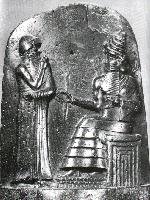
The practice was ancient. Compare these pictures: the first from the Hammurapi stele of the 2nd millennium BCE (which portrays the seated god Shamash instructing a standing Hammurapi in the ways of justice) and a Greek vase, more than 1500 years later (which portrays a student standing before his teacher, who is consulting a laptop folding tablet).


Friday, July 07, 2006

Vermes on the Qumran Concordance

There is not really much drama in the editing of a concordance, but Geza Vermes puts his finger on an important aspect of the recently published Dead Sea Scrolls Concordance. In the course of reviewing said volume, he rehearses the history of Scroll concordances, and mentions the important card-index concordance put forth by John Strugnell in 1988. This privately photocopied book was not meant to be used outside the circle of original Scroll editors and their students. However:

Not only did "illegal" copies circulate among scholars (I received one myself), but as those familiar with the history of Qumran studies well know, an "official" copy of the Concordance, deposited in the library of Hebrew Union College Cincinnati by Strugnell, instead of being kept under lock and key, accidentally found its way to the open shelves and was noticed there by the renowned Talmudist Ben Zion Wacholder. He and a computer-savvy graduate student of his realised that from the concordance it was possible to reconstruct the underlying texts. Their work published in September 1991 ... was the first major breach on the embargo rule imposed on the unpublished manuscripts by the original chief editor Roland de Vaux, and maintained by his successors. The Cincinnati coup was a major contributory factor in the so-called "liberation" of the Qumran scrolls in October 1991. And the name of the graduate student, without whose computer expertise the venture would not have succeeded and who at one stage was threatened with legal proceedings, is none other than Martin G. Abegg, the editor of the present work under review. No revenge could have been sweeter.

I don't know if Marty Abegg has any sense of sweet revenge, but I'm glad to see Vermes reminding people of how much Marty and his trusty computer have meant to the history of Qumran studies.

Vermes's verdict on the Concordance: "an outstanding achievement ... truly indispensable." It's always nice to hear such kind words about a project in which one has participated.

BIBLIOGRAPHY: Vermes's review appears in Journal of Jewish Studies 57 (Spring 2006), 177-179.

Wednesday, June 28, 2006

Brooke on Book by Cook (et al.)

G. J. Brooke reviews The Dead Sea Scrolls Concordance, Vol. I, on which I was a collaborator, in the Society for Old Testament Study Book List 2004: "a magnificent achievement." Thank you, George! He also says, "I have not yet found any errors." Well, keep looking, you will. Not many, I hope.

We are currently working on Vol. 2, a concordance of the biblical texts.

BIBLIOGRAPHY: Martin Abegg with James Bowley and Edward Cook, The Dead Sea Scrolls Concordance. I. The Non-Biblical Texts from Qumran. Leiden: Brill, 2003.

Tuesday, June 20, 2006

Bibliographical Note

For what it's worth, the newest issue of Near Eastern Archaeology has published my "Forgery Indictments and BAR: Learning from Hindsight," as well as other contributions to the SBL Forum that originally appeared on-line in March 2005. You can read it for free by finding the proper link on the right-hand side of this blog.

Fans of "Ralph" will recall that the article had its origin in a series of posts here in 2004-2005.

I'm a little ambivalent about the long Nachleben of this piece. It is not my career ambition to become known principally as an antagonist of Hershel Shanks, a man I like personally and respect professionally. Nevertheless, I think the points I made were important and I stand by them.

By the way, the magazine identifies me as "Research Consultant, West Semitic Research Project," which was true in March 2005, but now is not. (The grant under which I was working for WSRP has expired.) I should stress that the viewpoint of my article is not necessarily that of the WSRP.

BIBLIOGRAPHY: Edward M. Cook, "The Forgery Indictments and BAR: Learning from Hindsight," Near Eastern Archaeology 68/1-2 March-June 2005 [appeared 2006], pp. 73-75.

Monday, June 19, 2006

Here and There on a Monday

Father's Day: This weekend my lovely children took me to see Nacho Libre, which we all enjoyed hugely, unlike most critics. Since my daughter is getting married in August (to an excellent young man) and moving to California (where she will begin doctoral studies at Stanford), this may be the last Father's Day for a while for us all to be together. *sniff*

ECUSA: Looks like dark days in the ECUSA for orthodoxy. The Episcopalian Church is well on its way to becoming Unitarianism, With Mass. Am I concerned about Katherine, our new presiding bishop? Yes. Not because she's a woman — that's no big deal — but because her respect for Scripture and tradition seems to be weak, as far as I can tell. The leftists in the denomination, as this example shows, are not even bothering to pretend to be nice anymore.

Friday, June 16, 2006

Facing the Caboose: Time-Orientation in Hebrew, Aramaic, and Aymara

An interesting story in Language Log about the Aymara language, which is reported to have a "reverse concept" of time, i.e. the past is considered "in front," while the future is considered "behind." Apparently other Asian and Pacific languages have the same feature.

It should be noted that Hebrew and Aramaic also have this perspective, to some extent. Observe, for instance, Biblical Hebrew yemei qedem, days of old/of long past; the word qedem incorporates the root q-d-m, meaning basically "to be in front of." And every beginning Hebrew student will know of the prepositions אחר and אחרי, which have a spatial meaning, "behind," and a temporal meaning, "after, afterwards, in the future."

In Aramaic, the situation is similar. Something that happened "previously" or "a long time ago" is said to have occurred (min) le-qadmin, using the cognate root q-d-m mentioned above; the preposition qodam "before, in front of" is well-known. In early Aramaic, the root אחר is also used to denote both "behind" and "futurity," but its use fades in later dialects in favor of the neologism bathar "after" (from b + athar, "in place of").

This is not a complete survey of all the time-related words and expressions in Aramaic and Hebrew, but it's enough to show that, cross-linguistically, Aymara is not alone. There is a certain psychological aptness to this system, in that what is in front of one can be seen, while that which is behind cannot be seen. In this respect, the past, which is known and visible, is like the front view, while the future — unseen and unknown — is like the unseen vista behind one's back. It's like sitting on a train facing the caboose.

Wednesday, June 14, 2006

ECUSA fiddles while Bible burns

At the Episcopal Convention in Columbus, they've already had a U2-charist, a communion service featuring the music of (although not the actual voices of) U2. Apparently it triggered

a joyous celebration in response to the Episcopal Church embracing the goals set forth by the United Nations: eradicate extreme poverty and hunger, achieve universal primary education, promote gender equality, reduce child mortality, improve maternal health, combat HIV/AIDS, ensure environmental sustainability and create a global partnership for development.

Well, whoop-de-do. Yep, those are all good things, I guess. But pardon me for questioning whether the Episcopalians (of which I am one, at least for now) ought to be joyously rubber-stamping vague UN "goals." Did Christ say, "Go ye into all the world and achieve universal primary education"? For all I know, some of the bishops may think exactly that. You never can tell with Episcopalian bishops.

Dear God, how the ECUSA could use a good swift kick in the pants right about now. I doubt whether anyone will give it to them.

Monday, June 05, 2006

June 6: A beastly day?

Lots of mindless tittle-tattle on the Internet concerning the date tomorrow — 6/6/06. Ooooh! Isn't that the Number of the Beast, according to Revelation 13:18? What if something happens?

Fear not. The number of the beast is not 666 ("six six six"), it's six hundred and sixty-six. There's nothing ominous about the number 6 three times in a row; that's just the way we write that particular number in Western arithmetic. Is there anything scary about DCLXVI (= six hundred sixty-six in Roman numerals)?

Plus, it's not completely clear that 666 is the original number of the beast (see here), although it probably is.

Monday, May 29, 2006

Warriors

Memorial Day in the US is for the remembrance of those who died fighting for their country. I don't know of anyone related to me who has died in battle, but there've been a few who did serve in the military and saw combat.

My great-great-great-uncle Andrew Kincannon (d. 1829), fought in the battle of King's Mountain (1780) against American Tories and the British.

My great-grandfather Joseph Pope Morgan ("Granpappy", d. 1933) served in the Confederate Army (3rd Mississippi) and was wounded in the battle of Chickamauga.

My step-grandfather Bill Erkelens (d. 1965), flew in bomber biplanes in World War I as the gunner. "How many German planes did you shoot down?" I asked him once, when I was a kid. He said, "Just one," and looked away. Not a good memory.

My uncle Joe Morgan (d. 1966), served in the Pacific Theater in World War II, most notably on the island of Peleliu.

My father, Charles G. Cook (d. 1985), was a bomber pilot (B-17's) during World War II. In 1948, he flew C-47's in the Berlin Airlift. Later, in the early '50's, he was stationed on Guam and was a "typhoon spotter," flying 27 missions into the center of typhoons to gather meteorological data.

My brother, Chuck Cook, was in Vietnam (I think actually Cambodia) as a radio communications specialist.

I'll also mention my wife Amy's illustrious ancestor, Nathaniel Chapman, who was one of the original Minutemen and fought at Bunker Hill. One of his children, John Chapman, became better known as Johnny Appleseed. (JA's half-brother, also named Nathaniel, is Amy's great-great-great-grandfather.)

Me? I gave up my student deferment in 1971; that year my lottery number was 189, and they didn't draft me. According to the rules in place then, if you weren't drafted the first year you were 1-A, you couldn't be drafted later. Although I had grave misgivings about Vietnam (who didn't?), I had no plans to dodge the draft or to declare myself a conscientious objector. If I had, my father might have done me serious harm, and I was more afraid of him than of the Viet Cong. But by the luck of the draw, I was passed by. Nothing to be proud of, but at least no one had to go in my place.

Sunday, May 21, 2006

Goodbye, Shelby

Yesterday our long-time family dog, Shelby, was put to sleep at the age of 15. We acquired him in the fall of 1990 as a puppy, when the kids were 7 and 3. Now they are 22 and 18, all grown up, and, as if his work was done, Shelby's body started to give out. He had a good long run as our friend, playmate, and little brother.

He was a mixed-breed dog of medium size, with a beagle-type head and ears, but with a hunter's deep chest and slender hips. It's a pity that none of us have ever been hunters, because he would have excelled at that; he knew how to point, and when he barked (not very often, for he was rather quiet), it was with the hound dog's arooo! and not the yike-yike-yike of the lapdog. Occasionally he would slip through the security system for independent forays, returning hours later with some strange dog's supper dish. And who will ever forget the time when he snuck into the kitchen and ate an entire plate of brownies, with no ill effects? He was the children's special friend, sleeping on their beds until his hips and legs became too fragile to manage even that small hop.

With most species, we share the planet as passengers share the same train (although no doubt the animal creation finds us an unusually loud, smelly, violent, and unruly group to travel with), and God's purpose and plan for them is a complete mystery; neither Scripture, tradition, nor reason give us any clue about the post-mortem fate of creatures, if any. But the species Canis domesticus seems to have evolved alongside Homo sapiens, and their fate — biologically, at least — seems intertwined with ours, their behaviors shaped by human habits.

Even the few hints about our own human destiny do not encourage the view that the Resurrection life is just this world all over again; and yet there must be some kind of continuity at some level. Otherwise talk about "the new creation" would be devoid of content, denoting only "unimaginable beings in some unimaginable mode of existence." Since there must be some continuity, perhaps it is not going too far to hope that these creatures, at least, may find a place in the new heaven and new earth; and that when we awake in newness of life, out of all the other wonders in store for us, one of them might be the sight of our glorified dogs jumping up to lick our faces.

In closing, I append a poem by Robinson Jeffers, called "The House Dog's Grave." Many thanks to Michael Gilleland, who recently included it in his blog.

I've changed my ways a little; I cannot now
Run with you in the evenings along the shore,
Except in a kind of dream; and you, if you dream a moment,
You see me there.

So leave awhile the paw-marks on the front door
Where I used to scratch to go out or in,
And you'd soon open; leave on the kitchen floor
The marks of my drinking-pan.

I cannot lie by your fire as I used to do
On the warm stone,
Nor at the foot of your bed; no, all the nights through
I lie alone.

But your kind thought has laid me less than six feet
Outside your window where firelight so often plays,
And where you sit to read - and I fear often grieving for me -
Every night your lamplight lies on my place.

You, man and woman, live so long, it is hard
To think of you ever dying.
A little dog would get tired, living so long.
I hope that when you are lying

Under the ground like me your lives will appear
As good and joyful as mine.
No, dears, that's too much hope: you are not so well cared for
As I have been.

And never have known the passionate undivided
Fidelities that I knew.
Your minds are perhaps too active, too many-sided...
But to me you were true.

You were never masters, but friends. I was your friend.
I loved you well, and was loved. Deep love endures
To the end and far past the end. If this is my end,
I am not lonely. I am not afraid. I am still yours.

Friday, May 19, 2006

Au lieu de moi

Sorry I've been non-blogging lately, a trend that shows no signs of letting up. (Or is that "every sign of not letting up"? Oh well.)

In place of my own ideas, here's a couple of links from Slate. First, a review of the movie of The DaVinci Code. A quotation:
To my mind, the most ineffable gnostic secret of all is how such hooey has managed to capture the imagination of tens of millions of people all around the world.
Also, please note that Slate now has its own biblioblogger, sort of.

Thursday, May 11, 2006

Lost Again

Forget the Gospel of Judas, the DaVinci Code, the Dead Sea Scrolls — the most pored-over, closely read mystery text in the U.S. today is undoubtedly the Blast Door Map from Lost.

We learned one interesting thing last night; the "?" site is the Pearl station. That puts Locke and Eko at least one step ahead of the unknown map-maker, who labeled the site "Purpose unknown." Locke's fear that what they found at the station invalidates his button-pushing mission may (or may not) be addressed by the Latin tag attached to this station on the Map: Nil actum reputa si quid superest agendum, "Nothing is considered done if anything remains to be done."

One reading on the Map should be corrected; although everyone reads Credo nos in fluctu eodem esse (at about 2 o'clock on the map), the word eodem is not there. "I believe we are in a/the wave."

Speculation: I think the Others must live underground and travel by tunnel. I guess we're about to find out.

By the way, if you're not getting enough egghead in your Lost diet, you should know that there is an online Journal of "Lost" Studies.

Thursday, May 04, 2006

Books 'n' Records

Just a few notes on what's on the bookshelf/CD player:

Last week I read The Power and the Glory, this week I'm reading The End of the Affair, both for the first time. Where have you been all my life, Graham Greene? ... Over the weekend I read King Dork, by Frank Portman, which was good, although my expectations were slightly higher than the book turned out to be. The kids in this young-adult novel, by the way, don't listen to CDs (it's vinyl instead), nor do they have cell phones, cars, iPods, or any of the other iconic impedimenta of today's youth. And yet it's supposed to take place in the present day? Try around 1985 instead ... The Fiery Furnaces have just come out with Bitter Tea, and I can't recommend it too highly. Just as plot is the backbone of fiction, and draughtsmanship of art, melody is the backbone of music — and no-one these days writes better melodies than FF's Matt Friedberger. The fact that he festoons them with all kinds of collaged sound effects, synth blats and beeps, backwards tapes, and cartoonish keyboard doodles matters not a whit (in fact, I like it): the tunes themselves adhere to the synapses with the delirious speed of ad jingles. But what ad jingle ever had lyrics like

The isolated lady,
an isolated older lady:
a dignified dame who keeps her own counsel,
in love with the out-of-the-way,
identifying with the unfamiliar,
contemptuously turns her back on the wicked world
with its vulgar delusions and correspondingly
scorns its regard.
("Whistle Rhapsody")

Very cool.