Thursday, June 23, 2005

Rasheed Wallace and the Synoptic Problem

The always stimulating Language Log provides more grist at this post. Mark Liberman is interested there in possible collocations in English, but his post interested me as an example of the problem of written transmission of oral sources. The quotes in the following are taken from that post, but are put to a different use.

Rasheed Wallace, the great forward for the Detroit Pistons, arguably let his team down in Game 5 of the NBA Finals when he left his counterpart on the Spurs, Robert Horry, unguarded to make the winning 3-pointer. After Game 6, which Rasheed helped his team win, he was asked in the pool press conference what made the difference between his Game 5 and Game 6 performances. These are the reported replies:

New York Times: "I just made a bonehead play the other night," said Wallace, who finished with 16 points. "I had to put it behind me, it was over with and I had to come to play tonight."

Philadelphia Inquirer: "Even though I did a bonehead play the other night, I just had to put it behind me," Wallace said.

Houston Chronicle: "I did a bonehead play the other night," he said. "I had to put it behind me. It was over with. It was no pressure. I don't feel pressure. I had to do the things I needed to do."

Toronto Sun: "I did a bonehead play the other night (leaving the Spurs' Robert Horry open for the winning shot in Game 5), but I had to put it behind me," Wallace said.

Obviously the same utterance is being reported, but the words are slightly different. Everyone has the phrase "bonehead play," but only the Times says he "made" it, not "did" it. The Times also says he "just" made the play, while the Inquirer says he "just" put it behind him. The Chronicle and the Sun don't have "just" at all. The Inquirer puts the bonehead play in a subordinate clause ("even though..."), while the others don't. The Chronicle has a sequence the others don't, about "pressure." The papers also differ on what Rasheed felt he "had to" do. The Times has two things he had to do: put it behind him, and come to play. The Inquirer and the Sun just have the first one, while the Chronicle agrees he had to do two things, but they are put it behind him, and "do the things I needed to do."

Now all these guys were listening to the same press conference and, I assume, were taking notes by hand. If they recorded the utterance, they still had to write/type it out by hand. Even so, they were unable to agree on the ipsissima verba Rasheedi, although, arguably, one can hear in their stories the ipsissima vox Rasheedi.

As it happens, there is a transcript of the press conference, and we have the verbatim utterance of Rasheed:
Just went at it as another good game. Even though I did a bonehead play the other night, had to put it behind me. It was over with, just came out and had to play tonight.
Now compare the "real" thing with the reports. The Times and Inquirer writers did hear "just" (twice), but inserted it at the wrong places. The Inquirer was right about the subordinate clause. The Times and the Chronicle were right about the two "had to"'s, but were wrong about the second one: he "had to play," not "had to come to play" (Times) or "do the things I needed to do" (Chronicle — what was this guy smoking?). None of them reproduce the introductory remark about "another good game." The Sun and the Inquirer abridge the whole utterance. And he "did" the play, not "made" it.

All of these differences — revision, reordering, abridgement, etc. — are paralleled in the Synoptic Gospels. What interests me is that the results from this little real-life sample are not unlike the results gained elsewhere from studies of oral transmission and written transmission, especially the very interesting article by Robert McIver and Marie Carroll in JBL 121 (see below). They performed experiments to test the reliability of oral transmission and written transmission, but they didn't test the reliability of written notes on an oral utterance. I've always thought it was highly possible that the first auditors of Jesus (or of the apostles, if that makes you more comfortable) took notes, a perfectly normal thing to do in antiquity. But — if the "Rasheed test" is typical — even that does not guarantee any kind of verbatim record. As for me, I'm satisfied with the ipsissima vox. (Note to self: also relevant for comparison of Targumim.)

In conclusion, I'll give another example from the same Language Log post. In this case, we don't have a transcript, so you'll have to use your critical faculties to decide which is closest to the "living voice." The speaker is A. J. Feeley, backup quarterback for the Philadelphia Eagles. A. J., are you going to reward your offensive line by taking them out to dinner? The Synoptic response:

"On my salary, I'll take them out to Wendy's for a cheeseburger," Feeley said. "Make it a limit of one." (Philadelphia Inquirer)

"With my salary, I'll take 'em out to Wendy's for a cheeseburger," Feeley said, flashing his perfect smile for the cameras. "And they get limited to one...the Happy Meal." (New York Daily News)

"With my salary," he said, "I can take them all out to Wendy's for dinner. Limit them each to one cheeseburger." (New York Times)

My guess is that the "Markan" redaction is found in the Daily News. It's all there, the vernacular language ("take 'em"), the personal detail (the smile), and the vivid lifestyle reference (the Happy Meal). The "Matthean" redaction is the Inquirer, which abridges the statement, omits the smile and the Happy Meal, and cleans up the language. The New York Times is the "Lukan" representative, who also leaves out the smile and the Happy Meal, eliminates all traces of colloquialism ("I can take them all out" for "I'll take 'em out"), and introduces a reference to "dinner," moving "cheeseburger" to the end of the pericope.

Who says sports and scholarship don't mix?

BIBLIOGRAPHY: R. McIver and M. Carroll, "Experiments to Develop Criteria for Determining the Existence of Written Sources, and Their Potential Implications for the Synoptic Problem," Journal of Biblical Literature 121 (2002): 667-687.

UPDATE (6/24): Mark Liberman responds and includes a more exact transcript of the Rasheed pericope.

Wednesday, June 22, 2005

CBS and the Junkumentary

Last night, whenever there was a timeout during the Pistons-Spurs game, I switched over to the "100 Greatest Movie Quotes" show on CBS. It was clear from this limited exposure that the networks have no idea of how to make junkumentaries (my word, as far as I know). VH1 churns these things out by the truckload, and they're fun (100 Greatest Metal Moments, etc.) as long as the brain is disengaged. But VH1 knows what to do with talking heads; have them on for five seconds, then go back to the clips. CBS thinks it has to move up really close to them, vary the angle and lighting, and in general treat the heads like the Delphic oracle. I think they were trying to fool us into thinking this was a real, critical look at film instead of the quickie junk it actually was. ("We're CBS! We're not cable!")

As for the quotes? The usual suspects, as far as I could tell. My own quotes would have been dramatically different. Here's a selection off the top of my head:

"I caught you a delicious bass." (Napoleon Dynamite)

"Do the chickens have large talons?" (Napoleon Dynamite)

"Back off man, I'm a scientist." (Ghostbusters)

"Whassup?" (A Night at the Roxbury)

"Max, are we going through plutonium?" (Annie Hall)

Rebels are we,
Born to be free,
Just like the fish in the sea.
(Bananas and Sleeper)

SONIA: Boris, let me show you how absurd your position is. All right, let's say that there is no God and each man is free to do exactly as he chooses. Well, what prevents you from murdering somebody?
BORIS: Well, murder is immoral.
SONIA: Immorality is subjective.
BORIS: But subjectivity is objective.
SONIA: Not in any rational scheme of perception.
BORIS: Perception is irrational. It implies immanence.
SONIA: The judgment of any system or a priori relation of phenomena exists in any rational or metaphysical or at least epistemological contradiction to an abstract and empirical concept such as being, or to be, or to occur, in the thing itself or of the thing itself.
BORIS: Yeah, I've said that many times.
(Love and Death)

Monday, June 20, 2005

Some Movies

I saw some movies this past weekend. Everyone seems to be blogging about "Batman Begins," and I saw it, so I'll join in. It was OK. It was good, in a summer-blockbuster-y kind of way: lots of explosions, gadgets, iron-jawed heroes, slimy villains, last second escapes. The usual stuff. Was it great? No. Actually pretty formulaic. The script didn't make a whole lot of sense. (Why didn't Bats bring the antidote with him in one of his gazillion pockets instead of having to schlepp whats-her-name back to the Batcave to save her sanity? Just so they could have a Race Against Time?)

I might have liked it better if, the day before, I hadn't seen "Howl's Moving Castle." Truly amazing. I have no idea why, in Cincinnati, this movie is tucked away in the local art-house cinematheque instead of being out there at the Jumboplex where America's kiddoes can see it in droves. It had all the excitement of "Batman" — no, make that twice the excitement — and a ton of imagination, of which "Batman" had zero. Some of the visuals had the quality of dreams, and the characters all had character. Three cheers for Miyazaki.

Saturday, June 18, 2005

The Date of C.S. Lewis's Conversion(s)

When I was growing up as a Southern Baptist, I was told many times that if you can't name the very year, month, and day — nay, even the hour — that you became a Christian, your claim to be saved was in serious doubt. I've come to doubt this punctiliar understanding of conversion; I've encountered too many godly people who have "always been Christians" or whose conversion occurred (or is occurring) in increments or installments. This is not to say that the dramatic crisis-conversion is not valid either, but it's not the only way to go.

A case in point is perhaps the most famous conversion in 20th century English-speaking Christianity, that of C. S. Lewis. Not only is there some doubt among his biographers as to the exact date of the conversion, there seems to be some vagueness in Lewis's own writings on the subject.

Readers of Lewis will recall that his conversion took place in two stages. The first was his conversion from a pantheistic Absolute Idealism to Theism. This process is described in some detail in his memoir Surprised by Joy (1955), but the date is not given, beyond "the Trinity Term of 1929." The Trinity Term lasts, I gather, from about mid-April to about mid-June. It is therefore only a slight inaccuracy when Humphrey Carpenter in his book The Inklings refers to CSL's conversion in "the summer of 1929."

Unfortunately, there is no reference in any of Lewis's letters of 1929 to this event. The editor of the Collected Letters, Walter Hooper, guesses that the night when Lewis knelt down in his rooms at Magdalen and admitted "that God was God" was sometime in May 1929. But CSL does not refer to any spiritual change in himself until Jan. 1930 in a letter to Arthur Greeves, in which he refers to his renewed efforts to live a moral life and his afternoon "meditations" — but his language still implies a pantheistic, not a theistic, understanding of God.

And, in a letter that is assigned by the editor to Feb. 1930, Lewis writes to Owen Barfield that "the Spirit ... is showing an alarming tendency to become much more personal and is taking the offensive and behaving just like God." Hooper rightly notes that this experience is also described in Surprised by Joy ch. 14: "Idealism ... cannot be lived. It became patently absurd to go on thinking of 'Spirit' as either ignorant of, or passive to, my approaches." But this realization, as Lewis describes it in the memoir, came before the Trinity Term of 1929. This is impossible. The 1929 date must be incorrect.

Lewis also tells us in SBJ that "as soon as I became a Theist I started attending my parish church on Sundays and my college chapel on weekdays." It is not until Oct. 1930 that Lewis writes to Greeves that "I have started going to morning Chapel at 8." Although one cannot be sure when this habit began, it's unlikely that a man who had been going to chapel for over a year would write in this way.

I've therefore become convinced that Lewis misremembered the date of his conversion to Theism, and that it was very likely the Trinity Term (or even later) of 1930, not 1929, that saw the crucial change from Pantheism to Theism.

But is it conceivable that Lewis himself could have gotten this date wrong? He was notoriously vague about dates. We find him writing in July 1939 to a correspondent that "though I'm 40 years old as a man I'm only about 12 as a Christian." "About 12" would place his conversion to Christianity (which came in 1931) around 1927, which is too early on any reckoning. In Feb. 1946 he tells another correspondent that "my beliefs continued to be agnostic, with fluctuation towards pantheism ... till I was about 29." "About 29" would be in the year 1927 or 1928 (Lewis was born Nov. 29, 1898); again too early, on the evidence of the letters. Lewis's own recollection was too vague to be relied upon.

Oddly enough, we are in better shape concerning the second stage of his conversion, when he accepted Christianity. I say "oddly" because Lewis admits in SBJ that he himself remembered little about it. His letters from the time, however, fill in the blanks of the memoir. On Sept. 19, 1931, Lewis had a long discussion with J. R. R. Tolkien and H. V. Dyson in which his last objections to Christianity were overcome; the details are given in several letters to Greeves.

On Oct. 1, 1931, Lewis tells Greeves "I have just passed on from believing in God to definitely believing in Christ — in Christianity.... My long night talk with Dyson and Tolkien had a good deal to do with it." The conversation is not described in SBJ, and he does not mention in this letter the trip to the zoo he describes in SBJ:
I know very well when ... the final step was taken. I was driven to Whipsnade one sunny morning. When we set out I did not believe that Jesus Christ is the Son of God, and when we reached the zoo I did.
There seems to be no documentation of exactly what day this was. Hooper states that it was Sept. 28, 1931, while George Sayer in his biography of Lewis says that it was Sept. 22. All we know for certain is that it had to take place between Sept. 19 (the date of the Tolkien-Dyson conversation) and Oct. 1 (the date of the letter to Greeves).

Well, what is the upshot of all this? Simply that Lewis's (and our) uncertainty surrounding the exact dates of his conversion(s) are not, in the final analysis, all that important. As he himself said: "As for what we commonly call Will, and what we commonly call Emotion, I fancy these usually talk too loud, protest too much, to be quite believed, and we have a secret suspicion that the great passion or the iron resolution is partly a put-up job." It is not Lewis's (or our) remembered decisions or emotions that finally tell the story of conversion; the true story, the important details, of all our biographies, can only be told from the perspective of Heaven. We are all unreliable narrators; but — "there is One Who is reliable."

Tuesday, June 14, 2005

Dylan and the Bleeding Tree

In Bob Dylan's "A Hard Rain's A-Gonna Fall" (1963), the narrator speaks of a series of frightening and ominous things that he encountered on his journey, all of them heavily loaded with symbolism. One of them is this:
I saw a black branch with blood that kept drippin'
I've always been intrigued by the possibility that Dylan was influenced by a scene in Dante's Inferno when writing this line. In the seventh circle (Canto 13), Virgil leads Dante through the Wood of Suicides, where Dante breaks off a twig from one of the trees:
Then I stretched my hand a little forward and plucked a branchlet from a great thorn-bush, and its trunk cried out, "Why dost thou rend me?" When it had become dark with blood it began again to cry, "Why dost thou tear me? hast thou not any spirit of pity? Men we were, and now we are become stocks; truly thy hand ought to be more pitiful had we been the souls of serpents." (tr. Charles Eliot Norton)
As all the commentators note, Dante in turn is influenced by a scene in Virgil's Aeneid (Book 3):

There, while I went to crop the sylvan scenes,
And shade our altar with their leafy greens,
I pull'd a plant- with horror I relate
A prodigy so strange and full of fate.
The rooted fibers rose, and from the wound
Black bloody drops distill'd upon the ground.
(John Dryden translation)

In the 16th century, Spenser used the same image in The Faerie Queene:

And thinking of those braunches greene to frame
A girlond for her dainty forehead fit,
He pluckt a bough; out of whose rift there came
Small drops of gory bloud, that trickled downe the same.

In all these cases the tree is in fact a human being; but only in Dante's case is the arborification of the human a punishment for a specific sin, namely suicide. (The human trees in Virgil and Spenser just happened to fall afoul of the wrong god or witch.) This fits well in the context of Dylan's song, where the images in the catalog all have some kind of moral resonance.

And we now know that Dylan in the early '60's was reading The Inferno. He mentions it in his memoir Chronicles Volume One.

Still, even after all this source hunting, I remain uncertain. It recently struck me that an equally good source (if we must have a source) is the anti-lynching protest song "Strange Fruit" made famous by Billie Holliday:

Southern trees bear strange fruit,
Blood on the leaves and blood at the root

"Strange Fruit" was written by a Jewish songwriter (Abel Meeropol) under a different name (Lewis Allan). Meeropol was also known for having adopted the children of Julius and Ethel Rosenberg after their execution. It seems likely to me that Dylan, who was active in New York leftist circles in the early '60's, might have been attracted to this song for many reasons. ("Strange Fruit" is also mentioned in Chronicles.)

Sunday, June 12, 2005

WAC and the Sicarii

Danny Zacharias at deinde.org has been reading Wise-Abegg-Cook:

My sense is that it was probably Michael Wise who wrote the essay proposing that the Qumran sect was Sicarii in orientation. It was an interesting read, and I am curious to hear what others think of it. Ultimately I was unconvinced, but his noting of texts also found at Masada, as well as his explanation for the existence of 4Q448 (In Praise of King Jonathan) at Qumran was interesting. I am wondering what other readers or bloggers think about it. Perhaps Ed Cook would have time to blog about, since his name is technically attached to the proposal.

In fact, the introduction to Wise-Abegg-Cook (up to page 35) was drafted by me and then revised by both Marty and Mike. Therefore my name is more than "technically attached" to it.

Danny, if you will re-read the introduction with more care, you will see that there is no proposal that "the Qumran sect was Sicarii in orientation." The key sentence is found at the top of page 33, "After the Romans came to power, the situation changed." Our model sees the proper background for the Qumran scrolls in the internecine strife in the Hasmonean state of the first half of the first century BCE. The sect, broadly speaking, chose the anti-Pharisaic side in this dispute; the Sicarii did not yet exist. There are no specifically sectarian texts that seemed to have been composed after the Romans came to power; but, in the first century CE, sectarian compositions (War Scroll, 1QS, etc.) seem to have influenced and been adopted by other, "carrier" groups that may, or may not, have descended directly from the first century BCE group that composed the sectarian texts. One of these groups may have been the Essenes as Josephus describes them; there is strong evidence that another such group was the Sicarii. Therefore it would have been more accurate to say that "the Sicarii were 'Qumranian' in orientation" than the other way around.

I have previously blogged about the dating of the Scrolls here and here.

The revision has been completed for the second edition of Wise-Abegg-Cook; hopefully it will be in print by November and available at SBL.

A picture of the three of us at our last editorial meeting can be seen here; I'm on the left.

Saturday, June 11, 2005

The Flaming Fire Illustrated Bible

This is an interesting venture in multimedia Bible. (HT: Ann Althouse.) Caution: Not all of the illustrations are unto edification.

Wednesday, June 08, 2005

Ancient Stench and Corpse Removal

My "research" into the stench of ancient cities has thrown some light on a couple of passages in Jewish literature that always puzzled me. The ancients seemed to take a remarkably laid-back attitude to corpse removal, as this quote from Suetonius shows:
During Vespasian's aedileship, the Emperor Caligula, furious because Vespasian had not kept the streets clean, as was his duty, ordered some soldiers to load him with mud; they obeyed by stuffing into the fold of his senatorial gown as much as it could hold ... Then a stray dog picked up a human hand at the crossroads, which it brought into the room where Vespasian was breakfasting and dropped it under the table. (HT: David Noy).
My guess is that the corpses that tended to accumulate in the open were those of foreign travelers, slaves, criminals, or other pariah groups. This explains, I think, why Tobit was able to keep pretty busy at his avocation of burying fellow Jews:
If I saw the dead body of any of my people thrown out behind the wall of Nineveh, I would bury it. (Tobit 1:17) [Tobias said]: “Look, father, one of our own people has been murdered and thrown into the market place, and now he lies there strangled.” (2:3)
And lastly, the Mishnah quotes a saying of Hillel (Pirke Aboth 2:7):
One time he saw a skull (or: head) floating on the waters, he said to it: Because you drowned others, they drowned you; in the end, those who drowned you will drown.
I always thought the occasion for this saying was strange; how likely was it that someone would see a human skull in the water? But now I can see that it would not have been that unusual.

Monday, June 06, 2005

Aramaic Wordplay in Matt. 3:9 par.?

I've been reading Maurice Casey's Aramaic Sources of Mark's Gospel, and so far (I haven't read much) it's good, especially on the methodological side.

I have some quibbles with the Aramaic, though. For instance: Casey discusses A. Meyer's idea that there is an underlying Aramaic wordplay at Matt. 3:9 || Luke 3:8: "God is able of these stones (Gk. lithon = Aram. abnayya ) to raise up children (Gk. tekna = Aram. benayya) unto Abraham." This suggestion has made its way into many a commentary.

But Casey says:
That is not unreasonable, but it does involve the selection of benayya, which might well have been translated huious, rather than ynqyn, which was bound to be rendered tekna. (p. 13)
Casey's point, and it is well taken, is that you can't just translate the Greek backwards into Aramaic to find wordplays and such; you have to imagine how a translator would most likely have rendered any putative Aramaic original. He thinks that benayya would most likely have been rendered "sons," not "children"; yanqin is the Aramaic word most likely to have been rendered "children."

However, this clashes with another one of Casey's methodological points, and that is that the words of a putative Aramaic original have to be attested from the Aramaic of the right period. And the word yaneq, plural yanqin, is not attested in Qumran Aramaic or other Palestinian sources of this period. Not only that but semantically yaneq (etymologically "suckling") focuses on the youth of the person designated, not on their biological descent. Therefore in different dialects, yaneq can mean "boy" (Targum Onkelos), "infant" (Targum Neofiti) or just "young one" (Elephantine papyri). The best Greek equivalent for yaneq in the New Testament period would have been paidarion or nepios, not teknon.

Plus, teknon is well-established in the LXX as a translation of Hebrew ben, "son, child" (e.g. Gen. 22:7). Therefore, I conclude that Casey's critique falls to the ground.

That does not mean that there really was a wordplay in Matt. 3:9||Luke 3:8, though. For the wordplay to work, both "stones" and "children" have to be in the emphatic state, equivalent to the Greek article. But in the Greek, "these stones" has the article, but "children" does not. Therefore, if there is an Aramaic original underlying this saying, "these stones" would have been abnayya illen, and "children" would have been just benin, not benayya as Meyer thought. Not much of a pun. Therefore, IMHO, there was no Aramaic wordplay present in Matt. 3:9||Luke 3:8.

UPDATE (6/7): Ken Penner rightly asks in a comment below whether the wordplay might be better in Hebrew, rather than in Aramaic. Yes, it might. Delitzsch, for instance, in his Hebrew New Testament, translates min ha-abanim ha-elleh yakhol ha-elohim le-haqim banim le-abraham. It is also undoubtedly true that in some instances Hebrew is just as good a candidate for the substratum of the Gospels as Aramaic, since we now know that Hebrew was by no means a dead language in the first century CE.

Nevertheless, this has to be weighed against the preponderance of evidence showing that Jesus taught in Aramaic and that the early church was Aramaic-speaking. Not only that, but the Hebrew back-translation is more vulnerable to Casey's critique than the Aramaic one, because, while tekna might be a perfectly good translation of Hebrew banim, it also might render Hebrew yeled, pl. yeladim, which, like teknon, is related to a root meaning "to beget." (See Gen 33:6 LXX.) (Now that I think of it, the Aramaic cognate yelad, yaldin would also fit.) Therefore, I think strong evidence is lacking for Hebrew or Aramaic wordplay in this pericope (which does not mean I think there is no evidence for a Semitic substratum in the Gospels).

UPDATE (6/10): Mark Goodacre comments here. Jim Davila comments as follows:
I think Casey's methodology is weak. His discussions of translation theory and bilingualism don't feed directly into the rest of the book in any way that is clear to me. And he neglects or ignores a considerable secondary literature on problems with retroversion of Hebrew and Aramaic from Greek (Beyer, Maloney, Martin, Fitzmyer, Barr, Tov, Wright, etc.).
I don't necessarily disagree with Jim, as I haven't read more than about 20 pages of Casey at this point, and haven't gotten past Casey's review of past literature. If what Jim says is true, then what is (in my opinion) the book's good beginning methodologically goes downhill. I'll let you know what I think.

I will say this: Based on some casual glances at Casey's retroversions later in the book, I would say that his grasp of Aramaic is weak and is not up to the task of retroversion (whether that task is worthwhile or not). That sounds terrible, I know, and I hope to back up that opinion later on with some examples. (In the meantime, see Randy Buth's comment below.) But it is a fatal weakness for such a book on such a topic.

Friday, June 03, 2005

Ararat, Urartu, Lubar, Kardu

Apparently they are still looking for Noah's ark on "Mount Ararat," also known as Agri Dagi.

I suppose it is worth repeating that the biblical text does not mention a particular peak where Noah landed, but refers to the "mountainS of Ararat." Ararat was not a mountain, but a kingdom — the ancient name is Urartu — in the vicinity of Lake Van in modern-day Turkey. I don't know whether its borders extended as far north as the location of Agri Dagi, in the northeast of Turkey next to Armenia.

The Book of Jubilees (2nd century BCE?) named the mountain as "Mount Lubar." The Targum and Peshitta designated the area as "Kardu" or Cordyene, now known as Kurdistan. Jerome translated the key phrase as super montes Armeniae. Apparently the idea that Agri Dagi was the site of the ark's landing dates only from the 11th-12th centuries CE.

BIBLIOGRAPHY: Lloyd Bailey, "Ararat," Anchor Bible Dictionary I:351-353.

Wednesday, June 01, 2005

Sith Happens: Thoughts on Episode III

(Caution: spoilers ahead.)

This past weekend I finally saw Revenge of the Sith. I thoroughly enjoyed it, as I have all of the "Star Wars" movies (even the hapless Episode I — Jar Jar reminds me of a dog I used to have). Amy didn't; she had problems with the script. The Lad went with us; it was his third viewing, although the first one experienced with full sentience, since his first two were late-night outings.

I said just now that I enjoyed it, and I'll stand by that. It was a visual feast, with the full complement of space battles (with physically impossible sounds in the vacuum of space), gloriously impractical machines (tanks with legs?), and the spectacularly creepy General Grievous — a character that ignites all our subconscious fears of spiders, skeletons, sharp objects, and physical deformity in one wonderful design.

(Speaking of design, the Jedi archives look exactly like the Long Room in Trinity College, Dublin, as this site shows. Apparently Lucasfilm has denied any borrowing.)

Not only that, there were some scenes of great mythical power, especially when the Emperor descends to the banks of the lava rivers of Hell (also known as Mustafar) and retrieves the battered husk that is Anakin, to restore him to a tortured existence as Darth Vader. It is a hideous parody of the Resurrection, with a little Frankenstein thrown in.

However, the mythic power is often undermined by intrusions into the script from the Zeitgeist. At some point, Obi-Wan says, "Only the Sith deal in absolutes." Huh? So that would make the Jedi ... relativists? Post-modernists? Obviously the whole story falls to the ground unless the Emperor and the Dark Side are evil and the Jedi good, and those, folks, are absolutes. Seems to me like the line should have been, "Only the Sith believe in situation ethics"; or, "Only the Sith try to make evil seem like good." Especially given this exchange:
OBI-WAN: Anakin, Chancellor Palpatine is evil.

ANAKIN: From the Jedi point of view! From my point of view, the Jedi are evil.
But in the 21st-century USA, believing in absolutes is Bad, and suddenly we are not in a galaxy far, far away anymore. Boo, George Lucas!

There is also a scene of toe-curling badness, where Yoda is counseling Anakin; it needs only Anakin on a couch and Yoda with a notepad to make it a complete parallel to psychotherapy. Anakin is afraid Padme will die in childbirth:
YODA: Death is a natural part of life. Rejoice for those around you who transform into the Force. Mourn them, do not. Miss them, do not. Attachment leads to jealousy. The shadow of greed, that is.

ANAKIN: What must I do, Master Yoda?

YODA: Train yourself to let go of everything you fear to lose.

Eww. No, Master Yoda, that won't work, especially when it is Anakin's re-awakened love for his son (in "Return of the Jedi") that leads to his redemption.

So: Revenge of the Sith is not a deep movie, although it tries to be; the best things in it, as in its five predecessors, are the scenes that use, and revitalize, the most basic components of a half-century of pulp sci-fi and fantasy: spaceships, robots, desert planets, weird creatures, good guys and bad, true love triumphant, swords, sorcery, princesses, emperors, magic, treachery, loss, recovery, hidden saviors, secret identities, and ray-guns. When Lucas sticks close to these things, he can't be beat. His fanboy subconscious is mightier than his all-too-modern conscious. Use the Force, George! Thankfully, he did. Most of the time.

Monday, May 30, 2005

The Stench of Ancient Cities

A few weeks ago, I was reading a portion of Genesis Rabba (Parasha 34) with some HUC grad students, and we came across a story that begins: "Two women were coming out of Tiberias, and one said to the other: Blessed is He who brought us out of this bad air!"

The story is told to demonstrate how parochial the two women are, for Tiberias was a noted resort and famous city. But it seems likely that, for someone who lived in the country, ancient cities had a definite bad odor. In one of his letters, Seneca writes:

I expect you're keen to hear what effect it had on my health, this decision of mine to leave (Rome). No sooner had I left behind the oppressive atmosphere of the city and that reek of smoking cookers which pour out, along with a cloud of ashes, all the poisonous fumes they've accumulated in their interiors whenever they're started up, than I noticed the change in my condition at once....

Of course, the ancients had very different ideas about sanitation, cleanliness, and modesty. Readers of Josephus will remember the amount of time he devotes to the "strange" Essene toilet habits:

War 2:148-9: "Nay, on the other days they dig a small pit, a foot deep, with a paddle (which kind of hatchet is given them when they are first admitted among them); and covering themselves round with their garment, that they may not affront the divine rays of light, they ease themselves into that pit, after which they put the earth that was dug out again into the pit; and even this they do only in the more lonely places, which they choose out for this purpose; and although this easement of the body be natural, yet it is a rule with them to wash themselves after it, as if it were a defilement to them."

Josephus obviously thought it excessively modest to defecate in private (uncovered public latrines were common in his day), and excessively fastidious to wash afterwards — which sheds a certain light on the stench of ancient cities.

Interesting observations (including the quote from Seneca) and bibliography can be found here.

Friday, May 27, 2005

Quran or Koran?

OK, which is it — Koran or Quran? The New York Times vacillates, depending on which wire service they're picking up. If it's Reuters, the headline is "Guantanamo Probe Finds 5 Koran Mishandling Cases." If it's AP, the headline is "Inquiry Finds Some Quran 'Mishandling.' "

I'm not going to discuss the substance of these stories; I hope that all my readers will agree that the "mishandling" is deplorable, as well as counter-productive. But the question of popular transliteration interests me.

There seems to be an overall tendency these days to go with a stricter, more Arabically "correct" transliteration in the media. I notice muslim more often than moslem, Muhammad more often than Mohammed. The preference for quran or even qur'an over "Koran" is in line with this tendency.

Strictly speaking, a transliteration "Quran" seems at first glance linguistically correct. The root of the word is cognate to Hebrew קרא, and both roots refer to (among other things) reading or audible recitation. The qur'aan is the "reading," that which is read or recited (compare Hebrew מקרא, miqra, "that which is read," the Bible).

Nevertheless, the Arabic sound conventionally transliterated as "Q" indicates a phonemic contrast (to Arabic "K") that does not exist in English. In fact, in English, the grapheme QU always indicates the phonetic sequence /kw/, and English speakers are going to want to import that /kw/ pronunciation into the spelling "Quran," leading to the monstrosity /kwuran/ or the like.

Therefore, to better approximate the actual pronunciation of the word, I wish they would settle on the older standard spelling "Koran." In English, the Arabic /q/ and /k/ are both adequately signaled by English K. And after all, English is what we're speaking here, right? We don't refer to certain foreign capitals as Moskva, Yerushalayim, Bruxelles, or Roma. Nor should we adopt the spelling Quran for the Islamic scripture.

By the way, as far as I can tell, in German the spelling is still "Koran," and in French they prefer "Coran." In archaic English the preferred term was apparently "Alcoran," based on Arabic al-qur'aan "the Koran," occasionally leading to the solecism "the Alcoran."

Wednesday, May 25, 2005

Goodacre Becomes Blue Devil; BBC Mourns

Mark Goodacre is crossing the Big Pond to Duke University. Congratulations!

Just one crucial word of advice, Mark: Krzyewski is pronounced "Shashefsky." Practice it at home till you get it right.

Tuesday, May 24, 2005

Happy Birthday, Bob

Today is Bob Dylan's birthday.

Now that it's dust and ashes
now that it's human skin
Here's to you Bob Dylan
a poem for the laurels you win

Sincerest form of flattery
is imitation they say
I've broke my long line down
to write a song your way

Those "chains of flashing images"
that came to you at night
were highest farm boy's day dreams
that glimpse the Angels light.

And tho the dross of wisdom's come
and left you lone on earth
remember when the Angels call
your soul for a new birth

It wasn't dope that gave you truth
nor money that you stole
— was God himself that entered in
shining your heavenly soul.

— Allen Ginsberg, "On Reading Dylan's Writings," 1973

Saturday, May 21, 2005

The Latest "News" From Hershel Shanks

Hershel Shanks is still apparently unwilling to engage in any serious self-criticism or even enter into any serious dialogue on the subject of the recent forgery scandals. In the most recent issue of Biblical Archaeology Review (May/June 2005) he mugs, rants, denounces, criticizes, and mocks — but he does not seriously discuss any of the issues that have been recently raised about the scandal and the role of his magazine.

On p. 46 appears a misleading article entitled "Israeli Prosecutor Repudiates IAA Report on Forgery." This is based on what Shanks sees as a discrepancy between the IAA report on the ossuary and the wording of the forgery indictment — not, as the headline would imply, a new statement by the prosecutor rejecting the work of the IAA. Shanks notes that the forgery indictment claims that only the words "brother of Jesus" on the ossuary were forged, while, he believes, the IAA report claims that the entire inscription was forged. Shanks trumpets this as an "irreconcilable conflict."
There is not a word in the voluminous IAA report even remotely suggesting that the first part of the inscription is authentic, as the indictment now admits.
So, Hershel, have you actually read the IAA report? Then you might remember these words by Esther Eshel:

B.... The inscription itself exhibits variations in handwriting, thickness and depth of the incised letters when comparing the words “James son of Joseph” to the words “brother of Jesus”. ...
C. There is a significant difference between handwritings in the first and second parts of the inscription. The first part is written in the formal style of a scribe and the second part is cursive. The letters bet and kuf in the first part are characteristic writing of a scribe, and the second, cursive part has a characteristic alef.
...
In summary, the different handwritings of the two parts indicate that the inscription is not authentic, although the original ossuary may possibly have contained the first part of the inscription, the second part was added later.
In short, Shanks's article is advocacy journalism gone bad: misleading, sloppy, and inaccurate.

Also in the recent BAR is a wholly unwarranted piece (p. 49) ponderously mocking the recent contribution of Andy Vaughn and Carolyn Dobler in the March SBL Forum. For one thing, Shanks does not give a complete URL for the article, so that readers of BAR will not be able to read it for themselves. (It is here.) For another thing, Shanks does not deal in any way with the gravamen of the Vaughn-Dobler piece, which is the statistical analysis of the seals and the implication that the antiquities market has provided many forged items. In this article, as in all of his recent writings on the scandal, Shanks is not dealing seriously with any of the issues; he is just playing to the gallery and hoping no one will call him to account.

I might blog about a few of Shanks's other remarks in future posts. In closing, though, let me just note that in the SBL Forum in which Vaughn and Dobler's essay appeared, there was another essay dealing solely with Shanks's own contribution to the problem (written, as it happens, by me). Although he must have read it, he does not mention the article at all in BAR. Is he afraid his readers will find it? Would he rather attack others than defend himself? Stay tuned.

Thursday, May 19, 2005

Maarav 11/1 Is Out

The new issue of Maarav: A Journal for the Study of the Northwest Semitic Languages and Literatures (11.1, 2004) has arrived in my mailbox. The table of contents is as follows:

Shmuel Ahituv and Ada Yardeni
"Seventeen Aramaic Texts on Ostraca from Idumea: The Late Persian to the Early Hellenistic Periods"

Seth L. Sanders
"What Was the Alphabet For? The Rise of Written Vernaculars and the Making of Israelite National Literature"

Christopher A. Rollston
"Non-Provenanced Epigraphs II: The Status of Non-Provenanced Epigraphs within the Broader Corpus of Northwest Semitic"

Marilyn J. Lundberg
"Editor's Notes: The Ahiram Inscription"

Edward M. Cook
Review of A Dictionary of Judean Aramaic by Michael Sokoloff

Peter T. Daniels
Review of Absent Voices: The Story of Writing Systems in the West by Rochelle Altman

Lots of interesting stuff here for (and by) bibliobloggers. Go here to find out how to get a subscription for yourself or your institution.

Wednesday, May 18, 2005

Biblioblogoholics

Mark Goodacre describes the upcoming CARG session on biblioblogging, in which I have the honor of participating. Judging by some of the comments out there (collected by Stephen Carlson here), we will all need a professional 12-step program by November.

I guess we're all supposed to confess whether we're addicted or not. Well, I don't know about you, but I am not addicted. No sir! I can quit anytime. I mean it! No problem. Got that? Not a problem!

My Link to Elvis

I grew up in an atmosphere of warm personal interest in Elvis Presley. My grandparents were acquainted with his grandparents and lived in the same small town. When I was 4 or 5 years old, I was taken to see him perform at the Mississippi-Alabama Fair & Dairy Show (back in the days when he was still good).

Now, this past weekend, I discovered that Dr. William Hunt, the doctor who delivered Elvis, was married to my great-aunt Lula.

No, don't write to me asking for memorabilia, I don't have any. But law! ain't it a small world! (Sorry, after being in Mississippi, my Southern accent has reasserted itself.)

Thankyouverymuch.

Tuesday, May 17, 2005

"Sexual Cleansing" and Levirate Marriage

Last week, the New York Times featured an article about the practice of "sexual cleansing" in Africa:

Here and in a number of nearby nations including Zambia and Kenya, a husband's funeral has long concluded with a final ritual: sex between the widow and one of her husband's relatives, to break the bond with his spirit and, it is said, save her and the rest of the village from insanity or disease. Widows have long tolerated it, and traditional leaders have endorsed it, as an unchallenged tradition of rural African life.

Now AIDS is changing that. Political and tribal leaders are starting to speak out publicly against so-called sexual cleansing, condemning it as one reason H.I.V. has spread to 25 million sub-Saharan Africans, killing 2.3 million last year alone. They are being prodded by leaders of the region's fledging women's rights movement, who contend that lack of control over their sex lives is a major reason 6 in 10 of those infected in sub-Saharan Africa are women.

It sounds like a real problem; but I'm probably not the only Biblical scholar who was reminded of the practice of levirate marriage. A woman widowed without children was, in ancient Israel, married to her husband's brother in order, by means of a legal fiction, to bear children to her late husband (Deut. 25:5-10). From the Anchor Bible Dictionary:

This type of marriage is known as levirate marriage, from the Latin levir, “brother-in-law.” Its continuation into the NT era is demonstrated by the Sadducees’ question to Jesus about the childless woman who was married in sequence to six of her late husband’s brothers (Matt 22:23–33 = Mark 12:18–27 = Luke 20:27–40). We have seen that levirate marriage existed in Ugarit, in the Middle Assyrian (no. 33) and Hittite law codes (no. 193), and possibly in the Nuzi texts. In these texts the primary concern is with producing a (male) child to carry on the name of the deceased husband.

Here's my question: Is there any historical connection between the levirate law and the practice of "sexual cleansing"? Is the latter a debased and superstitious form of the former; or is the levirate law a later development of a primitive ritual that originally had nothing to do with "preserving the husband's name"? It seems to me that both alternatives are equally likely. It is also possible, of course, that there is no historical relationship at all. Maybe a historical anthropologist (if there is such a thing) can answer this.

BIBLIOGRAPHY: Richard Kalmin, "Levirate Law," Anchor Bible Dictionary

UPDATE: The article referred to by Andrew in the comment below is excellent. It doesn't address the historical question I raised, but many cross-cultural comparisons suggest themselves.

Wednesday, May 11, 2005

Goin' South

"Ralph" will be on a short hiatus the next few days as we visit kinfolk in Mississippi.

In the meantime, you can enjoy this article by a BBC reporter (HT: Bible & Interpretation), who reports on Mississippi with the air of Livingstone returning from the jungle. He discovers that there are — gasp! — Christians in the Deep South.

Tuesday, May 10, 2005

Google's Peep Show

I've been playing around with Google Print, and enjoying it — up to a point. It promises to be a valuable tool — one of these days. Their mission statement is as follows:

Google's mission is to organize the world's information, but much of that information isn't yet online. Google Print aims to get it there by putting book content where you can find it most easily – right in your Google search results.

Good enough. The problem is, I haven't yet come across a book whose entire content is online. The maximum amount I have been able to access for any one book is about 15 pages.

So what's the point? Is this in fact only an elaborate way of getting users to buy the book, as the numerous "buy this book from" links would suggest? There is in fact supposed to be a "find it in a library" link, but it doesn't appear on any pages that I have seen.

At this point, Google Print (and I know it's in the beta stage) is the print equivalent of a peep show: "Try these free samples! Get hooked and buy the rest!" They're going to have to lift some limitations on presenting full content, or else the tool will be more frustrating than helpful.

Saturday, May 07, 2005

Coleridge's Pants

It is interesting to reflect that John Betjeman was one of C. S. Lewis's first students. They didn't get along.
Even humour separated the two men, and Betjeman complained peevishly that his tutor had forever ruined Coleridge's 'Kubla Khan' by wondering whether the 'pants' in the line, 'As if this earth in fast thick pants were breathing,' were made of wool or fur.
Betjeman would really have hated this blog.

BIBLIOGRAPHY: Oxford in English Literature: The Making, and Undoing, of 'The English Athens', by John Dougill. (Univ. Michigan Press, 1998.)

Friday, May 06, 2005

George Psalmanazar

Mark Goodacre calls our attention to Alice Liddell, of Alice in Wonderland fame, as one of the DNB "Lives of the Week." Another featured life is that of George Psalmanazar (1679-1763), a fascinating character, a mad linguistic genius. A few excerpts:

... Psalmanazar decided to make his identity more exotic, and posed as a Japanese convert to Christianity. To facilitate the project, he revised the certificate that he had had drawn up to prove that he was Irish, and devised an alphabet and many words of a language that he thought might be taken for Japanese. Aware that Hebrew was written from right to left, he imagined that other ‘oriental’ languages would follow that pattern. He invented twenty letters with shapes, names, and pronunciations that resemble some Greek and Hebrew letters. By his own account, he also added ‘many other particulars equally difficult, such as a considerable piece of a new language and grammar, a new division of the year into twenty months, a new religion, &c. and all out of my own head’ (Memoirs, 137).

... this time [he] used the name of Salmanazar (ibid., 169), which he took from the name of a biblical king of Assyria and captor of the Israelites, Shalmaneser (2 Kings 17). Later he began spelling the name with an initial P to make it more exotic.

... [H]is fanciful account of Formosa, which occupies little more than half of the book's 327 pages ... raised doubts about his veracity in several quarters at the same time as it excited many readers. Among his entertaining but suspicious claims were that Formosa was Japanese rather than Chinese; that the state religion, founded by an avatar named Psalmanaazaar, required the annual sacrifice of 18,000 boys under the age of nine; and that the production of children was facilitated by the encouragement of polygamy, although adultery was absolutely forbidden.

... [Regarding other cases of false identity and forgery in the 18th century]: In these and many other cases of forgery and assumed identity in the period, the impostor imagined he had access to hidden information and that he himself was in touch with a deeper or older, often more ‘natural’, tradition of knowledge than that accepted by the current establishment. The flourishing of such forgers at this time may have been a response to the increased professionalization of knowledge during the period. Psalmanazar's quarrel with the Royal Society, his defence of revelation in religion, and his immersion in ancient Hebrew may be all regarded as a rebellion against modern forms of knowledge.

OK, so a "defence of revelation in religion, and an immersion in ancient Hebrew" are rebellions against modernity, are they? Well, count me in. Vive la revolution!

Happily, Psalmanazar eventually recanted his lies, became a believing Christian and a friend of the young Samuel Johnson. He died shortly before Johnson first encountered James Boswell in a London bookshop.

Wednesday, May 04, 2005

Onkelos in Les Miserables

I'm always interested when the targums wind up in unexpected places. I ran into a mention of Onkelos in Victor Hugo's Les Miserables, ch. 5:

[The monsignor] was a man of letters and rather learned. He left behind him five or six very curious manuscripts; among others, a dissertation on this verse in Genesis, In the beginning, the spirit of God floated upon the waters. With this verse he compares three texts: the Arabic verse which says, The winds of God blew; Flavius Josephus who says, A wind from above was precipitated upon the earth; and finally, the Chaldaic paraphrase of Onkelos, which renders it, A wind coming from God blew upon the face of the waters.

The good bishop was apparently interested in renderings of Genesis 1:2 that translated ruach as "wind." No more is said in the novel of this interesting dissertation.

Many modern translations translate "wind," including the JPS and NRSV.

Monday, May 02, 2005

"The Curse of Akkad" and Global Warming

For the first time since cities were built and founded,
The great agricultural tracts produced no grain,
The inundated tracts produced no fish,
The irrigated orchards produced neither syrup nor wine,
The gathered clouds did not rain, the masgurum did not grow.
At that time, one shekel’s worth of oil was only one-half quart,
One shekel’s worth of grain was only one-half quart. . . .
These sold at such prices in the markets of all the cities!
He who slept on the roof, died on the roof,
He who slept in the house, had no burial,
People were flailing at themselves from hunger.

That's from the "Curse of Akkad," a lament over the fall of the empire of Sargon the Great. It appears in Part II of a remarkable series of articles on global warming by Elizabeth Kolbert appearing now in the New Yorker. Kolbert has convinced me that global warming is real, caused by human factors, and of grave consequence.

I don't share the academy's visceral loathing of George Bush, but his administration has, in my opinion, fumbled badly on environmental policy. Here's hoping someone does something about it before 2100. Kolbert quotes one scientist:

“We may say that we’re more technologically able than earlier societies. But one thing about climate change is it’s potentially geopolitically destabilizing. And we’re not only more technologically able; we’re more technologically able destructively as well. I think it’s impossible to predict what will happen. I guess—though I won’t be around to see it—I wouldn’t be shocked to find out that by 2100 most things were destroyed.” He paused. “That’s sort of an extreme view.”

By the way, she quotes "The Curse of Akkad" because archaeologists working at Tell Leilan in Syria have theorized that climate change — a drought, to be specific — brought Sargon's 2nd millennium empire to an end.

Friday, April 29, 2005

George Lucas and Doctor Doom

No doubt many are starting to get all geeked up over the new Star Wars movie. I know I am. But let us not follow those who like to make George Lucas into some kind of deep intellectual disciple of Joseph Campbell. Take the time to re-read this Salon article from 2002, which points out what Lucas's true influences were. George Lucas is not a thoughtful purveyor of modern mythopoeia; no. George Lucas is a fanboy. His world is indebted to the comics, especially the creations of Jack Kirby.

I remember the first time I saw Star Wars, in 1977, with friends at Mann's Chinese Theater in Hollywood. When Darth Vader first came on the screen, I blurted out, "Hey! It's Doctor Doom!" And so it was:

doom

And this is to say nothing of the debt he owes to Darkseid:

dark


For those who are not comics cognoscenti, Doctor Doom is the long-time nemesis of the Fantastic Four, while Darkseid is the villain of the later series "New Gods."

UPDATE (5/2): Thanks to all of you for your comments. And don't miss this post at Thought-Dreams. By the way, I note that in the Star-Wars Hebrew poster that Eliyahu displays, the movie is described as a maaravon — a "Western"!

Wednesday, April 27, 2005

The Number of the Beast: 616?

Aside from the reference to the Book of "RevelationS," this paragraph in a National Geographic article on the Oxyrhynchus Papyri is quite interesting:

So far 65 volumes of transcripts and translations have been published by the London-based Egypt Exploration Society, which owns the collection.

The latest volume includes details of fragments showing third- and fourth-century versions of the Book of Revelations. Intriguingly, the number assigned to "the Beast" of Revelations isn't the usual 666, but 616.

My copy of Nestle-Aland (27th ed.) at Revelation 13:18 lists for the variant reading "616" only "C; Ir mss" (the 5th century uncial manuscript C and some manuscripts cited by Irenaeus). A 3rd or 4th century papyrus containing this reading would be extremely significant, although probably not enough to outweigh the many witnesses for "666."

As Bruce Metzger points out in his Textual Commentary on the Greek New Testament (1971), the numerical value of "666" is derived from the Hebrew/Aramaic values for the letters comprising the name נרון קסר, "Nero Caesar" (in Greek Νέρων Καῖσαρ) The variant "616" results from the alternate spelling נרו קסר.

For those of you unfamiliar with the numerical values of the Hebrew alphabet, the values in the above name are nun = 50, resh = 200, waw = 6, nun = 50, quph = 100, samekh = 60, resh = 200. Add 'em up!

The name "Nero Caesar" (נרון קסר) actually appears in a scroll from the Judean Desert, Murabbaat 18, dated to the "second year of Nero Caesar" (55/56 CE).

BIBLIOGRAPHY: Delbert Hillers, "Revelation 13:18 and a Scroll from Murabbaat," BASOR 170 (1963), p. 65.

UPDATE: The fragment (P.Oxy. LVI 4499) can be viewed here. Although it is pointed out that the numerology does not work with the Greek letters, the Hebrew values are not discussed.

UPDATE (5/4): I note that this post is getting, for me, a lot of hits. For laypeople, I want to emphasize these points: (1) the most likely reading of the number in Revelation 13:18 is still "666"; (2) the reading "616" has in fact been known for many years, and even the new papyrus has been known since the 1990's; (3) the variation between "666" and "616" does not materially affect the interpretation of the book of Revelation. In short, the reading "616" is mainly interesting to textual critics of the New Testament and is unlikely to make a change in anyone's Bible or beliefs.

UPDATE (5/5): See also these posts from Jim Davila, Mark Goodacre, and Stephen Carlson, each with valuable comments and links.

Tuesday, April 26, 2005

Misreading the Forgery Scandal

I don't think I write a particularly difficult brand of prose. And yet one of my writings seems to be very hard for people to understand. First Andre Lemaire, now this. Richard Anderson writes:

Edward M. Cook, blogging at Ralph the Sacred River, http://ralphriver.blogspot.com/ has published an article at SBL Forum: The Forgery Indictments and BAR: Learning From Hindsight, http://www.sbl-site.org/Article.aspx?ArticleId=371.
Cook would like to think that the James ossuary scandal is somehow the fault of the magazine, Biblical Archaeology Review (BAR) and its editor, Hershel Shanks. Ed Cook is not alone in his criticism. Under the view of these critics, responsible journalists would engage in a kind of self-imposed censorship. This to me is unrealistic. Furthermore it does not address the real problem.

Let's see: I am supposed to have written that the James ossuary scandal is "somehow the fault" of BAR. I have certainly criticized BAR in the past for contributing to the problem of the spread of unprovenanced artifacts, but I have never tried to say that the scandal is "somehow the fault" of BAR. The words I used, taken directly from the article, are these:

contributed to the problem
part of the responsibility
unwittingly contributed
might have contributed to
a kind of "accessory"


Anderson thinks the "real problem" lies elsewhere. It certainly is a complicated issue, with many variables. I was only writing about one of them. And I deplore seeing my views set up as a kind of straw man or foil, when a nuanced engagement with them would have been both possible and preferable.

Anderson says, "It is interesting to me that there is no urgent call for the IAA to examine all of the artifacts it has purchased over the last thirty years to determine which ones are fakes and of course, publish the results of their findings." Huh? On the contrary, there have been repeated calls both within and without the IAA to retest the whole range of unprovenanced items in museums both in Israel and in other countries.

Does IAA need to clean its own house? Maybe. There's a lot of cleaning up to do in the world of biblical archaeology. It's a big mess, with many causes. But to oversimplify matters as Anderson does is to darken counsel.

Monday, April 25, 2005

Will Books Disappear?

I've enjoyed reading this week Plato and the Internet, by Kieron O'Hara (co-writer of the computer game "Tomb Raider 4," according to the cover). It's given me a much better perspective than I had before on what exactly the Internet is, how it came to be, and how it affects the acquisition, production, and dissemination of "knowledge."

The world O'Hara describes, I now realize, really is my world. Although I don't play computer games (reflexes poor), download much music (still stuck at the "put a record in the record player" stage, although "record" = CD), own an iPod or a cellphone, and my iBook is fast becoming an antique — I am a "knowledge worker" in this world of information overload. Most of my income is derived from data entry for two knowledge management systems (Inscriptifact and Accordance), although I try to maintain a presence in the old knowledge economy (books and articles).

That's made me think about the role of the new cybernetic acquisition of knowledge in the "ecology" of other systems of text acquisition. I think that those who prophesy the end of the old regimes of printed books and actual libraries in real, not virtual, buildings, are on the wrong track. They are thinking of information only in terms of retrieval. You can't beat computers for retrieval, and if you are treating a text as a source of information, the computer will greatly magnify the power of any text to serve as information or evidence. That's not going to go away.

But a text is not just a database. A novel, for instance, is not going to be accessed as a novel except by reading it straight through, and the best way to do that (don't start with me about E-books) is in a bound book. This applies mutatis mutandis to any book linearly organized — i.e. to books of imaginative content, of sustained argument, of cumulative pictorial or narrative power. They are still going to be best accessed in the old-fashioned way, unless they are going to be used only as information (e.g. checking Fielding for the syntactical patterns of British English in the 18th century).

On the other hand I think that books of non-linear information (like dictionaries, encyclopedias, and indexes) are eventually going to disappear in print format. (Or do you want to flip through a dictionary to look up words?) Just the other day I was ribbing a grad student because he actually had the massive dead-tree version of the Anchor Bible Dictionary on his bookshelves taking up space, instead of at his fingertips in the laptop. Not in my lifetime, but eventually, these printed sets will disappear.

But the Bible will still be printed, and so will books about it. And biblioblogs will still discuss them both — I hope.

Sunday, April 24, 2005

My Review of Seow's Grammar

A few weeks ago there was a discussion of Hebrew grammars here; helpful, I hope, to some. Although my own experience with some of the grammars that were mentioned is limited, I have read and reviewed C. L. Seow's Grammar for Biblical Hebrew. The review appeared in Journal of the American Oriental Society 110 (1990): 337-338.

Now, as an experiment in making some of my printed material available, I've uploaded a PDF of this review, downloadable here (download starts immediately). [UPDATE: Link removed. See update below.] Let me know if this works out OK. The file is 2+ MB, which seems large to me, but I'm not sure what I ought to have done to reduce the file size. I scanned the pages, saved them as JPEG's, and then inserted them into a Word document, which I printed as a PDF. Is there a better way to do this for multi-page documents? Your input would be appreciated.

Note: the review is of the original edition of Seow's grammar. I believe there is a second, revised edition, which I have not seen.

UPDATE (4/25): Many thanks to Ken Ristau and Tyler Williams, who both sent me versions of the above PDF, optimized for the web. Download this one instead (483 kb), provided by Tyler. Also note Tyler's links in his comment below to his own resources for Hebrew grammar study. Thanks, fellas.

Friday, April 22, 2005

The Schoyen Aramaic Incantation Bowls

Jim Davila has a link to this UK news article dealing with Aramaic incantation bowls in the Schoyen collection that may have been illegally obtained.

The story says, "They were exported from Jordan, but their country of origin may have been Iraq, the site of ancient Mesopotamia." I would say that it is overwhelmingly probable that the bowls come from Iraq. Although Aramaic incantations are known from many locations in the Middle East, the use of incantation bowls in magical praxis is specific to Iraq.

Aramaic incantation bowls are of particular importance for the study of Eastern Aramaic and the dialect of the Babylonian Talmud, since they they are our largest corpus of epigraphic (as opposed to manuscript) Aramaic from the Talmudic and Geonic periods. Most of them date from the 5th-8th centuries CE.

My understanding was that Shaul Shaked was in charge of publishing the Schoyen bowls. It seems likely that this legal embroilment will hamper that.

In view of their origin in the antiquities market and their lack of provenance, should these bowls be considered fakes? I think probably not, for two reasons: (1) incantation bowls are in fact not uncommon at Iraqi sites, and are usually found close to the surface, and are therefore not valuable enough to be worth forging; (2) the dialect is so esoteric that a forger would have difficulty mastering it. Nevertheless, the necessary technical protocols should be carried out on the bowls as on any unprovenanced item.

If the bowls are to be repatriated, I would hope that they would go to the Iraq Museum, which has a large (and unpublished) collection of incantation bowls. As far as I know, this collection has been unaffected by the war or looting. The Schoyen bowls, by the way, were obtained before the 2003 Iraq war, so they are not a product of the recent lawlessness there.

One of the Schoyen bowls can be seen here.

Thursday, April 21, 2005

The Wild Truth

The last sentences of Chesterton's Orthodoxy:

"People have fallen into a foolish habit of speaking of orthodoxy as something heavy, humdrum, and safe.  There never was anything so perilous or so exciting as orthodoxy. To have fallen into any one of the fads from Gnosticism to Christian Science would indeed have been obvious and tame.  But to have avoided them all has been one whirling adventure; and in my vision the heavenly Chariot flies thundering through the ages, the dull heresies sprawling and prostrate, the wild truth reeling but erect."

Tuesday, April 19, 2005

Pope Benedict and Ecumenism

By now most know that Cardinal Ratzinger of Germany has been selected as Pope, choosing the name Benedict XVI.

Protestant readers might be interested in this quotation from a 1994 interview with George Lindbeck, one of the Protestant "observers" in attendance at Vatican II.

I would think that Ratzinger's ecumenical views are ... weighted by his disappointments with what has happened on the non-Catholic side. He clearly wants to avoid a doctrinal permissiveness that implies that church doctrine is unimportant, or a kind of pluralism that makes all churches doctrinally equal. He insists that this is not the way to read the Council. And I wouldn't disagree with that.

My guess is that Ratzinger thinks the time is not ripe for a definitive ecumenical articulation as long as the Roman Catholics don't have their house in better order and as long as non-Roman Catholics are incapable of communally authoritative teaching or decisions. This is my own interpretation, to be sure, but I think his view is that as long as the churches on both sides are in such immense disarray, the time for clarity about "reunion" has not arrived.

If Pope Benedict is going to delay ecumenical moves "as long as non-Roman Catholics are incapable of communally authoritative teaching or decisions," he's going to wait a long time. It seems unlikely that this Pope will make any strides towards Christian reunion; but it would have been foolish to suppose that any other candidate would have done differently. Ecumenical advancement and understanding must continue at the lower levels, even if only at the interpersonal level, since any move towards union, however limited, of structures and worship at the macro level is now deferred indefinitely.

Monday, April 18, 2005

Wikipedia on Aramaic

Jim Davila discusses the Wikipedia article on "Aramaic Language" in this post (follow his link to Wikipedia).

It should be pointed out that the entire Wikipedia article represents the dialectal views of principally one scholar only: Klaus Beyer, as presented in his Die aramäische Texte vom Toten Meer (Vandenhoeck & Ruprecht, 1984). The sections on dialectology have been translated into English as The Aramaic Language (1986).

Beyer is a fine scholar, but his dialect divisions and periodizations are not universally or even generally accepted. If I have time, maybe I'll discuss this some more in future posts. But for now note that the Wikipedia article, to reflect more mainstream views, would have to be totally rewritten, not revised here and there. Use it with caution.

Friday, April 15, 2005

Tobit's Dog

I've been doing some research lately on Ahikar, a major extrabiblical character who shows up in the book of Tobit in a minor role. Doing this reminded me of another minor character in the book of Tobit: Tobit's dog.

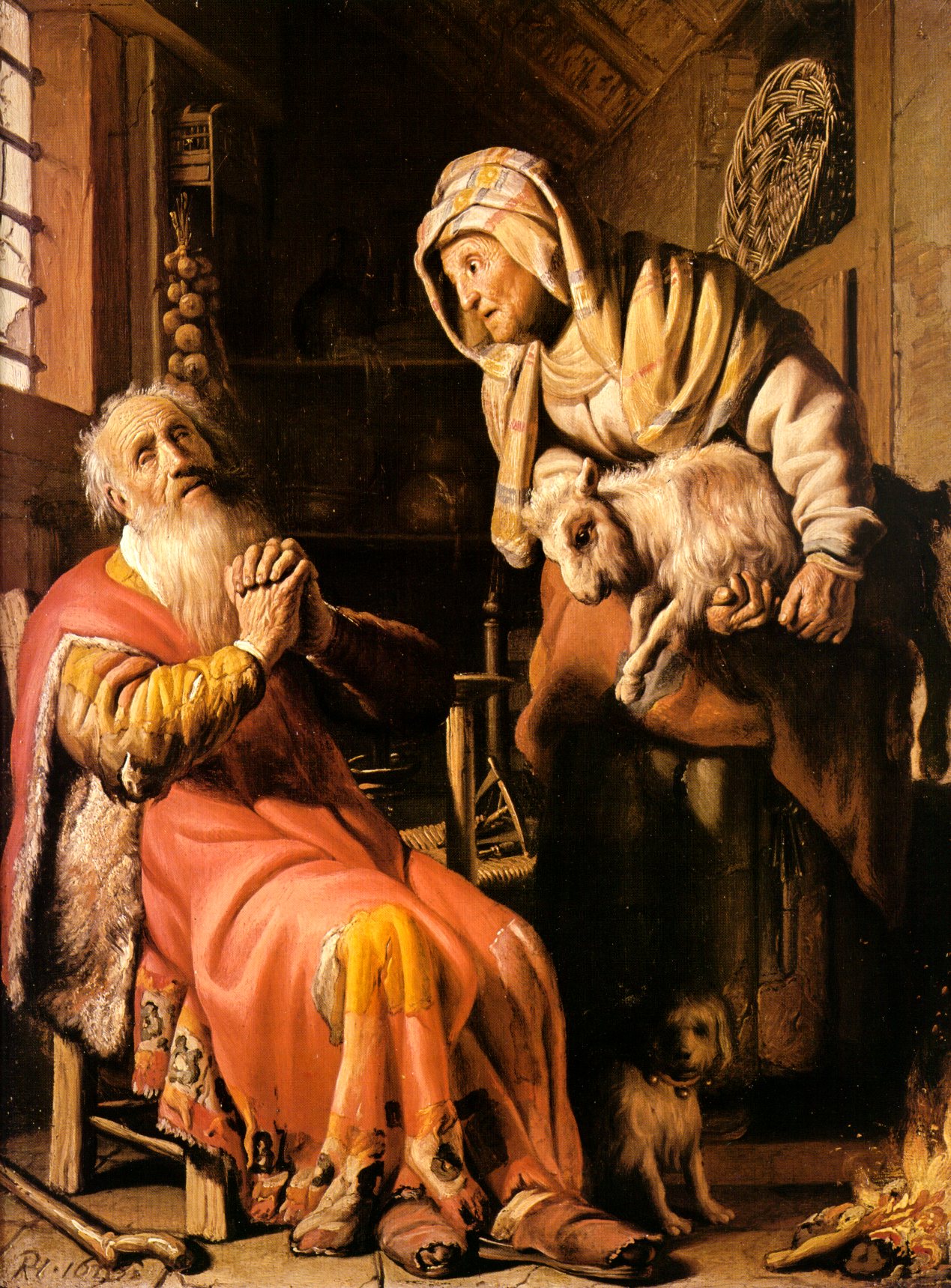
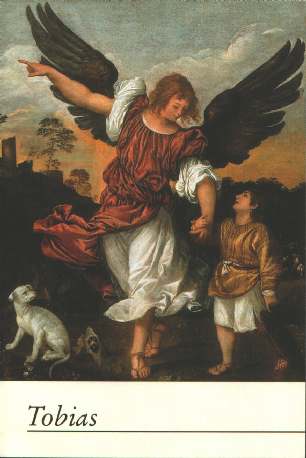
Tobit's dog appears only twice (in 6:2 and 11:4) and plays no role in the story (actually he accompanies Tobias, Tobit's son). Like many dogs, he just shows up whenever something seems to be going on. This little detail has greatly exercised the commentators, and even now no one seems to know how the dog got into the story.

Tobit's dog also shows up more than you might think in literature. For instance, here he makes an appearance in Tobias Smollett's Roderick Random:
With this view he approached us, with many bows and grimaces, and, after having welcomed Miss Snapper to the place, asked her in the hearing of all present, if she could inform him of the name of Tobit's dog. Miss was so much incensed at his insolence, that I should certainly have kicked him where he stood without ceremony, had not the young lady prevented the effects of my indignation, by replying with the utmost vivacity, "His name was Nash, and an impudent dog he was."
Voltaire puts these words in the mouth of a fictitious scholar:
I will show them, with outstretched neck and twisted mouth, that you hold an erroneous opinion in relation to the cells in which the Septuagint was studied; that you have even spoken disrespectfully ten years ago of Tobit's dog, which you asserted to have been a spaniel, while I proved that it was a greyhound.

Jonathan Swift wrote:
THAT Expression in Apocrypha about Tobit, and his Dog following him, I have often heard ridiculed; yet Homer has the same Words of Telemachus more than once; and Virgil says something like it of Evander. And I take the Book of Tobit to be partly poetical.

The militantly Protestant, of course, don't like Tobit or his dog. A character in Walter Scott's Waverley:
‘But if your honour wad consider the case of Tobit — ’

‘Tobit!’ exclaimed Gilfflan, with great heat; ‘Tobit and his dog baith are altogether heathenish and apocryphal, and none but a prelatist or a papist would draw them into question. I doubt I hae been mista’en in you, friend.’

And J. N. Darby, founder of the Plymouth Brethren, has this to say:
Look at Tobit, and his dog; it is absurd! Bel and the dragon may be true, but it has nothing to do with inspiration.

But my favorite mention of the dog comes in Robert Browning's "Ring and the Book":
Let
Each level have its language! Heaven speaks first
To the angel, then the angel tames the word
Down to the ear of Tobit: he, in turn,
Diminishes the message to his dog,
And finally that dog finds how the flea
(Which else, importunate, might check his speed)
Shall learn its hunger must have holiday ...

The dog is also a normal part of the iconography of Tobit. These links give the idea: A B C D E F.

Thursday, April 14, 2005

Fiery Furnaces at the Southgate House

Someday, maybe soon, I'm going to be too old for this, but it hasn't happened yet. I mean going to a local club to see My Favorite Band. Yes, the Fiery Furnaces (finally!) made it to our area.

So I wended my way last night to the Southgate House across the river (a pleasingly lowkey venue) to catch the show. Radishia was there and we hung out and watched the show. I'd read the reviews and kinda knew what to expect: a long medley of their songs, with new arrangements, played really loud. And that's what happened. Imagine "Bohemian Rhapsody" played lickety-split, punk/garage-style (with synthesizers thrown in), for over an hour. Wow. Dang. It was good.

The last modern band I saw was the Flaming Lips a couple of years ago, and they present a decided contrast in performing styles. The Lips are determined to entertain you by any means possible, adding film, balloons, costumes, and stand-up comedy to the music. The Furnaces will not go to such lengths, they won't even meet you halfway. They won't court you. There are no balloons. They are uncompromising, unrelenting, and very musical.

Eleanor, the singer, is an alt-rock goddess in waiting, star quality in spades. She didn't play anything (I've seen pictures of her performing with guitar), but roamed the stage, mike in hand, bawling over the din. She looked a bit like Joey Ramone, skinnier than the pictures, hair in her eyes. Matt ran the band from keyboards and guitar (a Telecaster repaired with duct tape), and the drummer (Andy Knowles) was a revelation: a blond Keith Moon, mugging, knocking over cymbal stands, hurling the sticks high. Before the show he was hanging out behind the T-shirt counter.

The show brought out all the geekily hip and cognoscent folk in the area, made them drop their bohemian angst for a night and start in to hoopin' and hollerin'. It was cool. The band shone. Give them an A, and hope they come back soon.

Monday, April 11, 2005

Self-Sacrificial Euthanasia

Spring is here. The air is clear, the grass is suddenly too long, birds are singing. What better time to talk about death and dying?

I've never blogged about the Terri Schiavo affair, although I followed it with great interest. The areas involved -- the philosophy (and neurology) of mind, the morality of euthanasia -- are those in which I have almost everything to learn, and nothing to teach. This belated contribution is an effort to clarify my own thinking about a particular part of the issue.

I divide killing into five main types:

(1) A kills B for the sake of A. (murder; sometimes self-defense)
(2) A kills B for the sake of C. (some self-defense; war; capital punishment)
(3) A kills B for the sake of B. (euthanasia)
(4) A kills A for the sake of A. (suicide)
(5) A kills A for the sake of B. (sacrifice)

All of these main types admittedly give rise to a host of boundary cases, depending on how we parse the notions of "kill" and "for the sake of" in each individual case. Obviously the meaning of "for the sake of" in Type 1 will lead to a differentiation between Type 1a (murder), in which "for the sake of" means for gain, for revenge, out of hatred, and Type 1b, self-defense, in which "for the sake of" means "out of a legitimate motive of self-preservation." I take it that out of all these types, only Type 1a is expressly forbidden by the commandment "thou shalt not kill (murder)." (I should also say here that "kills" in the typology above is shorthand for any kind of death-causing, including passive kinds, such as letting someone expire, or refusing to rescue; or indirect kinds, such as directing another to kill, or withhold care; or in the case of Type 5, accepting death, or getting in harm's way, in the interest of another.)

Type 2 is also morally permissible or impermissible depending on the meaning given to "for the sake of" in individual cases. A war of aggression and a war of self-defense would have different moral standings. The varying positions taken on the war in Iraq, for instance, differ as one sees the motive being overall self-centered ("blood for oil") or overall altruistic ("freedom for Iraq"). And obviously a war will feature a mixture of all these types of killing, but by intention a "just" Type 2 will predominate.

Type 3 is the type most relevant to the Schiavo case. In the Schiavo case, the pro-death side hesitated between (a) parsing the feeding-tube withdrawal as a case of Type 3 killing (Terri would have wanted this; this was Michael Schiavo's position), or (b) Terri was already dead, having lost all higher brain function, in which case it is not a question of any kind of killing (the ghost having left, the machine may be turned off). The pro-life side in general hesitated between (a) taking the feeding-tube withdrawal as a case of Type 1a above (murder) or (b) admitting it to be a case of Type 3 killing (euthanasia), but (i) denying the overall moral permissibility of this type of killing or (ii) denying that Terri would have wished to be killed in this way (the position of Terri's parents).

There were thus three separate conflicts going on in this case. One is between those on both sides who admit that it was a Type 3 killing, but differ on whether Type 3 is permissible. A different conflict was the one about the definition of death, whether higher-brain death may be equated with death simpliciter. The key conflict legally, was the third, what Terri herself would have wished. As I understand it, the legal battle revolved only around the evidence in the third conflict, and was resolved in favor of Michael Schiavo.

(I should insert here that an excellent discussion on the question of higher-brain death has been carried on between the blogs Siris and Mixing Memory. Start here or here and trace the links back; it's worth the trouble. Rarely has the blogosphere reached such a high level.)

Since Terri Schiavo's death is now a fait accompli on any definition, I fortunately am free from the pressing obligation to come to any conclusion about that particular case. I am inclined to agree with those who find all Type 3 killings problematic; and I am inclined to agree with those who deny that higher-brain death should be equated with death simpliciter.

Nevertheless, my principal reaction to the Schiavo case was not intellectual, but emotional. Terri Schiavo literally gave me nightmares. I found her condition disturbing, not necessarily for her sake (although her fate was a grim one), but for the sake of those around her. I did find myself thinking about an advance directive, one that would fulfill every fondest wish of the pro-euthanasia lobby, but — not for my own sake. Should I ever have the misfortune to fall into a persistent vegetative state, I would wish to spare my loved ones years of pain, expense, false hopes, and the daily horror of seeing my empty, grinning face where once they saw a husband, a father, or a brother. I would hope that decisive action would put a quick end, not to my suffering, but theirs. I am sure that many other people must have had this reaction.

Now here is my question: What is the moral standing of such an advance directive? It does not fall easily under Type 3, because it is not for B's sake that A (the family by means of the doctor) kills B (allows B to die), but because B wishes to die for A's sake. This also disqualifies it from being Type 4. It seems to me to be closest to Type 5 (self-sacrifice). And of the five types I outlined above, Type 5, I believe, is never immoral, just as Type 1a is always immoral.

That's my thought as of right now; but I'm far from certain. I'd be interested in hearing what others think. Is self-sacrifical euthanasia (SSE) morally permissible? Or is it just another attempt to play God? Have I let my emotions run away with me?

Sunday, April 10, 2005

The Media and "the Holy Father"

Pity poor Cincinnati. We are sadly lacking in unbiased print media. The daily newspaper, the Cincinnati Enquirer, is so rigidly conservative that their corporate logo should be a robot. On the other end of the spectrum, the alternative weekly Citybeat is so kneejerk leftist that their editorial meetings probably look like can-can rehearsals.

One of the latest absurdities from Citybeat comes from media watchdog Ben L. Kaufman (formerly with the Enquirer) who writes:

Why did reporters death-watching the pope call him "Holy Father"? That's an honorific among Catholics only. Reporters for secular media should eschew such religiously partisan and divisive language.

Oh, come on. Maybe they should have just called him "Mr. Wotyla." By the same token, no one should have referred to "Mahatma" Gandhi or "the Ayatollah" Khomeini. These are also religious honorifics. The media should have used their given names Mohandas Gandhi and ... um ... what was Khomeini's first name anyway?

UPDATE (4/11): Charles Jones e-mails (subject: Mr Mousavi): "Ayatollah Ruhollah Khomeini, born Ruhollah Mousavi." Glad to get that straightened out.

Let's also make sure that no one refers to "the Dalai Lama." Or "Mullah" Mohammed Omar. Or "the Reverend" Billy Graham. Or "Saint" Francis. Or Jesus "Christ."

Friday, April 08, 2005

Did the Pope Contemplate Resignation?

It is being widely reported that Pope John Paul II, in his will, contemplated resignation. The New York Times story says this:

...the pope wrestled with thoughts about the end of his papacy, perhaps even entertaining a momentous possibility: his resignation.

In the last section, dated March 17, 2000, of a testament that was written in 15 bits and pieces over most of his 26-year papacy, John Paul took stock of his life.

"Providence has seen fit for me to live in the difficult century that is departing into the past," he wrote, "and now in the year in which I reach my 80's, one needs to ask oneself if it is not the time to repeat with the biblical Simeon, 'Nunc dimittis.' "

I just don't see any reference to resignation here. In the full context, John Paul II was obviously thinking about his death, not his resignation. Here is the full context:

As the Jubilee Year progressed, day by day the 20th century closes behind us and the 21st century opens. According to the plans of Divine Providence, I was allowed to live in the difficult century that is retreating into the past, and now, in the year in which my life reaches 80 years ("octogesima adveniens''), it is time to ask oneself if it is not the time to repeat with the biblical Simeone 'nunc dimittis' (Ed: Latin for ``Now Master you may let your servant go.'')

On May 13, 1981, the day of the attack on the Pope during the general audience in St. Peter's Square, Divine Providence saved me in a miraculous way from death. The One Who is the Only Lord of life and death Himself prolonged my life, in a certain way He gave it to me again. From that moment it belonged to Him even more. I hope He will help me to recognize up to what point I must continue this service to which I was called on Oct. 16, 1978. I ask him to call me back when He Himself wishes. ``In life and in death we belong to the Lord ... we are the Lord's.'' (cf. Romans 14,8). I also hope that, as long as I am called to fulfill the Petrine service in the Church, the Mercy of God will give me the necessary strength for this service.

John Paul says that he was allowed to reach the beginning of the 21st century, but recognizes that most of his work is behind him. He wonders, in view of that fact, whether the time of his departure is at hand. In the same way Simeon in the Gospel of Luke 2:29, after seeing the infant Christ, recognizes that his service of witness is over, and prays that God will now let him die ("depart") peacefully. JP then goes on to say that his life was spared in the assassination attempt in order that it may belong to God ("the Only Lord of life and death") even more fully. He wonders how long God will ask him to continue serving Him as Pope, but recognizes that God will "call him back" when He wishes, not when John Paul wishes. He hopes that he will be able to do his job as long as he is called to do it — in other words, as long as he lives.

In context, it seems clear to me that this document does not refer to resignation. The language plays on the themes of life and death, of Providence, service, submission to the Divine Will. And what else would a will talk about?

Thursday, April 07, 2005

Potpourri: Rollston, Williams, Carnivals

The Knoxville News-Sentinel has an article about a lecture given by Chris Rollston at the University of Tennessee about forgery of antiquities (use bugmenot.com to gain access). Among other interesting items, the article focuses on Rollston's skepticism about the Marzeah Papyrus:

"I think, based on the script, that this is a forgery as well," Rollston said. "There are various aberrations in the script, various anomalies."

The Johns Hopkins University-trained historian and philologist of the Ancient Near East spoke in the McClung Museum auditorium.

Rollston teaches at the Emmanuel School of Religion, a graduate seminary in Johnson City.

The exhibition's curator, Dr. William Noah, disagreed with Rollston on Wednesday, saying that other scholars had previously examined the papyrus and "said emphatically that it is (authentic)."

"Every publication on the piece says it is genuine," Noah said.

I've previously discussed the Marzeah Papyrus on this blog here and here.

Welcome: Tyler Williams of Taylor University College in Edmonton joins the blogosphere. Looks like a lot of interesting stuff to come on Qumran and other topics.

Carnivalia: The Biblical Studies Carnival is up at Ebla Logs, and the Christian Carnival at "Proverbs Daily." Check 'em out.

Tuesday, April 05, 2005

Understanding Genesis 2:5

One of the brothers at CADRE Comments is proposing a harmonization of Genesis 1 and Genesis 2 by suggesting that the word eretz in Genesis 2:5 refers not to the cosmological "earth" but to the more limited patch of "land" that became the Garden of Eden. This has the effect, he believes, of reconciling the differing orders of creation in Genesis 1 (earth, plants, humans) and Genesis 2 (earth, humans, plants):

Thus, since the term "erets" can mean either the entire planet or a particular area, then the definition of the word in a particular verse must be based on its context.

...In fact, Genesis 2 begins with God planting a garden in a place called Eden, whose location is described in the text that follows.

...Thus, it is apparent from the context that when Genesis speaks in Genesis 2 of the fact that "no shrub of the field was yet in the earth, and no plant of the field had yet sprouted, for the LORD God had not sent rain upon the earth, and there was no man to cultivate the ground" in Genesis 2:5, it is referring to a localized area -- not the whole world. The localized area being referenced is the "land" where God was about to plant the Garden of Eden.

But this won't do. The word eretz does indeed indicate areas smaller than the cosmological earth, but almost without exception the reference is to large geographical or political areas. In fact the only example I can find of eretz applied to a small plot of land is in Gen. 23:15: "A piece of land (eretz) worth four hundred shekels of silver, what is that between me and thee?" (The other main usage of eretz is to indicate the physical soil itself.)

Therefore one would not ordinarily expect eretz to be used without qualification of a future garden site. Furthermore, as the writer notes, context is important in determining the range of reference; but he errs by saying that "Genesis 2 begins with God planting a garden." In fact, the section begins in Genesis 2:4b: "in the day that the Lord God made earth (eretz) and heaven." In such a collocation, only the cosmological earth could be in view. The sense of the eretz of 2:5 is thus established by the usage of eretz in 2:4, just as the sense of the same word in 1:2 is established by its meaning in 1:1.

The argument therefore fails. But what really troubles me is that such arguments still find a place in the apologetic enterprise. Apologetics is a worthy and important activity, but I regret that many of my co-religionists find it necessary to read and defend Genesis as straight, error-free, unedited reportage; and lurking in the background of this flat reading of the text is a "creationist"* (actually Young-Earth) account of cosmology. Fellas, that dog just won't hunt.

Nevertheless, it seems to me that a good design argument could be (and has been) deployed by apologists without reliance on a biblical exegesis that ignores the sciences of both geology and philology.


*The word "creationism" is now well established to refer to "Young Earth" theories, which strike me as a form of pseudo-science. Nevertheless, all Christians are necessarily "creationists" in some sense, if we take seriously the Nicene Creed ("creator of heaven and earth").

Monday, April 04, 2005

Tel Dan and Garbini (v)

This is the last (probably) post critiquing Giovanni Garbini's analysis of the language of the Tel Dan inscription. The others are found here, here, here, and here.

Garbini says:
Another linguistic oddity manifested by the Tel Dan fragment is its use of qdm as an adverb ("formerly" according to the translation of Naveh). It should be observed that an adverb qdm doesn't exist in Aramaic: such a function is fulfilled by the noun qdm in the plural, qdmn, qdmyn, or the singular but with the presence of a preposition. It isn't amiss to note that an adverb qdm is documented in biblical Hebrew, usually meaning "eastward", but with the meaning "long ago" in two psalms (74:2 and 119:152), both of which are post-exilic.
Garbini is referring to the phrase ויעל מלך ישׁראל קדם בארק אבי, "the king of Israel came formerly into the land of my father." The gravamen of his argument is that the use of adverbial qdm here is a linguistic novelty in Aramaic, but is attested in later Biblical Hebrew; this suggests the hand of a forger.

Garbini evidently forgot the use of adverbial qdm in the Tell Fakhariye inscription, line 15: אל זי קדם הותר, "he made it (the statue) better than it was formerly." This attestation deflates this whole line of argument.

But even if there were no other attestation, the argument is weak. Are we to assume that no ancient text can evince a linguistic novelty? Are we to assume that all connections of ancient Aramaic with Biblical Hebrew are inauthentic? That would undermine quite a few Old Aramaic texts. The fact is that Garbini, once again, is caught reaching for insubstantial reasons to disqualify a text just because it is inconvenient to his own presuppositions.

It is worth asking, however, what possible linguistic phenomena should raise our suspicions. First, I would look for phonological or orthographic anomalies; Old Aramaic orthography has certain differences from later Aramaic. For instance, if the Tel Dan inscription had used the form ארע "land" instead of ארק, that would raise very serious questions. (But in fact there are no such anomalies.) Next, I would look for morphological anachronisms. If the Tel Dan inscription had used the suffix hwn "their," instead of hm, I would be suspicious. Also, I would look at the syntax. If the noun phrase מלך ישׂראל, "king of Israel" were written מלכא די ישׂראל, this might point to a forger, as would, for instance, ביתה זי דוד or the like instead of בת דוד, "house of David." There are no anomalies of this kind.

In my opinion, Garbini has failed to prove his case. Linguistically, the Tel Dan inscription gets a clean bill of health. This alone is not enough to prove authenticity. I also gave (and give) the James ossuary a clean bill of linguistic health, and there is now plenty of evidence to suggest that it is a forgery. But since the Tel Dan inscription, unlike the ossuary, was discovered in situ (and no one has brought evidence to deny that fact or to suggest that a conspiracy existed among the excavators), this in itself is enough to warrant the full use of the Tel Dan inscription in historical reconstruction.

Saturday, April 02, 2005

For This Week's Christian Dead

Not for that we would be unclothed, but clothed upon, that mortality might be swallowed up in life. These are words by which the slanderers of the nature of the body, the impeachers of our flesh, are completely overthrown... We do not wish to cast aside the body, but corruption: not the flesh, but death. The body is one thing, corruption another; the body is one thing, death another... What is foreign to us is not the body but corruptibility.

—John Chrysostom, On the Resurrection of the Dead

Apocrypha, Apocrypha

I'm still reading Macaulay's History; I do expect to finish it this year. I ran into a passage this morning that seemed appropriate in view of the recent discussion of canon on this site.

In 1696 a peer was being tried for treason, and some were arguing that two witnesses were required for conviction. They quoted Deut. 19:15 ("at the mouth of two witnesses, or at the mouth of three witnesses, shall a matter be established"), the procedure of Caiaphas during the trial of Jesus and that of Jezebel in taking the vineyard of Naboth (I Kings 21:13). And then:
"If the testimony of one grave elder had been sufficient," it was asked, "what would have become of the virtuous Susannah?" This last allusion called forth a cry of "Apocrypha, Apocrypha," from the ranks of the Low Churchmen.
The allusion is to the story of Susannah and the elders in Daniel 13, a chapter appearing only in the Greek additions to Daniel, and not contained in the Hebrew canon.