Monday, April 06, 2026

Magical Mystery

 While looking at a few Aramaic texts at the excellent Princeton Geniza Project, I came across an amulet that begins like this:    

אשבעית עליכון אף וחימא משביר וקצף וחרון ומשחת אתון מלאכיא דממניין למחבלא כל בני בישרא 

"I adjure you, Anger and Wrath, Shatterer, and Fury and Rage and Destroyer, you angels that are appointed to destroy all the sons of flesh." The words in italics are all Hebrew words. Five of them are found in other Jewish texts (e.g., Targum Pseudo-Jonathan to Deut 9:19 (אף וחימה וקצף ומשׁחית וחרון, Anger and Wrath and Fury and Destroyer and Rage). But the sixth, משביר, does not, as far as I can tell. The stem/binyan must be Pi'el (meaning to "shatter, destroy"); but as far as I can tell, is not elsewhere used as the name of a destroying angel. 

 However, we do find in Qohelet Rabba the following list: חֲמִשָּׁה מַלְאֲכֵי חַבָּלָה, קֶצֶף, וּמַשְׁחִית, וְהַשְׁמֵד, אַף, וְחֵמָה, "five angels of destruction, Fury and Destroyer and Annihilation, Anger, and Wrath." The second list doesn't have חרון (Rage) but does have השמד "Annihilation." So either (1) the list is not fixed in form or (2) משביר in the first text is a corruption of משמיד "Annihilator." Of course, both could be true. 

In another Geniza magical text there is a parallel to the amulet cited above, with the same five angels mentioned in Pseudo-Jonathan, אף וחמה וקצף וחרון ומשחית, "Anger and Wrath and Fury and Rage and Destroyer" (T.-S. K 1.56, 2a:7-8), but again without משביר or the like. Anyone out there have any citations to add to these?

LATER: I have found in the Babylonian Talmud, Shabb. 55a, the following list: א"ר חסדא קצף אף וחימה ומשחית ומשבר ומכלה, "Rab Hisda said: Fury, Anger and Wrath, and Destroyer and Shatterer and Consumer." So indeed there is a precedent for משבר and also for six angels instead of five (although Rab Hisda's six are not the same as the amulet's six). 

BIBLIOGRAPHY: Peter Schäfer and Shaul Shaked, Magische Texte aus der Kairoer Geniza, Band I (Tübingen, 1994), pp. 32, 38. 


Sunday, December 28, 2025

ralphiesralphiesRALPHIES

 My view of America 2025 is best summed up by two pop-cultural references.  One of them is the Twilight Zone episode "It's a Good Life,"wherein everyone is afrad of the monster child who shapes to world to his (and only his) satisfaction.  The other is the Marvel Comics Dark Reign storyline, wherein the reins of power are handed to evil billionaire Norman Osborn, who replaces super heroes with super villains.  Let the reader understand.

BOOKS: So many books to choose from.  For non-fiction I'll give the Ralphie to Ian Leslie's John and Paul: A Love Story.  I don't think I agree with the basic premise, but a book can be a little whack and still fascinating.  By the way, I consumed this book via audio, which some claim isn't really reading. As frequently with definitions, there are fuzzy boundaries.  Me, I take it as reading, so. Honorable mention goes to Loudon Wainwright III's Liner Notes: A Memoir. And that is one that really should be listened to, rather than read, because the author himself reads it and illustrates songs by playing them. For fiction, I have to give it to The God of the Woods, by Liz Moore (2024), an absorbing mystery wherein the suspense is maintained at a high level throughout without forsaking character development (which indeed is crucial). 

MOVIES/TV: I don't know if there is any distinction in this age of streaming between movies and TV, since both are consumed the same way (by and large).  For both, I give the Ralphie to Shetland, a TV? series set in, uh, Shetland.  The stories are well-developed over several episodes (the first few seasons based on novels by Ann Cleeves), and Shetland (it was filmed on location) is so vividly evoked, the islands are almost like a character in their own right.  I binged through the whole thing in a few months. I did see a movie an actual theatre, though,  A Complete Unknown. Verdict: meh. 

MUSIC: So much good music.  Some that caught my ear: "Just Two Girls" (Wolf Alice), "Oom Sha La La" (Haley Heynderickx), "Idiot Box" (Sharon van Etten), "Bovine Excision" (Samia), "Tunnel Vision" (Beach Bunny), "Arm's Length" (Sam Fender), "She's Leaving You" (MJ Lenderman). But the Ralphie I will give to "Slow Talkin'" (Haley Heynderickx), which stuck with me so long it became my mental theme song. 

SPORTS: There were no aporting events in 2025. 

I don't know what the future holds for 2026. Regimes come and go, mountains fall and valleys are raised up.  But the Ralphies, God willing, will be back next year around this time.  Thanks, you've been a great audience!


Friday, October 10, 2025

Blowin' in the Howlin' Wind

Back in 1974—before the flood—I went to hear Bob Dylan in person for the first time, in Fort Worth, Texas, backed by The Band. The set list is here .( I notice that they quote Bob as saying, before “It Ain’t Me Babe,” “This is another lasting song.” I can tell you that that quote is incorrect.  What he said was, “Here’s another message song.”)

Among the numbers he did was “All Along the Watchtower,” with a nod to the Jimi Hendrix arrangement.  But honestly I prefer the album cut to the live version; it sounds lonesome and spooky in a way that the latter-day guitar pyrotechnics seem to bury. 

And that eerie song is truly a song for our time, I mean right now. Consider: in the first verse, a joker complains to a thief that his property is being stolen; in the second verse, the thief suggests  to the joker that although some feel that “life is but a joke,” “you and I” no longer do. In fact, the thief answers in a series of stilted cliches: “this is not our fate,” “let us not talk falsely,” “the hour is getting late.” He doesn’t respond to the joker at all; there is no communication between the two.

In the third verse, princes keep watch from a tower, with women and "barefoot servants" moving around in the background. “Outside in the distance” two riders are approaching, and … we’re back where we started. “There must be some way out of here,” but the song forms a closed loop. There is no way out.

It’s actually kind of terrifying, in the same way that the American scene today is kind of terrifying.  Two sides talk in incommensurable codes, while elites look on impassively from a height. There must be some way out of here.  Hey, maybe the answer is blowin’ in the wind, which has begun to howl.


Tuesday, December 31, 2024

Ralphies 2024

 I observe that "Ralph" began 20 years ago, in November 2004.  At the time, it seemed like a cutting-edge thing to do.  Then Twitter with its hot takes came along, and Reddit with its memes, and Donald Trump to corrupt everything, and Elon Musk to corrupt what Trump overlooked.  Now social media is a vast wasteland. Blogging seems like a quaint holdover from a simpler era.  I'm OK with that, because I get to do ...

Ralphies! Here we go ..

Movies: It's getting harder to distinguish movies from TV these days; it's all streaming content, and I don't go to theaters anymore.  Not against it or anything, but, hey, everything winds up on Netflix or whatever eventually.  I don't think I saw anything that came out this year, but I did catch up by watching Oppenheimer from 2023-pretty good, I guess? But the one that wowed me the most was 1917 (2019), innovative filmmaking and an exciting, moving story. It gets the Ralphie.

TV: Again, what is TV? Something you watch on a TV network? Or something called TV on a streaming service? I'll opt for the latter, since actual TV we use only for news, weather, and sports.  I enjoyed the series Dark Winds, although Zahn McClarnon is not at all my idea of Joe Leaphorn (probably not Tony Hillerman's, either). But the Ralphie goes to Arcane for the action and highly imaginative graphics and world-building, although it has more characters than War and Peace

Music: This, too, is affected by the streaming trend.  People used to get albums; now it's replaying your favorite track on a streaming service (take your pick).  But there were some good songs this year.  I got into listening to acoustic versions of rock hits; among them I give high marks to "1979" by Freedom Fry (Smashing Pumpkins cover) and "Wonderwall" by Ryan Adams (Oasis cover). But there was plenty of good new music too: "People Watching" by Sam Fender, "SPEYSIDE" by Bon Iver, "Josh Tillman and the Accidental Dose" by Father John Misty; "kisses" by Slowdive; but the Ralphie goes to "Candy" by Mk.gee, because I'm a sucker for melodic guitar playing.

Books: This one is always tricky, because I read a lot, both for business and pleasure.  For fiction, I'm going to give the Ralphie to Mythago Wood by Robert Holdstock, and for non-fiction to All of the Marvels: A Journey to the Ends of the Biggest Story Ever Told by Douglas Wolk.  I'm sure I'm forgetting some, so I might revisit this later.

As far as current events go, I can't think of a more distressing and worrisome year, and 2025 doesn't look like it's going to improve things.  So I guess the only answer is to keep calm and keep blogging. See your around, true believer. Nuff said. 


Thursday, December 26, 2024

Hell and Donald Trump

 Donald Trump, with his usual delicacy, seems to have spent most of Christmas telling various parties to "go to hell." or, more picturesquely, "rot in hell." No, I'm not going to link to any of his posts. 

Perhaps Donald Trump has never pondered the possibility that he himself could one day find himself in hell.  If you flinch at the notion that anyone should go to hell, then ponder these prophetic words of C. S. Lewis:

Picture to yourself a man who has risen to wealth or power by a continued course of treachery and cruelty, by exploiting for purely selfish ends the noble motions of his victims, laughing the while at their simplicity; who, having thus attained success, uses it for the gratification of lust and hatred and finally parts with the last rag of honour among thieves by betraying his own accomplices and jeering at their last moments of bewildered disillusionment. Suppose, further, that he does all this, not (as we like to imagine) tormented by remorse or even misgiving, but eating like a schoolboy and sleeping like a healthy infant—a jolly, ruddy-cheeked man, without a care in the world, unshakably confident to the very end that he alone has found the answer to the riddle of life, that God and man are fools whom he has got the better of,that his way of life is utterly successful, satisfactory, unassailable. ...

    Supposing he will not be converted, what destiny in the eternal world can you regard as proper for him? Can you really desire that such a man, remaining what he is (and he must be able to do that if he has free will) should be confirmed forever in his present happiness—should continue, for all eternity, to be perfectly convinced that the laugh is on his side?

This imaginary person in The Problem of Pain reminds me of Donald Trump. Such a man, argues Lewis, challenges the assumption that no person should go to hell; challenges it by recruiting our sense of justice to argue with our (possibly over-developed?) sense of mercy. 

Well, it challenges me.  Trump, and to a lesser extent, his minions (like Elon Musk) challenge daily my sense of mercy.  What a disheartening time we live in.

BIBLIOGRAPHY: The quotation is from The Problem of Pain (New York, 1947), pp. 108-109. 

Saturday, December 14, 2024

A Previously Unnoticed Alternative Targum to Psalms 38:4


    In preparing a reader's edition of the Targum to Psalms, I came across an alternative targum (marked תרגום אחר) in the margin of Codex Solger (the Nuremberg codex) to Psalm 38:4 (38:3 in English versions).  The RSV translation of the Hebrew reads "There is no soundness in my flesh because of thy indignation; there is no health in my bones because of my sin." 
    The main targum text of Codex Solger reads (in translation): "There is no healing in my body because of your anger, no health in my limbs because of my sin." Not a great departure from the Hebrew. But the marginal alternative targum reads as follows: 
 לית אסותא לבישרי מן קדם תקוף רוגזך על דלא קיימית פיקודך ולית שלם לאיתתי
דאיתקרית עצם כדכ<תיב> עצם מעצמי מן קדם חובי ארי אלהא מסער חובי גבר על
איתתיה כדכתיב למה יקח משכבך תחתיך
Translation: "There is no health to my flesh because of the strength of your anger, because I did not observe your commandments and there is no peace to my wife (who is called Bone as it is written, bone of my bones [Genesis 2:23]) because of my sin, for God visits the sins of a man on his wife, as it is written, lest he take your bed under you [Prov 22:27]." 
    As noted, I haven't seen a reference to this text, and David Stec makes no mention of it in his translation (The Targum of Psalms [Aramaic Bible 16], 2004).  Since Codex Solger was a principal source of the Rabbinic Bibles of 1517 and 1525, one might expect to find it there, there's no trace of it.  I also haven't seen this particular midrash anywhere (but there's a lot to search, so); it's not in Midrash Tehillim to the verse. None of the other alternative renderings in this Targum quote other Scripture, either, so this one is unique in that respect. (I also don't quite get the application of Prov. 22:27, which, by the way is slightly misquoted, the Masoretic text having מתחתיך not תחתיך). 
    Anyone out there have any comments? Anyone seen a similar take on the verse elsewhere?


Sunday, December 31, 2023

Ralphies 2023

Wow, what a crazy year. Lots of ups and downs. But there is one thing solid in an unstable world: the Ralphies. 

Movies: Did I see any movies at all? I’ll give the Ralphie to the only one I remember watching (online): Spider-Man Across the Spiderverse

TV: On the other hand, there was a lot of fun TV.  Murder at the End of the World was good, especially for Emma Corrin’s performance. Bob’s Burgers became my main go-to late in the year (a wholesome show with fart jokes). The Chosen provided much fodder for Ralph, as you might have noticed.  But the Ralphie goes to The Americans, which absorbed me (and even moved me) deeply. Yes, I watched the whole thing in 2 months. 

Books: So many books, so little time. For fiction, the Ralphie goes to Fugitive Telemetry, a novel in the Murderbot series (which I love). For non-fiction … well, I haven’t finished reading it, but of course I have to give a Ralphie to this volume. *blush* 

Music: Listening has shifted from album-based to song-based, because of the ubiquity of streaming services, and I’ve succumbed.  Some of my favorites were Bang Bang, by Momma; Psychos, Jenny Lewis; Woman on Fire, BEL; Goner, girlhouse; and from the past, That Old Black Magic, Louis Prima and Keely Smith (and she was the best singer of her era, you can’t deny it); and Me & Magdelena, a gem by the Monkees (!). But the Ralphie goes to I’m In Love With You by The 1975 (dumb name for a band, great song). 

Sports: Nice to see the Longhorns return to being good, and the Bengals are hanging in there as I write. But the Nats were awful again, and will probably be awful again in 2024. No Ralphies! 

All right, my children, that’s it.  If the Republic still is standing next December --which is far from certain-- I’ll see you then. 


Monday, September 04, 2023

Little lamb, arise (Chosen 5)

 This post is mainly concerned with the episode in The Chosen (season 3, episode 5) dealing with the raising of Jairus's daughter (see Mark 5:37-41 and parallels). In general, the episode is well done, as are all the healing miracles in this series (I say nothing about the cringey ending, where Jesus and the disciples go swimming in the Sea of Galilee fully clothed). 

I was interested to see that the healing words spoken by Jesus in the episode were "Little lamb, arise!", representing talitha kum(i) ταλιθα κουμ, a Greek transliteration of Aramaic טליתא קומי. (Mark 5:41). But, although the word טליתא "girl" is originally derived from a word meaning "lamb" (or perhaps just "young of an animal"), in Aramaic, throughout its dialects טליתא means just "girl" (as טליא talya means "boy").  The scriptwriters evidently got hold of an idea that etymology equals meaning; and this particular idea is often used sentimentally in fundamentalist homilies (like this). 

There are a thimbleful of occurrences in very late Aramaic texts where טליתא or טליא means "lamb," where the writers are actually using a borrowed Hebrew word טלה taleh, which does mean "lamb." For instance, in the Babylonian Talmud, Bava Mesia 47a we find ומשכה לפרה, ולא משכיה לטלא, "he pulled the cow, but did not pull the lamb," both "cow" and "lamb" are Hebrew. 

So the proper rendering of the Aramaic sentence is just "Girl, arise!" By the way, the standard Aramaic word for "lamb" is אמר immer (fem. imra), while in Hebrew it is כֶּבֶשׂ keves (fem. kivsa). 

Thursday, August 17, 2023

The Chosen (4)

 Currently I'm into season 2, but these comments are wrapping up season 1.

  • Jesus likes to hug. A lot. Not complaining, I've just never thought of Jesus as a big hugger. But why not?
  • Erick Avari's performance as Nicodemus was excellent, kudos to him. 
  • I like the diversity of this cast, both as to gender and to ethnicity. But I'm not comfortable historically with Mary Magdelene being a de facto disciple.  Surely a single woman would not have traveled around with 13 single men? 
  • The Romans, in the last episode of Season 1, don't like the attention Jesus is getting, so they put up a notice in "Aramaic, Latin, and Greek" that is to say "By order of Rome, and punishable by detention and imprisonment, religious gatherings outside the synagogue and Hebrew school are strictly prohibited. The teacher known as Jesus of Nazareth is wanted for questioning." Then a scene shows a Roman soldier posting the notice: 
    Not Aramaic (or Latin or Greek, natch) but Modern Hebrew and not very smooth at that (and in fact a couple of lines are obviously missing). I know that the prop is meant only for verisimilitude and not meant to be historically accurate, but still this is pretty inept. (And it started my mind down a rabbit hole: How would you say "religious gatherings" in ancient Hebrew or Aramaic? I don't think there was even a word "religious" in either tongue.) Couldn't they find a scholar  (ahem) who could produce a decent prop in the ancient languages?
  • It's axiomatic that every portrayal of Jesus is a kind of mirror image of the age that produced it. In the '60's we had Godspell, with a hippie Jesus.  Mel Gibson's Passion of the Christ reflects the conservative Catholic piety of its producer.  This Jesus is an evangelical Jesus.
  • Which is not to say it's bad by any means. I do enjoy this show, and its kind heart.  I nitpick because it's my job. 

Wednesday, August 09, 2023

The Chosen (3)

 Continuing with reactions to The Chosen ...

The episode of the wedding at Cana in Galilee was overall well-done, I thought ... but sooo slooooow. This series has a problem with pacing. It was a nice touch having Thomas present as a wine wrangler. 

But my job is to nitpick! It was this episode I think that began at the pawnshop, which displayed a sign in typeset (!) Hebrew (!) טובין משועבדים, which means "pledged goods" in Modern Hebrew. In both modern and ancient Hebrew (and Aramaic) the notion of pawning is expressed by the root משכן, so I'm not sure where they got their expression. 

I also have a beef with the presentation of John the Baptist's imprisonment. The Pharisee Nicodemus visits him in a Roman prison, where he has been put because a Pharisee laid an information against him (because John called them a "brood of vipers," Matt. 3:7). But it's explicitly said in the gospels (e.g, Luke 3:19-20) that Herod Antipas, tetrach of Galilee, imprisoned John because John had criticized him for marrying Herodias, his brother's wife. Neither the Romans nor the Pharisees enter into it.  Since the biblical scenario has all kinds of dramatic possibilities, I'm not sure why the script ignores it (and so far the script doesn't mention Herod at all). 

Watch this space for more carping to come!


Monday, August 07, 2023

The Chosen (2)

 Forging ahead with The Chosen ... (see previous post)

I'm about at the 4th episode, season 1.  The miraculous draught of fishes (Luke 5:1-11) was very well done, I thought, and vividly presented.  High marks to whoever wrangled all those fish for the filming. 

I'm not so happy with the staging of Jesus' teaching: the hearers seated in rows before him, while he stands and talks, like a Sunday School class. That just felt wrong. In those days, the students stood and the teacher sat, if possible at an elevation that had speaker's and hearers' heads at the same level; or else the teacher would walk and talk and the students followed. (Notice that in Luke 5:2, Jesus sits down.) (I told the rector of our church this years ago, and he said, "Wow ... if I could sit, I could preach for hours.") 

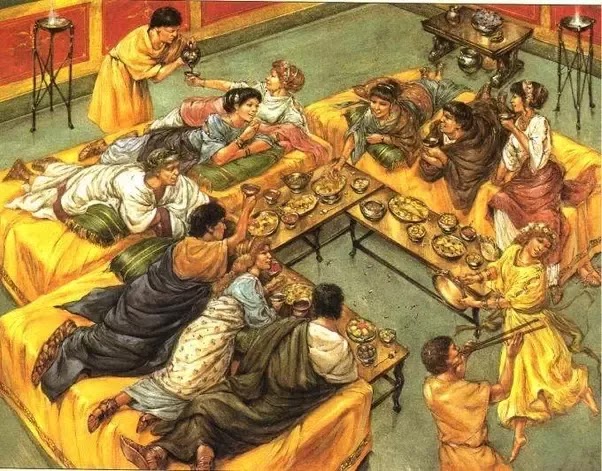
In fact, there is too much sitting going on in this show.  At mealtimes, everyone is shown sitting on chairs around a table. But, back then, if people sat down to eat, it was usually on the ground; but if a table was present, the diners would recline at an angle and reach for food in front of them:


This actually makes a number of scenes in the gospels easier to imagine, such as the notice in Luke 7:38, that the woman who anoints Jesus "stood behind him, at his feet"; or the disciple "whom Jesus loved" "leaned back against Jesus" at the Last Supper (John 13:23). It'll be interesting to see how the producers stage these scenes.

I know I'm carping, and in general, this is a good show (so far). But my concern is that people will watch it and think they're getting the Bible straight, instead of seen though a modern-day filter.

Many thanks to this site, from which I lifted the illustration. 


Friday, August 04, 2023

The Chosen, some quick reactions

 I started watching "The Chosen" on Netflix, based on the recommendation of a friend. It's the first show about Christ I've seen since "The Passion of the Christ" (which I have professional reservations about). 

In general, the production values are good, and so are the performances. (I've seen the first episode and part of the second.) In this respect, it stands up well next to other hit shows on Netflix and other streaming services -- well enough to make me want to keep watching.

I see a couple of weaknesses, though, and they are shared by almost all films about Christ.  First of all, the Romans are portrayed as a constant oppressive presence in Capernaum, where the action (so far) takes place. This is not historically accurate. Capernaum was in Galilee (not in Judea, as stated at one point), and Galilee was under the rule of Herod Antipas. Antipas was a client king under the Romans, true, but the Romans didn't control Galilee directly. It was under Jewish control. (The Romans did have a direct rule over Judea, though, in the person of the governor Pilate and Roman soldiers could be called on as needed, although they probably didn't walk the streets like military police.) So although the show sets up the Romans as bad guys, it's unlikely that this was the case in Capernaum (and I do wish they wouldn't keep pronouncing it "Caper-num." Caper-nay-um, please.)

Secondly, as is typical, the Jewish population is shown wearing Bedouin-type clothing, which fits the Western "Orientalist" view of ancient Palestine. However, based on ancient depictions and descriptions, the inhabitants of Palestine dressed the same as everybody else did in the Greco-Roman period, i.e., with a basic tunic (a big shirt reaching to the knees) and a mantle (like the Roman toga) worn over that. In terms of clothing the Galileans and Judeans and Gentiles and civilian Romans were no doubt indistinguishable. 

We haven't seen much of Jesus so far, but in his look he appears to be a break from the Euro-Christ image we've seen so much of.  So high marks for that. 

Maybe I'll write some more on this show, who knows? But I'm not bored, so far. 

Friday, December 30, 2022

New! More! Ralphies!


Almost let the Ralphies slip this year; we can't have that! It's been a year with a lot of ups and downs. But let's get to the awards …

Movies: Are they still making movies? I didn't see any in the theater. If I have to pick one for the Ralphie, I guess it would be The Blue Dahlia, which I watched online.

TV: In the nature of things, I can only remember the most recent shows watched.  For drama, I would pick Under the Banner of Heaven, very intense and historically interesting.  For comedy, I will agree with the vox populi and pick Wednesday; much better than Stranger Things 4 (which I watched while in Israel),  entertaining but incoherent.  The critical favorite Andor  I didn't enjoy particularly; there was almost no sci-fi element in it at all (although festooned with sci-fi signifiers, like spaceships, they played almost no role in the story itself).

Books: I gave the Wheel of Time umptilogy a try, but petered out after the 4th book. The Ralphie goes to All Systems Red, by Martha Wells, vol. 1 of the Murderbot Diaries. Well done. 

For non-fiction, the Ralphie goes to The Constitution of Knowledge, by Jonathan Rauch. Who would have thought a book about social epistemology would be so engrossing? But a special tip of Ralph's hat also goes to J. F. Collins's Primer of Ecclesiastical Latin, which was a helpful vade mecum to my re-entry into the world of Latin. I'm going to need Latin for my next project. Also I had a book published, which is gratifying.

Music:  The Ralphie for Album of the Year goes to Big Thief's Dragon New Warm Mountain I Believe in You, which is among the best I've ever heard and probably my favorite since Sufjan Stevens's Illinois (although very different in style and genre). I can't pick just one song for you, but here's the title track. I love the way Adrianne sings the word "recoil." For songs, there were too many to pick just one; some of the ones I particularly liked: "Speeding 72," Momma; "PBR," Bel; "Billy Toppy," Men I Trust; "Seasons Change," MorMor; "Higher," Sault; "Blue Bones," Billy Nomates.  For covers, "Fourth Time Around," by Yo La Tengo.

OK, pilgrims, that's it for another year. I'll see you at this same corner next year around the same time. 


Thursday, September 29, 2022

A Knot in a Rush and Nehemiah 2:1

 I’ve been reviewing Latin, with a view to reading some old commentaries and works of scholarship. I can’t say I’m a fluent reader (yet!), but I’m enjoying the process. Speaking of which …

Reading a book of commentary extracts on Nehemiah, I came across a Latin  expression that puzzled me. C. F. Houbigant (18th century Biblicist)  is commenting on Neh. 2:1וְלֹא־הָיִיתִי רַע לְפָנָיו, “Now I had not been beforetime sad in his presence” (KJV) – “him” being the Persian emperor. Houbigant translates et non ei displicui, “and I had not displeased him.” His comment is Nihil erat tam obvium, quam ut sic interpretaremur. Et prorsus me fugit, quare nodum in sirpo quaesierint plerique interpretes. “Nothing was more obvious, than that we should interpret  it so. And it utterly escapes me, why many interpreters have sought a knot in a bulrush.”

That last expression, nodum in sirpo, made little sense to me and was obviously an idiom. The Internet, however, was soon able to point me to a useful source. In a book entitled Letters and Exercises of the Elizabethan Schoolmaster John Conybeare (1905), the teacher is commenting on Latin idioms,, and we find the following: “Nodum in sirpo quaerere : To seeke a knot in a rushe. A proverbe where one maketh a thinge difficulte or doutfull, which is verie playne to be understode, or ys scrupulouse in a thinge without cause.” Eureka! But where does the idiom come from? Apparently it is classical and Plautus is cited as the earliest user of it.

The meaning, I assume, derives from the fact that a rush (or bulrush) is a straight stem, without complication or articulation; to seek for a "knot" in it is to overlook the plain in a search for the complex. 

The default gloss of the key word in the Nehemiah passage is "bad," with the exact sense varying by context. If most English versions choose "sad," it is because of the conversation that follows, in which the emperor notices that Nehemiah is gloomy or downcast. Houbigant's translation is certainly not obvious.

(Also, by the way, apparently John Conybeare was a forebear of the early 20th century Orientalist F. C. Conybeare.)

Wednesday, June 29, 2022

All His Furniture

 Following up on the last post, note also the word furniture in KJV Exodus 39:33: "And they brought the tabernacle unto Moses, the tent, and all his furniture." This word also, unexpectedly to modern ears, translates Hebrew kelim. Today furniture refers to the large furnishings of a house – the tables, chairs, rugs, lamps, and so forth – but in 1611 it meant equipment. In Exodus it refers to the dishes, cups, jars, bowls, pans, trowels, etc. used in the sacrificial worship. (The word his, by the way, refers to the tent, not to Moses.)

Here the KJV translators appear to have followed the Bishops' Bible, which also has furniture, while the Geneva Bible has instruments and the Tyndale Bible apparel — another word with a different modern meaning! The NRSV and ESV translate "utensils."

So  we have seen the KJV use three words in three different verses to translate a single Hebrew word. This illustrates the obvious point that there is no one-to-one relationship between the words of one language and the words of another – a point that is sometimes obscured by the hankering for a "literal" translation. A second point is that these three words – artillery, carriage, furniture – have changed their meaning in the 400+ years between King James and ourselves. The KJV is a monument of English literature, but its archaic language renders it liable to misinterpretation.  

Sunday, June 26, 2022

Jonathan's Artillery and David's Carriage

 "Jonathan gave his artillery unto his lad." Such is the translation of 1 Sam 20:40 in the KJV, a reminder that the word artillery used to mean any shooting weapons, not necessarily those with shells. The translations that preceded the KJV didn't use this term; the Bishops' Bible (a major source for the KJV) used " instrumetes" (sic) and the Geneva Bible just has " bowe and arrowes." The Hebrew term thus translated is kelim, plural of kli, a term with a broad range of application. Other words used to translate it in the KJV in various contexts are "jewels," "stuff," "vessels," "furniture," "thing," "instruments," "weapons," "armour," and "bag." There is no single English word that covers the same range; kli basically refers to any thing useful that can be carried by a single person.

Another interesting KJV rendering of the same word is in 1 Sam 17:22: " David left his carriage in the hand of the keeper of the carriage," a sentence that is liable to be misunderstood. Here "carriage" is again Hebrew kelim, referring to what we would call today "baggage." The Bishops' Bible for the same verse reads " Dauid left the thinges which he bare, vnder the handes of the keper of the vessels," the italicized words rendering kelim. Geneva has " Dauid left the things, which hee bare, vnder the handes of the keeper of the cariage."

Modern translations of 1 Sam 17:22 are generally like the NRSV: "David left the things in charge of the keeper of the baggage" (also ESV). I'm not sure why there is a tendency to translate kelim by two different English words. JPS (1985), like KJV, does not: " David left his baggage with the man in charge of the baggage."

Friday, December 31, 2021

Ralphies 2021

A year where things happened. The appalling 6th of January.  The rise and fall and rise of the pestilence. Things change, and they don't.

I was on sabbatical, and finished a book.  I was supposed to go to Israel, but that didn't happen. I was supposed to go to California, and that did happen. I returned to the classroom in the fall, but I'm betting I'll be back teaching via Zoom next month. 

Yeah. Well. 


Shall I give Ralphies? I shall.


TV: We're still in the golden age of TV, which has shifted to streaming. In the spring, I finished watching every episode of Deep Space Nine, and by the end I felt like all those people were my friends. In the fall I started The Expanse, with The Mandalorian in between.  But the Ralphie goes to a Netflix show with a title not safe for a family blog.  Also a Lifetime Achievement Ralphie to the Beatles for the compulsively watchable Get Back.


MOVIES: We didn't go to a theater this year, but there were (was?) an abundance of movies on (once again) streaming channels.  I'll give the Ralphie to an obvious but well-deserving winner: Shang-Chi and the Legend of the Ten RIngs, with a special mention of Morris, who reminds me of our visitation of rabbits. 


BOOKS: For fiction, I read for the first time Little Women, because I needed a novel and it was in the house.  I liked it a lot more than I thought I would, so a special Lifetime Achievement Ralphie to Louisa May Alcott.  But the best novel award goes to Haruki Murakami's Kafka on the Shore. Couldn't put it down.  For non-fiction, no award; I read a lot of articles, but few (no?) complete books. I wrote one, though. 


SPORTS: A year best forgotten.


MUSIC: There was music, a lot of good stuff.  I'll give big thumbs up to "Serotonin," by Girl in Red; "Bunny is a Rider," by Caroline Polachek; "Be Sweet," by Japanese Breakfast.  But I became a real fan of Big Thief, the band headed by Adrianne Lenker.  Right now, everything else by comparison seems cheesy and shallow.  I could link so many of their songs, but I'll give the Ralphie to "Little Things" and a second-place Ralphie to "Change." I was also lucky enough to see live music for the first time since the advent of COVID, a solo show by Adrianne. Can't resist another link to the song she did as an encore, "Anything."


Is that it? That's it. Thanks for reading, you guys are swell!


Friday, December 18, 2020

Something Something Ralphies

 The first Ralphies were awarded in 2004.  I'll let you guys figure out how many years that's been.

Speaking of years ... 2020, amirite? A global pandemic that just won't quit, and internal strife in the US the likes of which I've never seen before -- and I survived the '60s. I and my loved ones are lucky to have so far escaped being affected by either one of these viruses, although I had a brush with cancel culture in the spring, which did not shake my commitment to the more liberal side of things.  So you know where I stand, but I can't help thinking that it doesn't conduce to the common good to keep harping on all the ways we differ from others. Our illness is not just that the two sides are hostile, but that we want the other side to know just how much we despise them and disagree with them. Nothing good can come of this.

But hey! We're here to give out awards, not to kvetch! So herewith we get down to business

TV: The pandemic produced a Golden Age of TV, aided by the streaming revolution. After some years of idly watching not much TV, I watched a ton of streaming shows this year, on platforms which are no doubt cleaning up. I love The Mandalorian, and went back and watched all the other Star Wars-related content, with a particular liking for Rebels. Also enjoyed Daredevil. The Boys.  Lots of fun stuff.  My favorite, though, would have to be Queen's Gambit. I swore that it would not make me take up chess (again), but ... 

MOVIES: What movies?

MUSIC:  Since after March I was not commuting to work every day, I wasn't listening to Sirius XMU, my main source for encountering new music. I did find some good things by Soccer Mommy ("Circle the Drain"), Phoebe Bridger ("Kyoto"), Arlo Parks ("Black Dog"). Of cover songs, "How Will I know" by the Lemonheads. But my #1 jam was the album "St. Cloud" by Waxahatchee (Katie Crutchfield), which was my pandemic theme record.  Superb mix of Americana sounds and indie sensibility. Listen to "Fire."

Also I have to mention the column by Tom Breihan at Stereogum, The Number Ones, wherein he discusses every #1 Billboard Hot 100 hit, from 1958 onward.  (He's up to 1986 currently.) Some of the best music writing around, even when he's talking about songs I don't care for. 

Also a fruit of the pandemic is my own rejuvenated interest in playing.  I picked up the guitar again back in March, shook off the rust, and ... we'll see. 

BOOKS: Drawing kind of a blank here with fiction. Mostly I read old favorites (comfort books).  Of non-fiction, aside from things I read for work, I enjoyed Stone of Hope: Prophetic Religion and the Death of Jim Crow by David L. Chappell (2004); very enlightening and a great piece of historical writing, especially pertinent now. Not at all along the same lines was Bobby Fischer Teaches Chess, a helpful pseudepigraphon. 

SPORTS: What sports? There were (and are) games, but games without live fans are depotentiated. We'll see what happens in 2021.

POLITICS: Who says 2020 was all bad? The election results are something to cheer, and the current bag of bile occupying the Oval Office will be turned out next month. 

OK, folks, that's it for another year. Let's drink to unforgettable 2020 and greet the new year with hope and a hangover.  


Tuesday, October 13, 2020

Mike Pence and the Spider

 After the vice-presidential debate with Mike Pence and Kamala Harris, all anyone could talk about was the fly that landed on Pence's head.  Arguably of more consequence is Mike Pence's spider.  The following occurs in Bob Woodward's Rage:

"Pence recounted [to Dan Coats] the Old Testament story of David, who was hiding from King Saul in a cave when God sent a spider to weave a web across the cave opening.  On seeing the web, Saul did not enter the cave.  The spider had concealed David's presence and saved his life. The story showed that even a spider might be an instrument of great salvation in the hand of God. 


   "Marsha Coats [Dan's wife], whose grandparents were ministers, had never heard a sermon as serious and deep. The story raised obvious questions. Could a spider, normally a cause for fear, bring salvation?"


I don't know if this story influenced Pence or Dan Coats to support Trump; Woodward does not say so. But the important thing to note is that this story is not in the Bible at all.  It is found in the late Jewish midrash the Alphabet of Ben Sira:


וכשנחבא במערה מפני שאול המלך שלח הקב״ה עכביש וארגה על פי המערה וסגרה אותו, בא שאול וראה ארוג אמר בודאי לא נכנס אדם הנה שאם נכנס היה קורע הארוג לקרעים והלך ולא נכנס לשם, וכשיצא דוד וראה העכביש נשקה ואמר לה ברוך בוראיך וברוכה את


When David hid in a cave from King Saul, the Holy One, blessed be he, sent a spider, and she wove a web at the mouth of the cave and closed it. Saul came and saw a web, and said, "Certainly no man has entered here, for if he had, he would have torn the web to pieces." So he left and did not enter. And when David came out, he saw the spider and kissed her and said, "Blessed is thy creator and blessed art thou!"


My experience has been that, in general, Catholics, growing up, do not acquire the same degree of biblical literacy as Protestant evangelicals.  Not a criticism, just an observable fact.  So it is completely possible that Pence believed this story was found in the Bible.  I am surprised that Wheaton grad Dan Coats bought this as a biblical citation, though (if he did).  And beyond all this, I am wondering where Pence heard this story.  Does it have some currency among conservative Christians?  Inquiring minds want to know.


By the way, the same story is told in Islamic legend of the prophet Mohammed.  Good stories have a way of getting around.


This post is dedicated to the memory of the late Fr. Bill Gartig, Ph.D., on what would have been his 68th birthday. 


Friday, July 24, 2020

How is the Fourth Beast in Dan 7:7 "different"?

In Daniel 7, the seer has a vision of four beasts who arise from the sea to trouble the earth (we later find out that these beasts stand for four kingdoms or empires that will arise). He describes each beast, with the remark that they were "each different from the other" (שָׁנְיָן דָּא מִן־דָּא).  The first three beasts resembled, in order, a lion, a bear, and a leopard. The fourth beast is not given an animal name, but is said to be "different from all the beasts that preceded it" (7:7, NRSV; מְשַׁנְּיָה מִן־כָּל־חֵיוָתָא דִּי קָדָמַיהּ). The other translations are similar to the NRSV, as are the ancient versions (LXX, Peshitta, Vulgate). However, what is the point of saying that the fourth beast was different from all the other beasts, when in v. 3 it had already been stated (and shown) that all the beasts were different from each other?

The answer lies, perhaps, in the different verb stems used. In v. 3, the Pe'al (G stem) is used statively, in the meaning "be different" (in other contexts it can denote a change of state, "change, become different").  In v. 7, the Pa'el (D stem) passive participle is used.  The D stem's function with this verb is factitive, that is, it brings about the state denoted by the G stem — in a word, it makes it transitive, "change something, make something different." The passive participle would mean, at face value, "changed, made different."  So does it mean "the fourth beast was changed/made different"? Not exactly, but we're getting there.

Many times, when the root שׁני is used, there is a nuance present beyond just "change," in that the change is often for the worse.  In Dan 5:9, when the king is troubled, his "countenance changed upon him" — that is, he turned pale, or his features were twisted by fear, or the like. In other dialects, some of the translation values it has are fade, be dislocated, depart, go insane, deteriorate. (See the entry in the ComprehensiveAramaic Lexicon.) In the Qumran Enoch text, the sinful angels are told "you perverted/corrupted your activity" (שניתן עבדכן).

Now the meaning of Dan 7:7 comes into focus. The fourth beast is not just "different" or even "changed"; it is distorted, or perverted, an even more monstrous creature than they are.  The comparative grade should be used with the translation, in keeping with the use of the particle min with adjectives or participles of this kind: "it was more monstrous than [or perhaps: stranger than] the beasts that preceded it": a fitting description of a creature with iron teeth and ten horns!

 BIBLIOGRAPHY: Comprehensive Aramaic Lexicon, s. v. šny